
QR TIGER Exclusive: Interview with Masahiro Hara, Inventor of the QR Code
QR TIGER sits down with Masahiro Hara, inventor of the QR code, to discuss the technology's global impact, its unexpected evolution, and what lies ahead in the age of digital transformation. Watch the full interview on our official YouTube channel on August 21, 2026.
“If you make something very easy for people to use, then the number of people who start to use it will grow. Once many people in the world start to use your product, it's exciting to see, and I hope many of the new innovators get to experience that,” says Masahiro Hara, chief engineer at DENSO WAVE and inventor of the Quick Response (QR) code.
Originally created in 1994 to track automotive parts in Japan, the QR code now serves a much bigger purpose.
It powers many of today's digital experiences. These include mobile payments, digital product passports, connected retail, healthcare, food systems, smart manufacturing, marketing, and workplace access.
Reflecting on more than three decades of innovation, Hara reminisces on the beginnings of the QR code, the engineering decisions behind its success, common misconceptions about the technology, and what he believes comes next for it in an AI-driven world.
Table of Contents
Who is Masahiro Hara?
Masahiro Hara is a Japanese engineer at DENSO WAVE, a subsidiary of the Toyota Group.
Born in Tokyo on August 8, 1957, Hara graduated from Hosei University with a degree in electronic engineering.
He started his career at NIPPON DENSO (now DENSO) and led the development of the QR code to improve the tracking of vehicle components during production.
His invention later became open-source technology. Smartphone cameras also gained built-in QR code scanning, which made it widely accessible to consumers.
Hara continued to improve the QR code by shrinking it for use on micro-sized products, such as integrated circuits, and by incorporating encryption features that allow only devices with compatible decoding software to read protected data.
Because of his groundbreaking invention of the QR code, Hara was honored with the prestigious AIM Global Lifetime Achievement Award in 2025. He also won the Imperial Prize and the Japan Academy Prize in 2023, and the European Inventor Award in 2014.
Major milestones with QR codes
These milestones highlight how the technology has continually adapted to new industries, user needs, and global challenges.
- 1994. The QR code is introduced: DENSO launched it as a high-capacity two-dimensional code capable of storing up to 7,000 numeric characters—more than 100 times the capacity of traditional barcodes—and enabling fast, omnidirectional scanning.
- Early 2000s. Mobile phones drive adoption in Japan: QR code usage surged after Japanese mobile phones began supporting QR code scanning. It made it easier for consumers to access websites, promotions, and digital content with a simple scan.
- 2010s. Global adoption expands: Businesses around the world began integrating QR codes into retail, advertising, events, logistics, and other industries, recognizing their ability to bridge physical and digital experiences.
- Late 2020. The COVID-19 pandemic accelerated its use: Demand for contactless interactions grew. QR codes became essential for digital menus, venue check-ins, mobile payments, and health passes, demonstrating their value during the global health crisis.
- 2026 and beyond. Continued growth: QR code usage continues to rise, with 70% of users saying they scan QR codes more often than they did in 2023, based on research by QR TIGER. Meanwhile, the global QR code market is projected to reach $33.14 billion by 2030, growing at a compound annual growth rate (CAGR) of 20.5%, signaling sustained adoption across industries.
The inventor's perspective: Masahiro Hara on QR codes
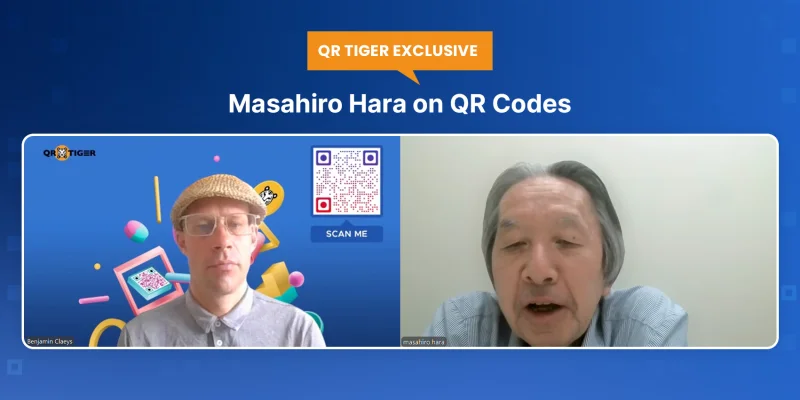
Masahiro Hara sat down for a virtual interview with the founder and CEO of QR TIGER QR Code Generator, Benjamin Claeys, to explore the story behind the QR code and its continued influence and evolution in the digital age.
The first spark of inspiration
Hara says his passion for engineering began in childhood. He remembers watching the launch of Apollo 11 while he was in elementary school, an experience that sparked his lifelong interest in the field.
“I thought anything would be popular and sell as long as the technology is good,” Hara observes.
That same passion led him to the automotive components firm NIPPON DENSO, where he began his career as an engineer.
An engineer's challenge and breakthrough
“I wanted to make sure whatever I do will be beneficial to society.”
Masahiro Hara started getting into the operations frontline, where things are happening, to understand the pain points people are experiencing. He saw how workers struggled with using the barcodes.
“Because that particular product has to deal with so many different products, there is a lot of data information that needs to be processed,” Hara explains.
“Sometimes, to manage one product, they had to print 10 barcodes because one single barcode could only sustain or hold only up to certain information,” he adds.
Furthermore, scanning the barcodes was difficult given how they use oil in manufacturing.
“Oil can actually make a kind of dirt on the barcodes. So, there are printed barcodes, but because of oil being smeared, they (manufacturing operators) were actually putting the numbers on their keyboard instead of using barcodes.”
Seeing the challenges operators faced every day inspired him to create a better system. That pursuit ultimately led to the invention of the QR code.
The QR code can hold around 7,000 numeric characters, allowing it to store roughly 10 times more data than a barcode in a smaller footprint.
It can also be read from any direction and uses built-in error correction to recover data even if the code is dirty, damaged, or printed on curved or uneven surfaces.
From automotive to the world
When asked whether he realized he would be working on something that would impact the world, Hara confessed that the thought never crossed his mind.
“To be honest, I didn't really think so, because I thought QR codes would be used in business environments, at factories, maybe at retail shops, or in an office,” he says. “So, I thought the locations being used for QR codes were going to be quite limited on those occasions.”
He realized the technology had greater potential when Japan began adding QR code scanners to smartphones in 2002.
“You could generate a QR code on your mobile phone that represents the URL. When I saw that adoption, I thought QR codes would be used in the digital age,” Hara states.
Surprising innovations
When asked which QR code innovation has impressed the most, Hara singles out QR code tattoos and how people use them to share personal information.
“I think it was around 2004 when some people started to have the QR code on their arm tattooed, and they were basically exchanging personal information like email address and telephone number with different people by scanning the tattooed arm. That was quite surprising,” he says.
As for recent use cases, Hara was most moved by the use of QR codes to store facial data, revolutionizing QR code authentication by enabling facial detection even offline.
“With a camera, you can take data of your face and then turn that facial data into a QR code and use that as an authentication process. That way, you can still authenticate yourself even when offline.
“Also, personal computers were not going to be seen in any devices, so I was quite surprised when that system was introduced,” he adds.
Misconceptions and concerns
During the COVID-19 pandemic, Hara noticed that some European countries adopted QR codes to track people's movements, raising concerns about their use for government surveillance.
“You have to willingly show your QR code to reveal your personal data,” Hara said.
“It is different when you use devices connected to the internet, as someone can technically capture your data without your permission. But the QR code is different, because you have to willingly show the code itself.”
Hara also touched on QR code scams and phishing (quishing), noting his oversight in how the technology is used for such malicious purposes.
“Somebody with malicious intent could have QR codes and guide somebody to a very malicious site nowadays. I didn't really think it would be a risk when I was developing it.
So if I could implement an authentication mechanism that lets you track who issued that QR code, that may help prevent such scams. That would be the one thing I would change.”
QR code adoption and AI
When asked why it took so long for QR codes to be adopted globally, Masahiro Hara said it’s because barcodes have served their purpose in the retail industry until now.
“Barcodes can only host 13-digit numbers,” he says. “If you only care about pricing information, barcodes are going to do the job sufficiently.”
But recently, more consumers are seeking more information about products, so richer data is required by the market and consumers. That's where the shift happened.
According to recent data from Global Standards 1 (GS1), around 75 countries worldwide across various industries have already begun the shift to GS1 2D barcodes to comply with identification and traceability requirements.
The QR code supports GS1’s Sunrise 2027 initiative, serving as the symbol of the next-generation matrix code that makes products more connected and transparent.
Touching on the use of Artificial Intelligence, Masahiro mentioned that they’re exploring ways to embed QR codes in entertainment content using AI tools, making them less intrusive.
“We're actually looking into developing some applications or use cases where you can just merge QR codes with some entertainment content.”
On the QR code industry
Masahiro Hara expressed satisfaction at seeing millions of businesses worldwide build on the foundation he laid by not licensing QR codes.
“We made it very open to access QR code technology, and I think that strategy paid off. There was a lot of disagreement among some people about making the QR codes so open. But I actually pushed to make it license-free and made it open. I’m very glad for that decision.”
When asked which industry he believes uses QR codes the most, Hara mentioned that it’s the one that uses QR codes in combination with internet access.
“I would say a company that is selling to a lot of mass consumers tends to use the QR code quite smartly,” Hara states.
Masahiro’s proudest accomplishment
Looking back on everything QR codes have become over the past 30 years, Masahiro said he is most proud that they have positively helped society.
“Their convenience can bring a lot of comfort to your daily life,” he shares.
Closing the conversation: Wise words from Masahiro Hara
Masahiro Hara explains that innovation will always be tied to its users, and that by offering a simple, intuitive solution designed with them in mind, businesses will naturally reach more people and create a greater impact.
He also acknowledges that such meaningful innovations rarely come without setbacks. However, he encourages aspiring innovators to stay passionate, embrace failure, and keep refining their ideas.
“If you are thinking about bringing, making things better, that will also help you innovate, you know, a wonderful thing. And with those, I'm sure young innovators will become quite successful.”
About QR TIGER
QR TIGER, a QR code generator and management platform, is dedicated to helping businesses, organizations, and individuals connect the physical and digital worlds through customizable QR code solutions. It specializes in dynamic QR codes, scan analytics, integrations, and tools that support marketing, operations, customer engagement, product data management, and digital transformation.
Founded in 2018 by Benjamin Claeys, the company has helped over 850,000 companies across 150 countries.
In August 2019, its Multi URL QR code received high praise from the community on Product Hunt. QR TIGER is also rated 4.8 stars on G2 and SourceForge and 4.5 stars on Trustpilot.