
How Amul’s QR Code on Packaging Promotes Food Transparency
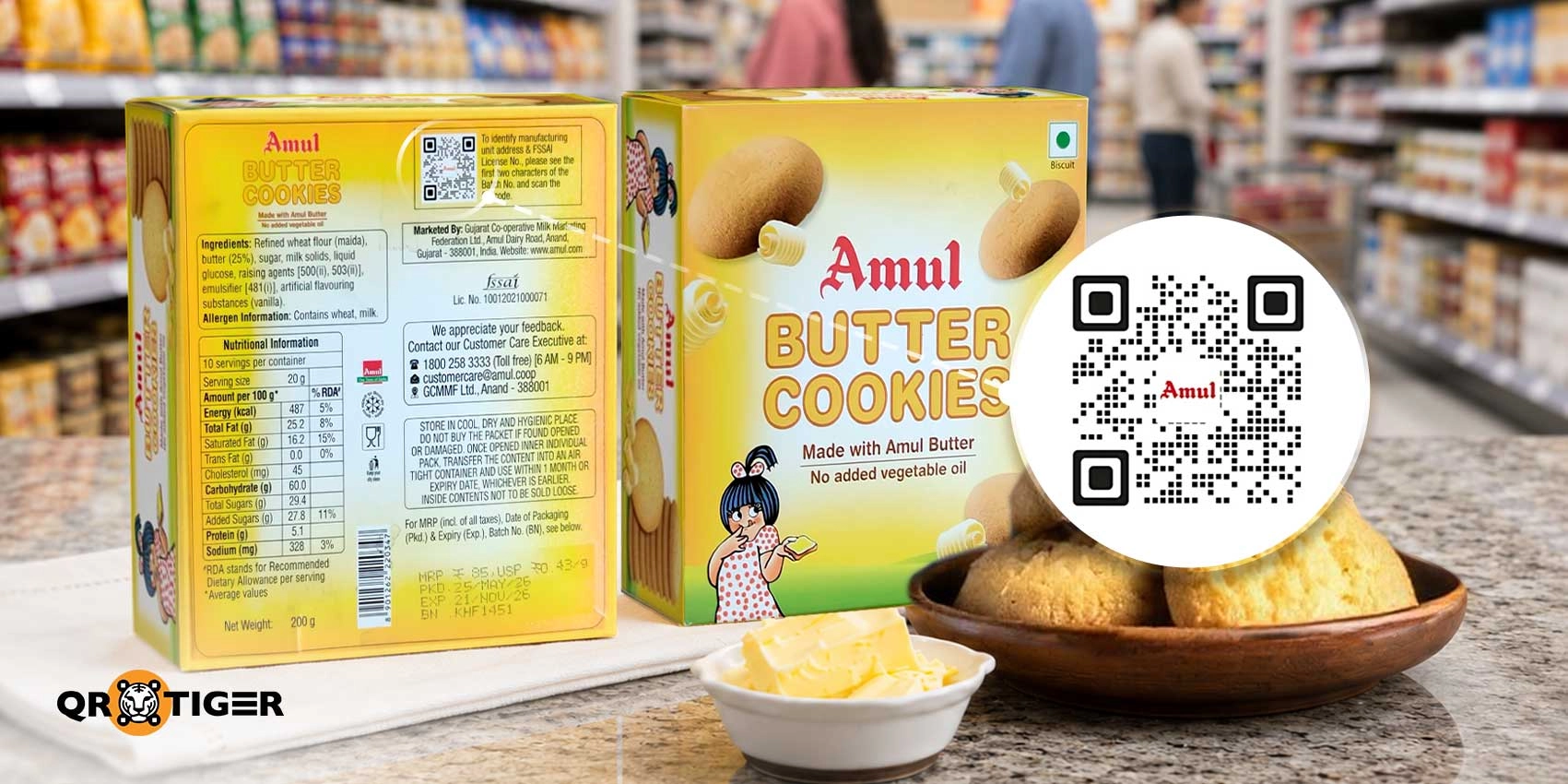
The Amul QR code is a branded code that links directly to its official manufacturing units’ addresses page, allowing consumers to check a food product’s origin.
The rollout started in 2025 to help consumers quickly verify product authenticity and prevent counterfeiting. They are printed on Amul's milk, butter, ghee, and all other products.
Counterfeit products have become an increasing concern for many businesses. Fake packaging and imitation damage consumer trust, harm brand reputation, and pose safety risks, particularly for edible products.
Manufacturers and food brand owners address the problem by using a dynamic QR code generator to make products easier to trace and identify.
At a glance
|
Table of Contents
- What is the Amul QR code, and how does it work?
- How to scan the QR code on Amul food products
- Why did Amul add food product packaging QR codes?
- Benefits of using QR codes for food manufacturers and consumers
- Best practices for implementing food product traceability QR codes
- What businesses can learn from Amul’s strategy
- Frequently asked questions about Amul QR codes
What is the Amul QR code, and how does it work?
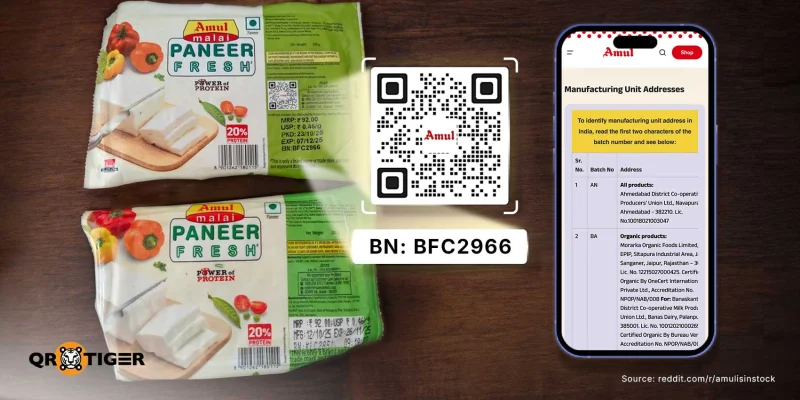
The packaging QR code by Amul directs customers to its official website when scanned with a smartphone, allowing them to view a list of all its manufacturing facilities.
The brand uses an advanced QR code generator with logo integration to display its official logo on the code. Consumers can verify the product’s legitimacy at a glance.
What information does the QR code reveal?
When people scan an Amul milk QR code or its other products, they can see the following information:
- the manufacturing plant that made the product;
- the manufacturer’s address;
- the facility’s Food Safety and Standards Authority of India (FSSAI) license number; and
- the specific products manufactured by the facility.
To identify the manufacturing unit address, the brand instructs consumers to read the first two characters of the batch number (BN). They can find this alongside other information printed on the packs.
For example, if a product has a batch number that starts with “BF,” it is addressed to Banaskantha District Co-operative Milk Producers’ Union Ltd.
Amul’s QR codes on food packaging are designed to increase transparency around its food products and allow consumers to easily identify whether a product was made by an authorized manufacturer and to report defects or counterfeits if needed.
How to scan the QR code on Amul food products
1. Look for the Amul QR code found on the product. It’s usually found alongside the product’s nutritional information at the back of the packaging.
2. Locate the first two characters of the product’s batch code. It’s normally located near the Amul product’s barcode.
3. Scan the QR code using a smartphone or a QR code scanner app (Google Lens or a third-party application). It shows a short URL that redirects users to an official list of Amul’s manufacturers.
4. Look through the list of manufacturers to find which manufacturer matches the first two characters of the product’s batch code (Example: AN, BA, BB).
5. Review the manufacturer’s address, license, and list of products offered to ensure the product originates from the brand’s authorized facility.
Why did Amul add food product packaging QR codes?
Amul is one of the brands that use QR codes in India to address growing concerns about counterfeiting and duplication of its products.
In 2025, Chairman Ashok Chaudhary announced that all the brand’s products, including milk, cheese, and butter, would have a QR code.
The company issued warnings to consumers in 2024 regarding counterfeit ghee products with misleading branding, as reported by The Economic Times. A month before the announcement, fake ghee (clarified butter) was apparently sold at Tirumala Tirupati Devasthanam and was found to contain animal fat.
In 2022, the Times of India reported that the company pursued legal action against multiple businesses, accusing them of selling dairy products packaged in ways that closely resemble its branding (similar colors, artwork, typography, and packaging design).
With QR codes on Amul products, the brand provides consumers with direct access to manufacturing information, helping them earn their trust through authentic, transparent dairy goods.
Did you know? Data reveals that 63% of QR code users are eager to use codes that offer more product information and support richer experiences. (Source: QR TIGER Decoded Report)
Benefits of using QR codes for food manufacturers and consumers
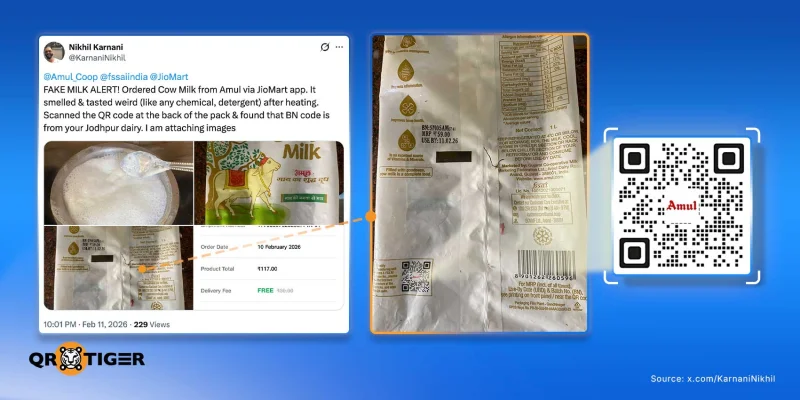
A consumer scans an Amul milk QR code, finds the manufacturer's information, and reports the issue to the brand and the store.
Using food packaging QR codes for product authentication offers the following benefits to both consumers and brand owners:
- Support faster product verification: Placing QR code labels on edible products helps consumers verify manufacturing details in seconds using only their smartphones.
- Improve consumer confidence: Products with QR codes enable customers to quickly access official manufacturing information before purchasing or consuming them.
- Increase supply chain visibility: The tracking features of dynamic QR codes allow manufacturers and brand owners to identify where their food products go and how often customers scan them for information.
- Strengthen brand protection: Providing official manufacturing information makes it more difficult for counterfeiters to rely solely on copied packaging.
- Enable future product services: The same QR code can later support recalls, customer support, warranty information, sustainability reporting, or digital product passports.
Best practices for implementing food product traceability QR codes
Producer businesses and food manufacturing brands like Amul can make use of a product label with QR code in order to improve their product authentication strategy. They can implement them through the following ways:
Use unique identifiers
Assigning unique identifiers, such as Amul’s ghee QR code for each item, can help brand owners, manufacturers, and retailers easily trace where a specific product was produced and monitor its movement throughout the supply chain.
This also helps quickly identify issues within the supply chain and recall specific product groups during quality investigations.
Shift to GS1 QR codes
A GS1 digital link QR code is a more compact and secure version of the standard UPC barcode and allows users to store far more information than the original.
This means that not only can it store your product’s Global Trade Item Number (GTIN) and batch code, but it can also store additional information such as expiry dates and manufacturer details.
Brand owners and manufacturers can use a recognized GS1 Solutions Partner like QR TIGER to create them.
Show an official verification page
Lead customers to an official product verification page. From there, they can quickly verify the product's authenticity either by cross-referencing it with the list or by looking up the product's unique code on the page.
Display useful information
Rather than simply displaying a message that the product has been verified, it's better to include in-depth information that helps customers identify if the product is legitimate.
Some details and information you can display include the following:
- Product details (color, size, designs, etc.)
- Photos of the legitimate product for comparison
- Production date
- Manufacturer details
- Supply chain tracker
A recent industry report by QR TIGER found that 49% of QR code users often scan QR codes to access additional information, so providing more context will not only help customers trust the brand but also make it harder for counterfeiters to duplicate products.
Monitor scan activity
With dynamic QR code analytics and tracking, businesses can monitor metrics such as location, device type, and scan date and time to identify unusually high scan volumes in specific regions, often due to counterfeiters or unauthorized reselling.
These insights can help businesses easily investigate potential issues before they become more widespread.
What businesses can learn from Amul’s strategy
Amul’s QR code product authentication initiative shows how it strengthens product transparency, traceability, and consumer trust.
With product authentication and supply chain visibility becoming increasingly important worldwide, QR codes are now a must-have asset of any brand’s broader product authentication strategy.
You can also implement them in the same way in your company and goods.
To learn more, visit QR TIGER and book a demo with our experts to explore how secure, branded QR codes make your products more transparent, support long-term customer trust, and strengthen brand protection.
Frequently asked questions about Amul QR codes
What does the QR code on Amul products do?
The QR code on Amul product packaging links consumers to Amul’s official webpage, which lists all the brand’s manufacturing addresses, FSSAI license, and the specific products it manufactures.
Can consumers trace the origin of an Amul product?
Consumers can identify the unit that created the product by scanning the QR code. They can open the official list of manufacturers and find the exact facility by matching the first two letters of the batch number code in the packaging.
What is the QR code on the Amul dark chocolate packaging?
The QR code on Amul’s dark chocolate packaging is a unique code that leads customers to Amul’s official website homepage, where they can learn more about the brand and other products it offers.
Can QR codes help prevent counterfeit food products?
Serialized or dynamic QR codes help prevent counterfeit food products. Their tracking features help a specialized system to detect fake products. Static QR codes are not recommended since they can’t be tracked and are easy to copy and print on counterfeit food product labels.
Are GS1 QR codes better for food traceability?
Yes, GS1 QR codes are significantly better for food traceability, as they offer greater data capacity for additional product information and can also be used for product tracking.
GS1 QR codes are compatible with modern retail scanners and comply with most global food traceability regulations (FSMA Subpart 204, EU Digital Product Passports, Global Traceability Standards).