
QRators in Action: Charleston County Completed 5,000 Surveys Using QR Codes

QRators in Action is a compilation of how brands and institutions use QR code technology to listen more closely to their communities and turn those insights into action.
In this edition, we put the spotlight on the Charleston County Public Library (CCPL), a large public library system in the United States that ran its most successful community survey campaign with the help of QR TIGER.
Through the use of QR codes, CCPL was able to gather valuable feedback across its multiple branches and transform community voices into library services that could better help its patrons.
Table of Contents
A library rooted in community
Originally founded as the Charleston Free Library, the Charleston County Public Library first opened its doors to the public on January 1, 1931.
In its early years, the library operated out of the Charleston museum and was managed by civic leaders (including progressive women). Since then, CCPL has come a long way from its modest roots.
Today, the library dutifully serves the residents of Charleston County, South Carolina, through 18 library branches, a dedicated outreach team, and a bookmobile that extends access even further into its community.
Through decades of growth and change, the CCPL has remained steadfast in its mission to connect residents to information, ideas, and experiences that can enrich lives and create opportunity.
How the Charleston Library QR code captured community voices
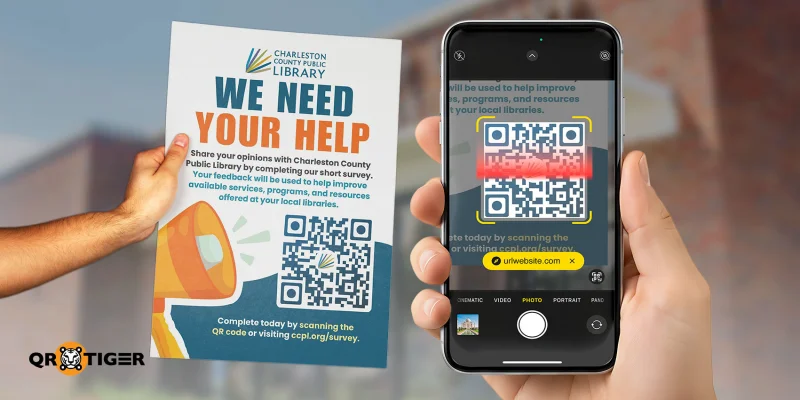
We spoke with Doug Reynolds, the Associate Director of Communications & Marketing for the Charleston County Public Library, to look closely into how much they value people’s opinions in improving their services.
He then reveals that a better understanding of QR codes contributed to their success, and that QR TIGER helped ensure their campaign was seamless and effective.
Tell us briefly about your company. What makes your brand or service unique?
“The Charles County Public Library serves the residents of Charleston County, South Carolina, with 18 library branches, an Outreach Team, and a bookmobile.
We strive to connect our residents to information, ideas, and experiences that enrich lives and build opportunity.”
Why did you decide to use QR codes, and what made you choose this approach for your campaign or event?
“QR codes are an easy way for us to share important information across our multiple library locations in a way that we can track and analyze for the continued success of our marketing campaigns.”
How has QR TIGER helped your company achieve its goals?
“QR TIGER's excellent features and ease of use have helped us create successful marketing and communication campaigns.”
What key insights or learnings did you gain from using QR TIGER in your campaign?
“Seeing not only how many people accessed our campaign but how they accessed it, and where from, is vital to learning more about our community.”
Can you share any results or numbers you're comfortable providing? (Engagement, reach, leads, conversions, ROI)
“With our most successful recent campaign, QR TIGER led to the completion of nearly 5,000 community surveys that will help us shape the future of our library system.”
Would you recommend QR TIGER to other businesses? Why?
“I would recommend QR TIGER for ease of use, availability of features, affordability, and more.”
Better library systems from fast survey distribution
The Charleston Library QR code project demonstrates what can be achieved when QR codes are utilized effectively.
By integrating it into the community survey campaign, CCPL successfully reached residents across multiple branches and gathered meaningful insights in real-time.
With nearly 5,000 surveys completed, the local library gains a clearer understanding of its patrons’ experiences, as well as a better foundation for creating services and programs that truly reflect the needs of its community.
This campaign demonstrates that when libraries adopt simple technologies like QR codes, they can amplify community voices and foster a better future for the people they serve.