
FASTag QR Code: India’s Toll Payment Collection System
 By Ashley P.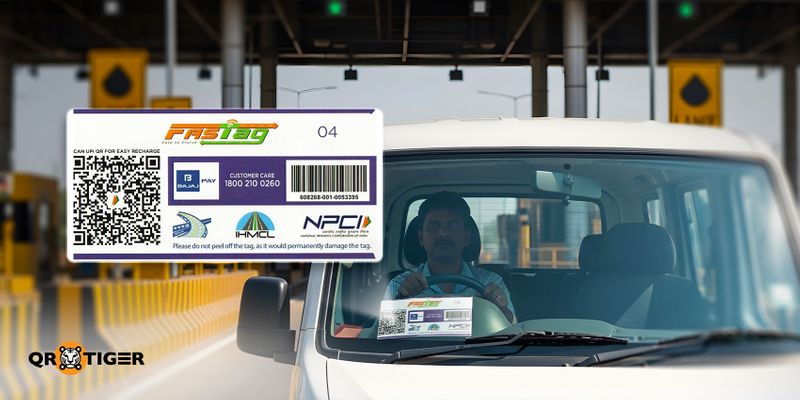
With almost a billion and a half people in India, it’s safe to expect the country’s highways to become congested. Fortunately, this issue is being addressed by the Fast Tag QR code and RFID tag system.
Officially called FASTag, this toll collection system allows toll plazas to collect payments from drivers without having to stop them.
To truly appreciate how this system changes toll collection and traffic management, it’s important to understand how it works and why it matters.
Let’s explore what makes this electronic system so effective at handling traffic and find out how QR code technology plays an important part in the process.
Table of Contents
What is FASTag?
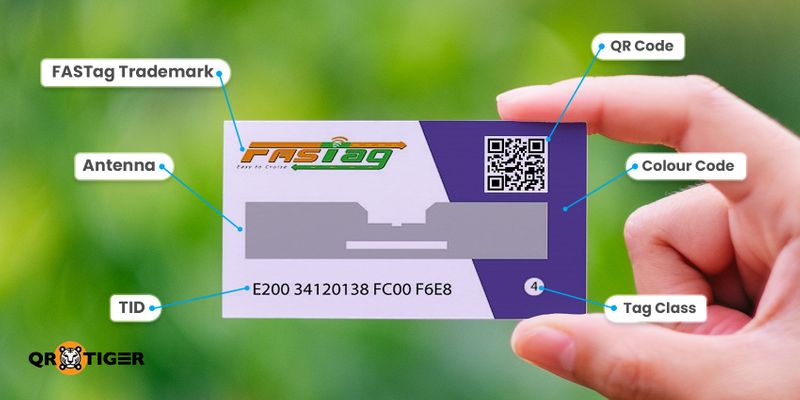
FASTag is an electronic toll collection system operated by the National Highways Authority of India (NHAI), an agency responsible for developing and maintaining India’s highways.
First launched in 2014, this system uses Radio Frequency Identification (RFID) technology to collect toll payments directly from the prepaid or savings account of drivers.
RFID technology uses radio waves to read data stored in components known as RFID tags. This is done through an RFID reader, which consists of an antenna and a transceiver.
The FASTag is commonly placed in the vehicle’s windshield for easy scanning and retrieval of payments at numerous toll gates throughout the country’s national highway network.
Tags are purchased from NHAI as well as official FASTag issuers and participating banks.
How does FASTag work?
RFID technology and dynamic QR code generator software vary in different ways, but that doesn’t mean they can’t be used together.
Case in point, FASTags also have a QR code that can be found at the upper right corner of the sticker.
FASTag uses a QR code to store the same information that was stored in the RFID tag. This means that toll collectors can scan this backup storage system in case the FASTag RFID scanner can’t read the tag.
While a FASTag QR code scanner isn’t available at every checkpoint, the QR code still has other uses.
Firstly, it is readable using a mobile app to manage user accounts, auditing, and verification of transactions.
Secondly, it allows drivers to seamlessly activate their FASTag with the help of the My FASTag App.
Similar to how a QR code for event registration works, recipients of a FASTag sticker can scan the unique QR code to link their vehicle registration number. This is also how vehicle owners can link payment methods to their FASTag account.
A new design for the FASTag was also introduced back in 2024. This design features a Unified Payments Interface or UPI QR code, this time at the non-adhesive side of the sticker.
This QR code was implemented to make the FASTag recharge faster, further improving the driving experience.
⭐Best practice: While RFID tags and QR codes are used in similar ways, they each have their own pros and cons. It’s best to compare RFID vs QR code technology to determine the best tool for your business. 
Can I scan FASTag from my phone?
The answer to this question depends on what part of the FASTag you will be scanning.
FASTag RFID tags can’t be scanned by your smartphones because RFID technology uses 865-867 MHz frequencies to communicate data.
While modern phones can use a branch of RFID technology called NFC, it can only operate in the 13.56 MHz frequency band.
On the other hand, the FASTag QR code is meant to be scanned by smartphones as a means of activating the sticker.
How to get a FASTag barcode?
While the use of this handy sticker was made mandatory by the NHAI in 2021, getting one is very easy. This is thanks to the three main methods of acquiring a FASTag sticker, all of which fare easy to follow and very accessible.
NHAI website
The first method is to go through the NHAI’s official website. To get a FASTag through this method, perform the following steps:
1. Visit the NHAI website and choose “Exempted FASTag Application”
2. Provide the necessary information, such as:
a. vehicle registration number
b. owner’s name
c. valid mobile number
d. complete communication address
3. Upload scanned copies of the necessary documents. These can include the Vehicle Registration Certificate (RC) and proof of identity.
4. Pay the necessary fees through accepted payment methods.
5. Wait for the delivery of the FASTag.
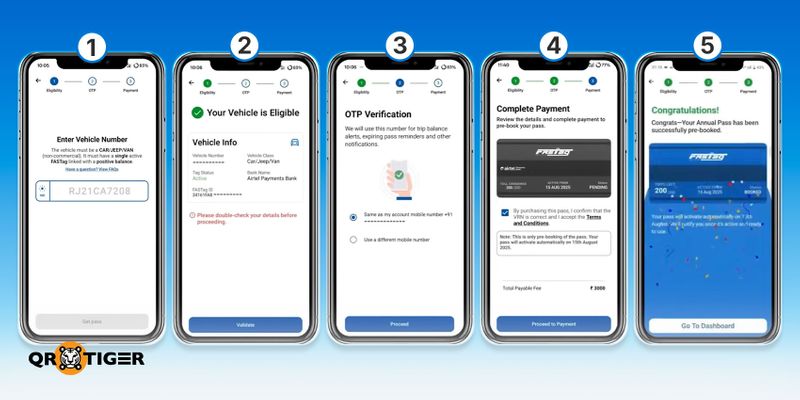
As of August 15, private vehicles can also get the FASTag Annual Pass to skip repeated recharges of their FASTag balance. This pass grants drivers an entire year of toll crossings, or 200 crossings if it comes first.
To activate the annual pass, drivers simply have to log in to the NHAI website and pay ₹3000.
Toll plazas
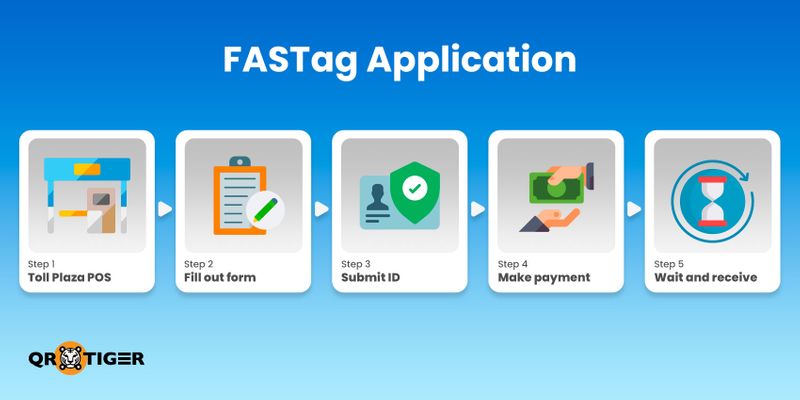
FASTag applications can also be done offline by visiting one of the many toll plazas in the country. Here are the steps you need to take to get your FASTag:
- Find a toll plaza point-of-sale counter
- Grab a FASTag application form and fill it up.
- Submit an RC, ID proof, and a photo
- Pay the necessary fees.
- Receive your FASTag.
FASTag issuing banks
NHAI’s partnership with several banks, such as the HDFC FASTag, makes it more accessible to the general populace. This article has the full list of authorized banks that provide a FASTag.
To get a FASTag this way, follow the steps below:
1. Visit an issuing bank and navigate to its FASTag-related services.
2. Choose the Customer Type: “New Customer” or “Existing Customer.”
a. If “New Customer” is chosen, fill up the application form.
3. Upload scanned copies of the necessary documents. These can include the RC and proof of identity.
4. Pay the necessary fees.
5. Submit your application, wait for your FASTag to be delivered to your address.
Why the Fast Tag QR code is an effective solution for traffic
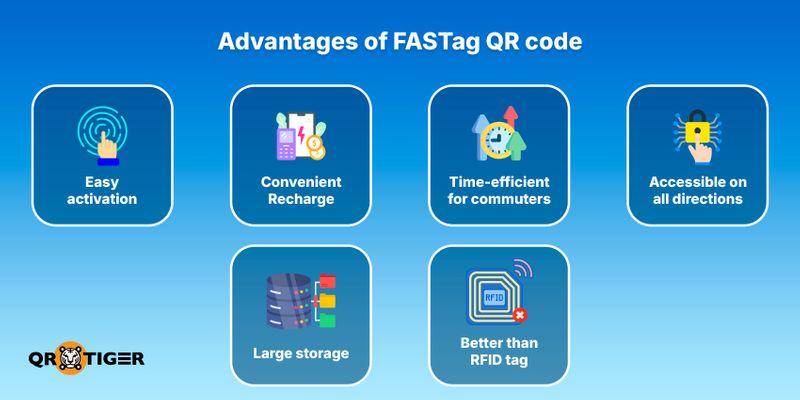
The NHAI’s travel QR code and RFID tag have many benefits, many of which help alleviate some of the inconveniences of traveling on the road.
Easy FASTag activation
After purchasing and receiving a FASTag, it needs to be activated before it can be used while traveling.
Normally, the activation is done by scanning the QR code using the My FASTag App. By scanning, the information stored within will be read by the application, removing the need for manual typing.
Imagine if the QR code for Fast Tag activation wasn’t available. That means that the vehicle information that should have been stored in the QR code will have to be read before providing it to the app.
This can take up time, especially when you consider the seconds spent double-checking the information and typing it in.
Using a QR code to activate the FASTag also removes the likelihood of human error, making the entire process even more reliable.
Convenient FASTag recharge
Another advantage of the QR code is that it enables users to recharge their FASTag balances. This can easily be done through any UPI application, such as Google Pay or Paytm.
Through the use of a QR code, users won’t have to manually enter the UPI ID given to them, which can be long and complicated.
To do so, simply login to your app of choice and navigate to any UPI payment option (which can depend on the app). You can then opt to scan a QR code before setting the recharge amount. Once entered, you will have to enter your PIN to confirm your transaction.
Time-efficient for commuters
FASTag’s RFID tags and QR codes allow people to travel along India’s highways without unnecessary stops.
According to the INRIX 2023 Global Traffic Scorecard, traffic congestion has increased worldwide. Congestion is high enough that in London, the city ranked highest in Europe, drivers spend 99 hours sitting in congestion.
The use of the FASTag system also means that drivers won’t need to pay with cash whenever they travel on the highway. Not only do drivers not need to stay at the toll plaza for long, but this greatly improves traffic along every highway in the country.
What’s more, if the RFID tag can’t be scanned, the QR code is readily available.
Readable from any direction
With a QR code, FASTag users won’t have to worry about their sticker being scanned the wrong way. This is thanks to the three eyes on the upper right, upper left, and lower left corners of the QR code.
These eyes are known as position markers and were conceptualized by Masahiro Hara, the inventor of QR codes. They help prevent scanning errors by telling the scanner (or camera) which direction to scan the QR code from.
This means that the QR code or FASTag scanner online could be upside down, and the data will still be read the same way.
Reliably stores a ton of data
One of the many improvements the QR code has over the traditional barcode is its storage capacity.
With a capacity for 7,089 numeric characters or 4,296 alphanumeric characters, a QR code has more than enough space for a user’s vehicle information and any additional details the NHAI might add in the future.
Simpler than RFID tag
A Fast Tag QR code is less complicated to set up than the RFID tag.
As explained, RFID tags are composed of an antenna, a transceiver, a power source (if the tag is an active tag), and the tag itself.
All of these must be manufactured and assembled before they can be of use, which makes it difficult for the average person to create them on their own.
QR codes, on the other hand, are made using QR code platforms, many of which are available online. Once the information is encoded, all the user has to do is print it as many times as they want or have it displayed on a screen.
In essence, the only thing needed to get a QR code is the right software.
💡Did you know: The QR code’s reliability and simplicity are contributing factors to Sunrise 2027, an initiative that seeks to incorporate Digital Link QR code technology in point-of-sale systems across the world!
Wrapping up
FASTag has been around for more than a decade and continues to be an important part in reducing traffic congestion in India.
The inclusion of a Fast Tag QR code is not only an indication of the NHAI’s continued efforts to improve the system, but also a great example of how effective a QR code can be when used alongside other technology.
Large enterprises and corporations can create reliable and high-quality dynamic QR codes using QR TIGER Enterprise, the most advanced QR code software for teams.
Trusted by over 850,000 brands worldwide, it offers up to 21 QR code business solutions, marketing and tracking tools, with 24/7 customer support team.
Don’t get left behind. Learn how we can help your organization by booking a demo with our team of experts.
This article is for general informational purposes only and does not constitute legal, financial, or other professional advice. For questions about QR TIGER's products or services, please contact our support team at [email protected].
Was this article helpful?
Maximize Scans with the Best QR Code Generator
Join thousands of global brands using QR TIGER to manage dynamic routing, bulk creation, and deep attribution analytics.
Get Started For Free