
QR Code for Winter Olympics 2026: Real-life Use Cases and More
 By Ashley P.
QR codes for the Winter Olympics have been in place for a long time to improve management and engagement.
As one of the world's largest sporting events, the Winter Olympics bring together thousands of athletes and millions of fans from across the world. QR codes help organizers deliver a smoother, more connected experience.
In this article, we explore real use cases of QR codes at the recent Milano-Cortina 2026 Winter Olympics, their previous applications, and more ways to support large international sporting events through various dynamic QR code generator solutions.
Table of Contents
- Top use cases of QR codes at the Olympics (Milano-Cortina 2026)
- Notable real QR code applications in other Olympic events
- More ways to employ QR codes for the Winter Olympics
- Key data that highlight the importance of QR codes at the Olympics
- Power the Olympics with a reliable QR code generator with logo
- Frequently asked questions
Top use cases of QR codes at the Olympics (Milano-Cortina 2026)
jpg_800.jpeg "Top use cases of QR codes in milano cortina")
The 2026 Milano Cortina Winter Olympics featured 116 medal events, gathering top athletes to compete at the highest level and fans worldwide to support and watch record-breaking performances.
Beyond competitions, the sports event is also setting the standard for the use of QR code technology in the arena.
1. QR code Winter Olympics tickets for venue access
With two prestigious events back-to-back (the Winter Olympics and Paralympics), it's expected that large numbers of sports fans will attend.
In fact, the official 2026 Winter Olympics data reveal that more than 600,000 people flocked to the various Fan Villages across host cities.
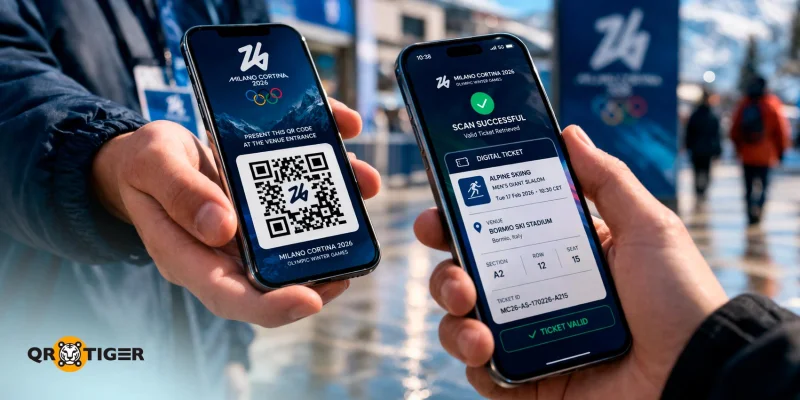
For a most-awaited event like the Olympics, a good ticketing system is critical. The organizers are quick to implement QR codes on tickets to make it easier for attendees to access essential information through the MilanoCortina2026 app.
With the mobile app and QR code-based tickets, which are given 24 hours before the Winter Olympics start to avoid counterfeiting, visitors no longer need to print or download their tickets as PDFs.
They can open the ticket through the app and display their codes at the entrance. It’s also accessible without an Internet connection, provided the user has logged in at least once before arriving at the venue.
The QR code-based Olympics ticketing is a significant measure, as over 1.3 million tickets were sold. Several games were close to selling out, proving that QR code ticketing is a practical solution for large-scale sporting events.
2. Samsung’s AR QR code for fan engagement
Global brands also use QR codes for the Winter Olympics to create interactive fan experiences.
Samsung, a long-time Olympic partner, launched the Samsung Victory Truck, which toured cities including Milan, Bormio, and Livigno.
Visitors could interact with augmented reality mascots, Tina and Milo, and take photos with them. They can download the pictures by scanning a QR code, creating a digital souvenir from the event.
These types of QR-powered activations help sponsors engage audiences while connecting physical event spaces with digital experiences.
3. New Zealand’s Olympics QR code jackets

Team New Zealand used QR codes in a unique way at the 2026 Winter Olympics.
During the opening ceremonies, the team debuted its specially made jackets. Designed in Aotearoa, New Zealand, by apparel partner Kathmandu, the jackets were not only made with 70% recycled nylon fabric but also featured a QR code badge woven into each one.
The QR codes direct the athletes and coaches to a website filled with messages of support from their fans. These heartwarming messages have become a cherished aspect of the team’s uniforms.
This initiative allowed athletes to stay connected with supporters around the world while showcasing an innovative use of QR codes in sports apparel.
Notable real QR code applications in other Olympic events
Aside from the use cases mentioned above, there are also pioneering applications of QR codes in other Olympic seasons that are worth discussing:
Pass Jeux QR code for the 2024 Paris Olympics
At the 2024 Paris Olympics, QR codes were used to manage access and security throughout the entire Olympic Games.
The Summer Olympics QR code served as a game and security pass, known as Pass Jeux, granting residents, workers, and visitors special access to checkpoint areas.
Four colored codes were implemented: blue, red, black, and grey, with the latter being the zones with the tightest security. These areas include the Seine River and other competition venues.
Health QR code for the Beijing 2022 Winter Olympics
To strictly monitor the health status of all participating athletes, staff, and accredited journalists and control entry at the Beijing 2022 Winter Olympics, the committee employed a digital health surveillance system using the My 2022 app and color-coded QR codes.
As part of its “closed loop” COVID-19 management system, everyone was required to install the app to log their daily health information, including their body temperature, COVID-19 nucleic acid test results, and vaccination status.
Based on these details, the system generates a green, yellow, or red QR code, each representing the person’s risk status. A green one was necessary to enter venues, transport hubs, and other locations near the village.
QR codes for PyeongChang 2018 Winter Olympics
As part of their preparations for the 2018 Winter Olympics, lodging businesses in PyeongChang and the nearby city of Gangneung installed QR codes in their rooms.
This allows guests to access information about the Olympics and public transportation schedules in different languages, including Korean, Chinese, Japanese, English, and Taiwanese Mandarin.
A QR code is also available for athletes, families, and other guests to quickly download the Go PyeongChang mobile app.
More ways to employ QR codes for the Winter Olympics
There are numerous ways to leverage QR codes at any Olympic event. They allow users to easily access information, engage in immersive experiences, or expand their networks.
In this section, we cover how the best QR code generator solutions can enhance the Olympic experience for the games, the athletes, and the fans alike.
Multilingual information access
The Olympics are an international event, so it is expected that people who speak different languages will be present during the games.
To address language barriers, organizers can use a QR code for multiple links to display translated web pages to attendees based on the languages on their phones.
This way, everyone can learn about the sports, rules, scoring criteria, and schedules in their own language.
A Smart URL QR code can support over 70 languages, including Afrikaans, Chinese, Greek, Portuguese, and Russian.
Olympic storytelling
Since 1924, the Winter Olympics have been a celebration of winter sports. That’s over a hundred years of athletic history with significant moments, iconic people, and history-making accomplishments etched in stone.
Using a QR code for photo sharing is a unique way to showcase documented personal moments and elite sports performance.
Aspiring Olympic athletes and visitors around the globe can fully picture the blood, sweat, and tears poured into achieving feats at the global sporting event.
Merchandise and retail experiences
The Winter Olympics are not only memorable for the sports and athletes, but also for the memorabilia available to attendees. From jackets to mascots, anyone can take home their own piece of history.
Typically, one would visit the online store to buy them. However, QR codes can bring the store even closer to sports fans.
At certain points in the broadcast and throughout the venues, organizers can display a website QR code for Winter Olympics merch available on the Global Olympic Online Shop at any time, anywhere.
Moreover, the Olympics can incorporate a Digital Link QR code to add transparency and authenticity to its merchandise.
Attendee registrations
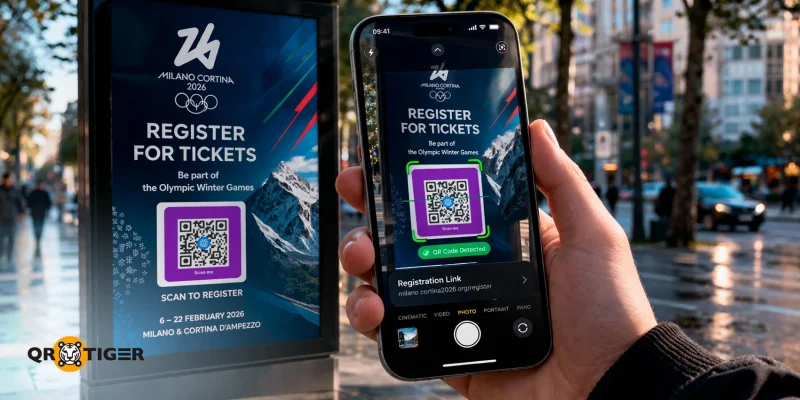
The Winter and Paris QR code Olympics tickets have successfully demonstrated their potential to handle large crowds, thanks to the technology's speed. This is why QR codes are an invaluable event management solution for any affairs.
Another practical method to manage the influx of visitors is to use a QR code for event registration that leads people to an online form or app to record their details and attendance.
According to a paper in the journal Survey Methods: Insights from the Field, including a QR code in mailed survey recruitment materials increased overall participation by 1.31%. The study also found that QR codes were more effective than the URL-only method for reaching respondents in hard-to-reach areas.
Because forms are so accessible via QR code, organizers have more room to handle other tasks, while sports fans can easily get their tickets.
Networking and athlete branding
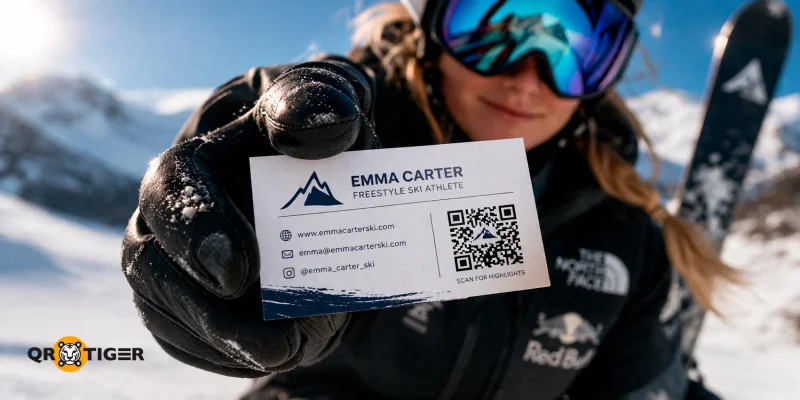
The Olympics is the best event to know other athletes and connect with sponsor brands.
For a more professional approach, we recommend using a vCard QR code to have a digital business card ready right on the smartphone. They can also link their public social media profiles to boost their follower count and engagement.
Athletes and their managers can use the QR codes at the Olympics to build connections with global brands or get to know other athletes and teams.
QR code-based cashless payments
Implementing QR code payments at the Olympics can significantly improve operations and crowd flows in the venues.
QR code-based payments are an effective mobile payment method that only requires scanning and confirming payment on their phones.
Cashless systems like this can cut transaction time from 12–15 seconds to under 3 seconds, helping vendors serve more people during peak periods, according to Billfold.
Moreover, Carat points out that 82% of people view contactless payments as safer and more convenient.
Sustainability and paperless operations
Something that not many people know or talk about is the International Olympic Committee’s (IOC) commitment to reducing carbon footprint and lowering emissions.
In the 2026 Winter Olympics alone, the IOC has taken measures to reduce its environmental impact by:
- powering locations with renewable electricity
- using existing infrastructure for the games
- prioritizing trains and shuttles in their low-carbon transport plan
The use of QR code-based Winter Olympics tickets is one of the steps the organization is taking toward sustainability.
With consistent use, the IOC will no longer need to print tickets, maps, or flyers. Furthermore, the cleanup will be faster with less clutter thrown around the venues.
Key data that highlight the importance of QR codes at the Olympics
The Milano Cortina 2026 Winter Olympics reached massive global audiences and participation levels and generated significant digital engagement.
These numbers highlight the need for scalable digital tools, such as QR codes, to manage audiences, deliver content, and improve engagement:
- More than 1.3 million tickets were sold.
- Over 600,000 visited the Olympic Fan Villages.
- France Télévisions had over 50 million viewers watching its coverage of the games.
- As of February 19, the Milano Cortina 2026 Olympic Winter Games had an average of 24.1 million viewers watching the games from the United States, making it the most-watched Winter Games in the country since 2014, and marking a 93% increase over US viewership of Beijing 2022.
- In Brazil, the Milano Cortina 2026 Ski Jumping events were the most-watched Winter Games competition in history. Streaming records for the Olympic Winter Games in the country were also broken.
- In Japan, over 92 million viewers saw coverage of the games thanks to the Japan Consortium’s TV channels, making it over 80% of the potential audience in the country
- 110 million users engaged with the Olympics Web and App platforms, setting a record for the Winter Olympics.
- The Olympics App during Milano Cortina 2026 was opened 120 million times, making it the No. 1 sports app across over 75 territories.
- 170 million mobile push notifications and 120 million personalized emails were delivered to fans.
- Over 400 campaigns across 9 languages were activated during the games.
- Social media engagement across all Olympics handles tripled in volume since Beijing 2022, reaching over 10 billion.
- Olympic social media accounts gained a total of 8.7 million new followers during Milano Cortina 2026, bringing the total global followership to over 172 million.
- According to a 2024 YouGov global survey, 52% of individuals say their main reason for watching the Olympics is the spectacle and excitement of the event. Other reasons for watching the Olympics include the following:
- 46% watch for national pride and to support their country’s athletes
- 45% watch to see athletic feats
- 26% watch to feel like they are a part of a global event
- 17% watch because family or friends are watching it
- 6% watch for all of the above-stated reasons
- 5% don’t know why they watch the Olympics
- 4% watch for other reasons
Power the Olympics with a reliable QR code generator with logo
QR codes for the Winter Olympics 2026 have shown positive results in event management, fan engagement, and brand activation.
As global sporting events continue to scale, reliable QR code software will play an even greater role in delivering seamless and interactive Olympic experiences.
To get started, book a demo with our experts to learn more about our Enterprise solutions and create the best QR code for the Olympics.
Frequently asked questions
Is there an app for the Winter Olympics 2026?
The Winter Olympics have the Tickets MilanoCortina2026 app. It is available on both Apple Store and the Play Store. Using the app, attendees can enter the event, view schedules and other information, and receive notifications.
How to get to Winter Olympics 2026?
The Winter Olympics 2026 were held in the Milano San Siro Olympic Stadium in Milan and Cortina d’Ampezzo, Italy. Attendees can get there by plane, railway, bus, or car. Tickets can be purchased from the official website.
References and Sources
Milano Cortina 2026 in numbers: record engagement, efficient delivery, world-class performance. (2026, February 23). International Olympic Committee. https://www.olympics.com/ioc/news/milano-cortina-2026-in-numbers-record-engagement-efficient-delivery-world-class-performance
Milano Cortina 2026 is a global success with audiences: all the numbers behind the major event. (2026, February 23). International Olympic Committee. https://www.olympics.com/en/milano-cortina-2026/news/milano-cortina-2026-is-a-global-success-with-audiences-all-the-numbers-behind-the-major-event
Beyond the Spotlight, Into the Heart of the Olympic Games: How Samsung’s Mobile Technology Connects Every Moment of Milano Cortina 2026. (2026, February 16). Samsung Newsroom UK. https://news.samsung.com/uk/beyond-the-spotlight-into-the-heart-of-the-olympic-games-how-samsungs-mobile-technology-connects-every-moment-of-milano-cortina-2026
This article is for general informational purposes only and does not constitute legal, financial, or other professional advice. For questions about QR TIGER's products or services, please contact our support team at [email protected].
Was this article helpful?
Maximize Scans with the Best QR Code Generator
Join thousands of global brands using QR TIGER to manage dynamic routing, bulk creation, and deep attribution analytics.
Get Started For Free