
QR TIGER Webinar Highlights: GS1 Digital Link QR Code Top Use Cases

QR TIGER hosts another webinar to further discuss the adoption of the new GS1 QR code standards by 2027, with the special participation of GS1 US’s Director of Global Standards, Andrew Morehead.
The 37-minute session breaks down the ins and outs of GS1 Digital Link QR codes, including their practical implementation and key use cases across industries.
In case you missed it, we’ve rounded up expert perspectives, key insights, and notable Q&A moments to help you understand and fully leverage the potential of these next-generation barcodes.
Table of Contents
- QR codes for Sunrise 2027: The new dimension in barcodes
- What is GS1?
- What are the barcode standards for?
- A comparison: UPC Barcode vs. QR code
- Why GS1 Digital Link QR codes matter for businesses
- GS1 QR code top use cases
- Key Q&A moments and insights
- What is the difference between a regular QR code and a QR code powered by GS1?
- Is the transition period where both 1D and 2D barcodes are required only until the end of 2027?
- How do I choose the right GS1 Member Organization to get my GTIN for my Barcodes?
- Is it okay to buy third-party barcodes instead of getting them from GS1?
- Most standard jewellery RFID tags are too small to accommodate a GS1 Digital Link QR code. Any suggestions?
- What are the latest timeline deadlines for retailers and manufacturers, including any perspective on where most companies are within the "journey" of this project?
- How to create a GS1 QR code
- Be a step ahead and make your brand GS1-ready today
QR codes for Sunrise 2027: The new dimension in barcodes
For over 50 years, the Universal Product Code (UPC) has been the most commonly used barcode type in the United States and other countries.
But with soaring consumer expectations and business needs, businesses require more data to operate effectively. There is also the desire to connect everything on the internet, which, in Morehead’s words, “we all know how large that world is.”
The problem is, 1D barcodes like EAN (European Article Number) and UPC can only hold basic product identification.
GS1 aims to solve this by enabling retailers to read and process 2D barcodes alongside 1D barcodes. This global initiative to adopt 2D barcodes, particularly QR codes, is called Sunrise 2027 and marks the milestone date for the transition.
What is GS1?
GS1 is a non-profit, user-driven organization run by more than 116 member organizations worldwide that establishes the standards on the use of identification and data as a global language for business.
They act as the authority behind Universal Product Codes and Global Trade Item Numbers (GTINs), providing unique product ‘fingerprints’ that enable traceability and global data sharing.
What are the barcode standards for?
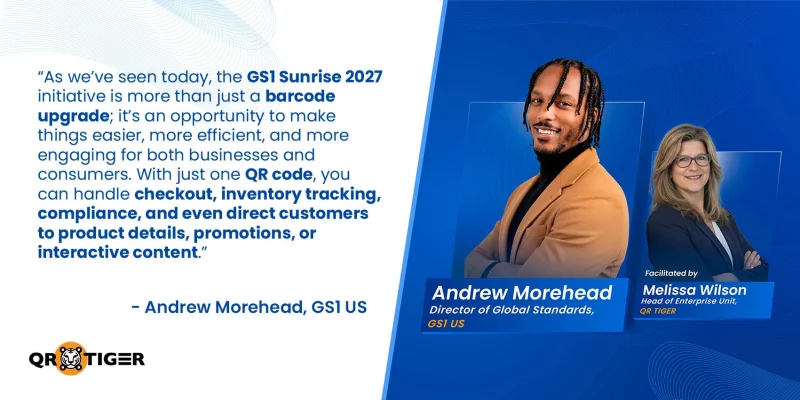
“Imagine a keyboard or outlet of different countries. If the port does not match the plug, then no power flows. GS1 is the standard that allows power to flow no matter where a plug is trying to connect to.”
– Andrew Morehead, Director of Global Standards, GS1 US
GS1 standards enable businesses to share a common language, making it easier to identify, capture, and share information about products, their locations, and logistics.
In doing so, companies ensure supply chain efficiency and regulatory compliance, and create a safe and reliable digital commerce platform for retail, healthcare, and many other industries.
A comparison: UPC Barcode vs. QR code
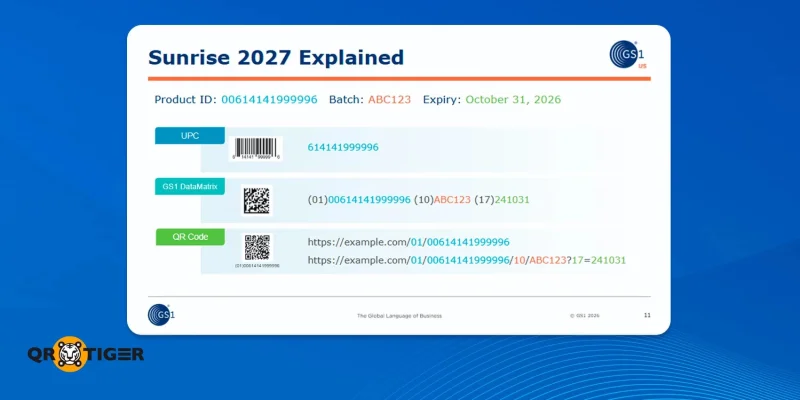
Structurally, the UPC barcode can only hold basic information regarding the product’s ID or GTIN. Unlike a QR code, it is generally wider and can store only numeric data through vertical lines.
A GS1 QR code is more compact than a UPC barcode because it can read information in both vertical and horizontal directions. It can also store more information by using a URL, or what they call the “Digital Link,” instead of numeric data.
This means that a QR code can easily store a link that includes the product’s GTIN, batch number, and expiry date, along with all the other information that scanners can access, similar to that of a website page.
As part of GS1’s transitional period, the plan is to use both the UPC barcode and the GS1 QR code on products, as downstream partners continue to update their scanners.
There is also a need to consider industries that still require UPC barcodes. As Morehead notes, the adoption of GS1 Digital Link QR codes doesn’t mean a ‘sunset’ or end of the 1D barcode; they can coexist.
Once the transition is over, businesses can then start using EAN UPC barcodes or 2D QR codes on their products.
Why GS1 Digital Link QR codes matter for businesses
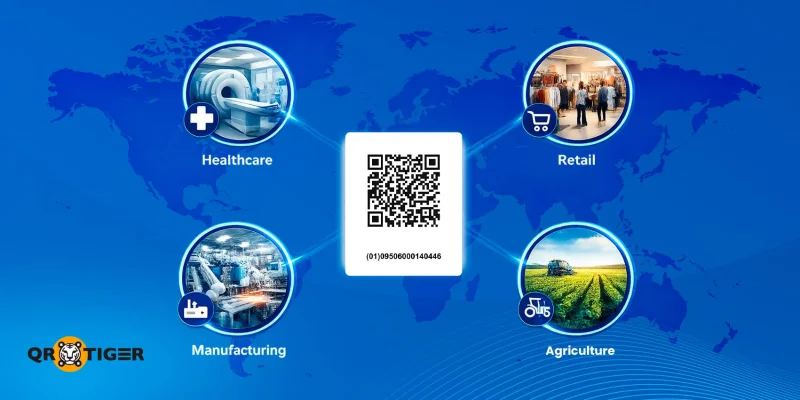
GS1 Digital Link QR codes are essential for industries to shift toward greater transparency, traceability, and consumer engagement. They help businesses meet regulatory requirements, improve supply chain visibility, and deliver information using a single code.
Their importance is already evident in how industries and sectors are transforming.
- In the fresh food sector, regulatory initiatives like the Food Safety Modernization Act of 204 (FSMA 204) emphasize end-to-end traceability and data transparency. With the growing volume of international imports and exports of fresh and ultra-fresh food products, QR codes on food packaging allow retail and agricultural businesses to track items from origin to shelf.
- GS1 QR codes support broader industry adoption by enabling consumers to connect with accurate, real-time product information. Programs such as Digital Product Passports (DPP), alcoholic beverage labeling, and even deposit return schemes use them to provide instant access to sourcing, ingredients, recycling instructions, and compliance details.
- The apparel and general merchandise sectors are also showing strong interest in using QR codes in clothing and other items to communicate their environmental commitments to consumers and improve traceability throughout the supply chain.
- Healthcare has long demonstrated the value of 2D barcodes. For over 15 years, the industry has relied on them to encode critical data and comply with global safety regulations. GS1 datamatrix barcodes already support traceability and unique device identification across more than 75 countries. QR code-enabled consumer apps are expanding their use, allowing patients to access electronic leaflets, medication guidance, and clinical trial information instantly.
- Accessibility is another major advantage. GS1 QR codes build on QR code accessibility and global familiarity, enabling users to access digital information anytime, anywhere. This aligns with the EU DPP’s accessibility objectives and removes the need for multiple QR codes on packaging. A single 2D barcode already ensures product information remains available to the over 315 million people worldwide living with sight loss.
GS1 QR code top use cases
Numerous brands across industries have already begun using GS1 Digital Link QR codes in ways that other businesses can learn from. Let’s take a closer look at what they are doing so far and why it matters:
Retail (Fresh/Ultra Fresh segment)
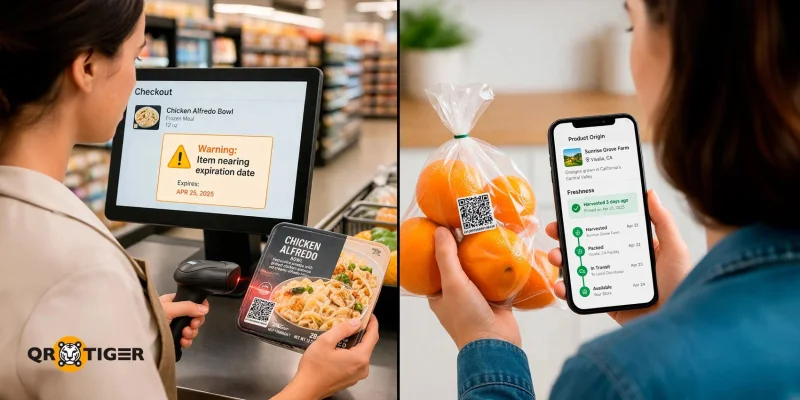
- 7-Eleven Thailand uses QR codes powered by GS1 Digital Links to store the expiry dates of Ready-to-eat products. This makes it easier to identify which products have expired through scanning the codes.
- The Mildura Fruit Company, with the support of Citrus Australia and Agriculture Victoria, established an end-to-end traceable GS1 Digital Link supply chain for consumers in the Asia Pacific. They can check the freshness of the fruit products via QR code.
Brand (Packaged goods segment)
- Procter & Gamble (P&G) and L'Oréal began using GS1 Digital Link standards on their products to enable consumers to open an easy-to-follow digital guide for product use on their smartphones.
- PepsiCo uses GS1 Digital Link QR codes for its rebrand of Sierra Mist Lemon Lime as Starry. When scanned, consumers could read the product’s information, including details on promos or loyalty rewards.
- Alcoholic beverages across different brands in the United Kingdom (UK) use GS1 Digital Link standards to provide consumers with the full ingredient list for each beverage, as required by EU Regulation 2021/2117.
Brand (Apparel segment)
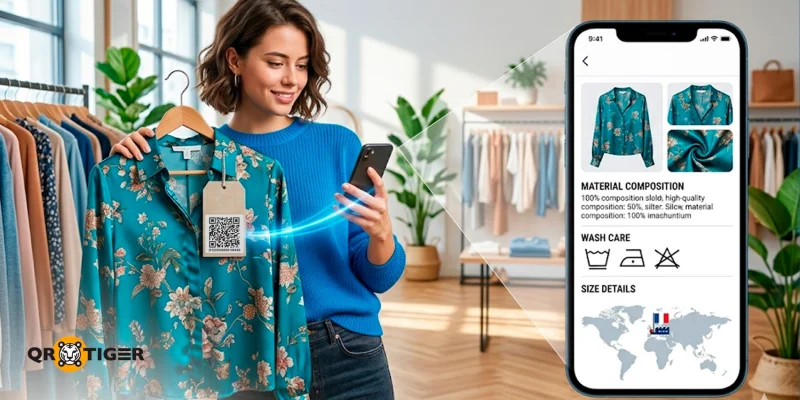
- PUMA adheres to GS1 standards in both its QR codes and RFID tags. The QR codes enable consumers to scan and view product information, while the RFID tags enable PUMA to maintain a comprehensive, up-to-date inventory.
- PATAGONIA uses GS1 Digital Link QR codes to create a personalized experience for its consumers, providing full product information in their local language when scanned. The product also reduces the usage of single-use tags, making it more sustainable.
Healthcare
- Pharmaceutical products that include a GS1 DataMatrix can easily meet the medicine traceability regulations in 75 countries and also meet the requirements for unique device identification (UDI).
- Primary packaging, Medical Devices, and Surgical instruments can use GS1 DataMatrix to streamline the recall and return process. It also supports sustainability initiatives by reducing waste and providing access to digital information.
- Clinical trials and investigational products, such as those conducted by Pfizer in 2022, can use a GS1 datamatrix to ensure that products reach the correct location and are delivered with the correct quantity. Hospitals can also provide patients with information about the clinical trial to ensure they are adequately informed.
Accessibility QR codes
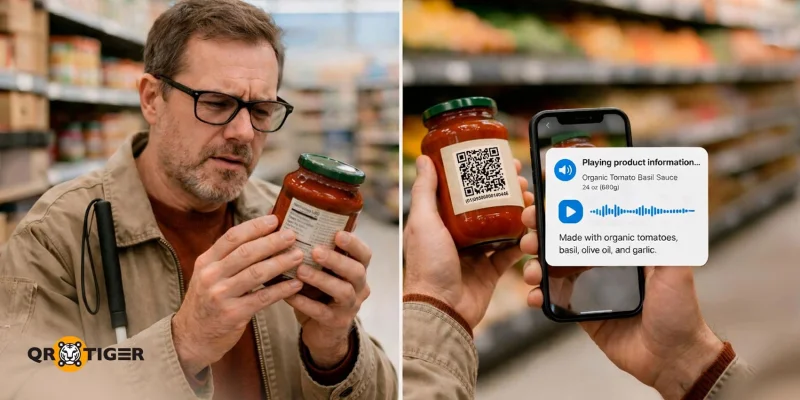
- Zappar uses the GS1 Digital Link standard to create accessible QR codes that can be scanned with a camera or via accessibility apps like Be My Eyes, Microsoft Seeing AI, and Envision to provide product information such as ingredients, allergens, and usage instructions.
- NaviLens developed accessible QR codes that conform to GS1 standards and then partnered with the Kellogg’s brand to offer blind and low-vision users an effortless way to identify and locate desired items through audible augmented reality experiences.
Key Q&A moments and insights
We also had the chance to hear more expert takes from GS1 US’s Andrew Morehead, which many of us can reflect on and gain insights from. These are some of the discussion highlights during the Q&A segment:
What is the difference between a regular QR code and a QR code powered by GS1?
What makes them different is how they store product data inside a URL. When using a GS1 Digital Link with a QR code, it identifies the product and includes additional data elements to further identify it, such as a serial number or expiry date.
This GS1-powered QR code can be used both during checkout and throughout the entire supply chain. While both a QR code and a GS1 QR code are easy to create, the latter follows a specific format to support business processes.
Is the transition period where both 1D and 2D barcodes are required only until the end of 2027?
Not necessarily. While the end goal is to ensure that every stakeholder in a business supply chain can scan and consume data from 2D barcodes, Sunrise 2027 is merely the target date for retailers to begin transitioning to QR codes for point-of-sale checkout.
While some brands are already working closely with their downstream partners to accelerate their transition to 2D barcodes, it will take time beyond 2027 for other businesses to fully adopt them.
How do I choose the right GS1 Member Organization to get my GTIN for my Barcodes?
The right GS1 member organization is dependent on where you or your business is located. There are already GS1 member organizations in 18+ growing countries worldwide, so it's likely that your specific country already has a GS1 member organization you can reach out to.
The GS1 website also lists which countries have a GS1 member organization and where each is located.
Is it okay to buy third-party barcodes instead of getting them from GS1?
GS1 does not necessarily sell barcodes. Instead, what they provide are the different identifiers for the product and the numbers that go into the barcode, also known as the GTIN.
This means that businesses can use a barcode from any solution provider or barcode provider, as long as it is encoded with a GS1-assigned number that identifies it.
These are typically called GS1 company prefixes, and they are important for identifying your brand and authenticating your products as they move through the supply chain.
Most standard jewellery RFID tags are too small to accommodate a GS1 Digital Link QR code. Any suggestions?
The RFID tag is separate from a QR code. When it comes to jewelry, this means it will include both a GS1 digital link QR code and an RFID tag that both lead to the same information.
The tag will typically go behind the actual label when attached to products that use dual identification, and most businesses selling these products will attach a small wire tag behind the label that shows the product’s RFID tag.
What are the latest timeline deadlines for retailers and manufacturers, including any perspective on where most companies are within the "journey" of this project?
GS1 standards are always voluntary, not mandatory. However, certain regulatory requirements are met by GS1 standards. In this regard, the best practice is to always follow the worldwide formatting.
There is no ‘Sunset’ for when the 1D barcode ends, so businesses are free to continue using the format beyond the given timeline. The only change is that retailers are expected to be able to scan 2D barcodes for POS checkout by 2027.
How to create a GS1 QR code
You can create and implement GS1 QR codes for your business by using a QR code solutions provider such as QR TIGER. Follow these steps to start:
1. Obtain a GS1 Company Prefix, a unique identifier for your business, by going to GS1’s official website and registering for a GS1 license. Here, you will receive a GTIN for each of your products.
2. Visit QR TIGER and select the GS1 Digital Link QR code solution.
3. After selecting an output method, copy and paste the product's GTIN along with all other appropriate data attributes and links, then click Generate QR code.
4. Test-scan your QR code. Then, click Download to save it in PNG, SVG, PDF, or EPS format.
5. Integrate with your inventory and retail systems for real-time stock tracking and enable POS scanners to read 2D barcodes.
Be a step ahead and make your brand GS1-ready today
Sunrise 2027 is only a year away. Innovation-driven businesses that start early will ensure their products and stakeholders become more connected before everyone else.
Start adopting GS1 QR codes now, not later, to get an early advantage.