How to Scan a QR Code on a Laptop (Windows, Chromebook, and Mac)
 By Belle
 Reviewed by Blessie Rae, Copy Editor
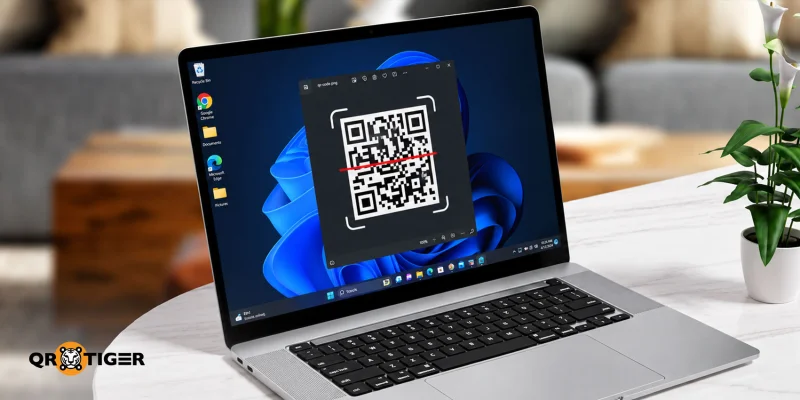
To scan a QR code on a laptop (Windows or Chromebook), use the Camera app’s QR code or barcode mode. On any laptop, including a Mac, upload a screenshot or a saved image file of the QR code to an online scanner.
Windows and ChromeOS have QR code scanning built into their cameras. Windows 11 can specifically read QR codes from screenshots. Meanwhile, Google Chrome lets you scan codes on webpages by right-clicking them.
The right method depends on where the code is and the laptop you’re using: in front of your webcam, on your screen, or saved as a file. You can scan and open the content behind the code without using another device.
Key takeaways
|
How to scan a QR code on a laptop?
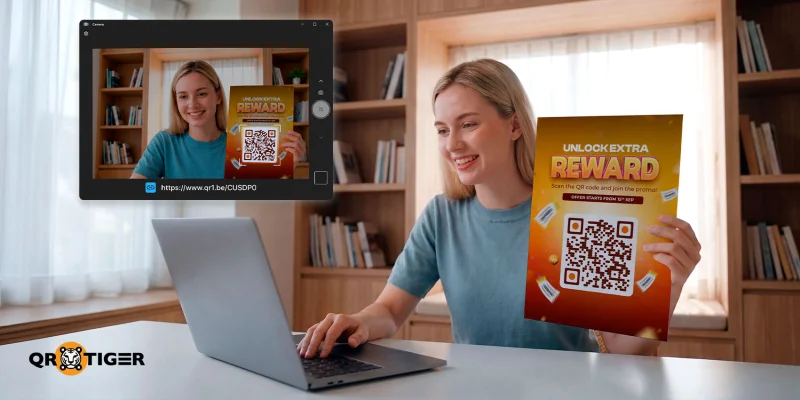
You can scan a QR code on a laptop using the tools it already has, without reaching for your phone. Here's a quick look at how to do it, depending on the laptop you have:
Method | Works on | Needs a webcam | Where does it scan the QR code |
Camera app, "Barcode" mode | Windows 10 and 11 | Yes | Scans a physical QR code using the webcam. |
Snipping Tool, "Text actions" | Windows 11 | No | Scans digital QR codes found on the laptop screen |
Safari, "Open Link" | Mac | No | Only works on the Safari web browser. |
Camera app, "Scan" mode | Chromebook | Yes | Scans a physical QR code using the webcam. |
Online QR code scanner | Any laptop | No | Only from a screenshot |
Google Lens in Chrome | Any laptop with Chrome | No | Only works on web browsers. |
Scan a QR code on Windows via the camera’s barcode reader
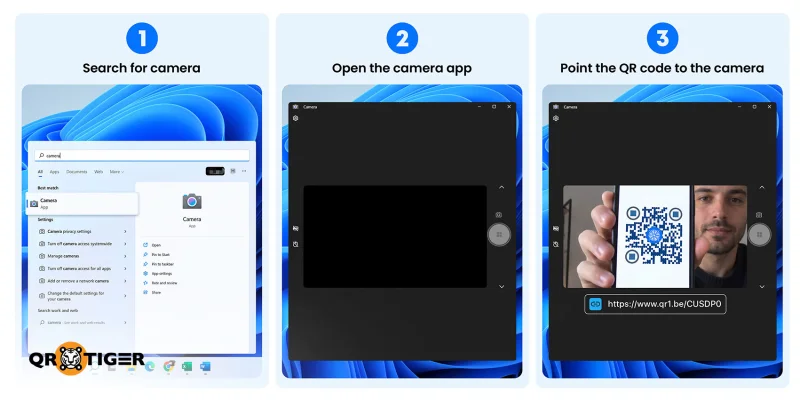
The Windows Camera app reads QR codes directly through your webcam, so it works for printed codes or QR codes shown on another device.
Here's a quick step-by-step guide:
1. Open the Start menu, type "Camera" and open the app.
2. Select the "Barcode" button on the right side of the app.
3. Hold the QR code in front of your webcam until it comes into focus.
4. Click the link that appears at the bottom of the app to open it.
The Camera app only reads a live camera feed, so it can't scan a QR code that's already on your laptop screen. The "Barcode" option also only appears on devices with a working webcam, so desktop PCs without one won't show it.
If the button is missing on your laptop, try updating the Camera app from the Microsoft Store and turning on experimental features in the camera settings.
Scan a QR code on your screen with Snipping Tool
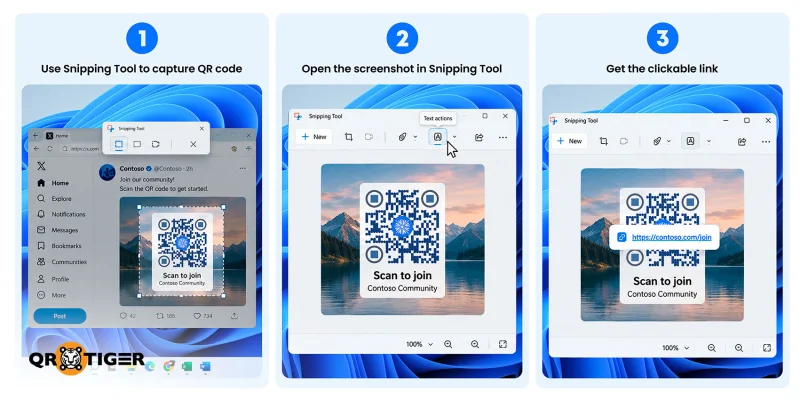
On Windows 11, the Snipping Tool can be used as a laptop QR code reader for screenshots, which takes fewer steps than switching to your phone. It also makes it easier to open codes in emails, PDFs, and video calls.
1. Press Win + Shift + S and drag a box around the QR code.
2. Click the notification to open the screenshot in Snipping Tool.
3. Click "Text actions" in the toolbar.
4. Click the decoded link to open it.
However, this feature isn't available on Windows 10, and older builds require you to upload the screenshot to an online QR code scanner instead.
Scan a QR code on a Mac
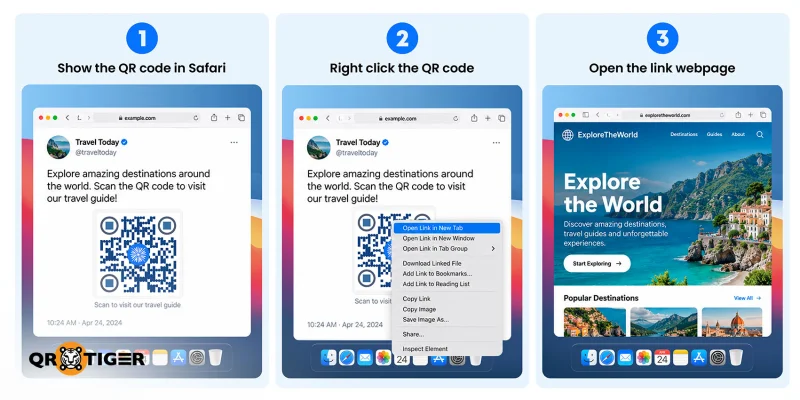
Mac's camera app, Photo Booth, doesn't offer any QR code scanning features. However, Safari can read one directly from a webpage, with no extra app needed.
Note: This method was tested on October 16, 2026, on a MacBook (OS 15) using Safari.
1. Control-click the QR code image in Safari.
2. Choose "Open (link name) in new tab" from the menu.
3. Safari opens the code's destination in a new tab.
Scan a QR code on a Chromebook
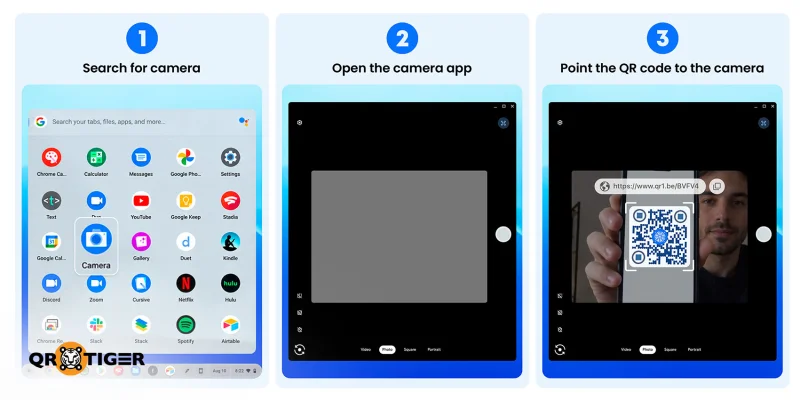
There is a built-in QR code scanner for Chromebooks. You can find it in the native Camera app, where you can scan codes through the front-facing webcam in seconds.
1. Open the Launcher and select "Camera."
2. Select "Scan," then "QR code."
3. Hold the QR code inside the viewfinder.
4. Select the text or link that appears to open it.
How do you scan a QR code on a laptop without a camera?
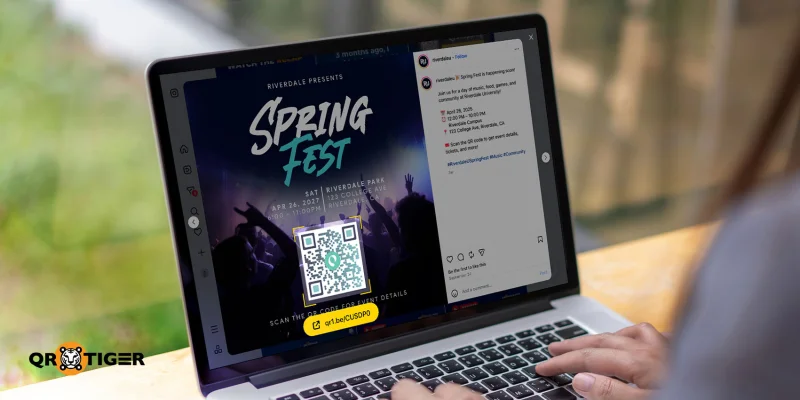
You don't need a webcam to scan the QR codes you receive in emails, PDFs, or on websites. A screenshot and a browser are enough, and these methods work on Windows, Mac, and Chromebooks alike.
Online QR code scanner
An online laptop QR code scanner can read codes from image files, allowing you to decode screenshots, downloaded tickets, and email attachments.
1. Take a screenshot of the QR code (Win + Shift + S on Windows, Command + Shift + 4 on Mac, or Ctrl + Shift + Show windows on a Chromebook.)
2. Open your browser and look for an online QR code scanner.
3. Select “Upload” and then select the screenshot of the QR code you wish to scan.
4. Copy or click the decoded link.
While some online scanners decode the image inside your browser, others may upload it to their servers. For this reason, it's better not to upload sign-in or two-factor authentication QR codes to an online scanner, since they contain your account setup key.
Use Google Lens in Chrome
The Chrome browser also includes a QR code scanner app for laptops, accessible through the Google Lens QR code feature that lets you scan a QR code on any webpage without extra software.
1. Using the Google Chrome browser, right-click on the image that includes the QR code.
2. Select "Search image with Google Lens."
Note: You may need to select the QR code with the mouse cursor to scan it effectively.
3. Click the decoded link in the Lens sidebar, or copy the link found in the sidebar and paste it into the address bar.
You can also take a screenshot of the QR code, then drag and drop it into the Google search bar to scan it.
Use a browser extension
A QR code scanner in your browser extension allows you to automatically scan any QR code found on the webpage you are currently browsing.
QR TIGER is fully verified by the Chrome Web Store, and the checkmark is easily visible under the extension's name. Here’s how to add and use it:
1. In your Google Chrome Browser, open the Chrome Web Store.
2. Search for QR TIGER’s “QR Auto Detect & Click”
3. Select “Add to Chrome.”
Once the extension is added, you can turn on the Auto-QR detection feature by opening the extension (found under the extensions tab) and moving the slider icon for “Auto QR detection” to the right.
Can you scan a QR code on your phone's screen with a laptop?
Yes, your Windows or Chromebook laptop's webcam can scan the QR codes on your smartphone’s screen, reading the pattern the same way it reads a printed one.
To scan it, open your laptop's built-in scanner and hold your phone's screen up to the webcam. You can use any one of the following, depending on your laptop:
- Windows: Switch the Camera app to "Barcode" mode, the same way you'd scan a printed code.
- Chromebook: Open the Camera app and select "Scan," then "QR code."
- Mac: Use a webcam scanner app from the Mac App Store, since Photo Booth can't read QR codes.
You may also be interested in our guide on how to scan a QR code on Android smartphones.
Reasons why laptops fail to scan a QR code
Most failed scans come down to the camera, the image, or the link behind the code. According to the QR Decoded 2026 industry report on QR code usage and behavior, device and camera quality are the highest barriers when scanning a QR code, with 39% of users struggling to do so.
Below, we’ve listed three common reasons scanning a QR code on a laptop fails, along with possible causes and how to resolve the issue.
The webcam cannot read the code
Laptop webcams usually have lower resolution and fixed focus, making them pickier than phone cameras. As a result, small changes in light, distance, or angle often decide whether a scan works. Here are some quick fixes:
- Proper lighting: Face a window or lamp so the code is evenly lit. Glare on glossy paper or a phone screen washes out parts of the code, leaving the scanner with gaps it can't read.
- Distance: Try scanning the QR code from a distance, starting at about a forearm's length away, and slowly move it closer to the camera. Fixed-focus webcams have a narrow sweet spot, and if you move too fast, you'll lose focus.
- Angle: Hold the QR code flat and centered in the frame, not tilted. Scanners use the three squares in the code's corners to orient it, so a tilted QR code can distort the pattern they read.
- Dirty lens: Wipe the webcam. Fingerprints and dust can blur the image, especially on laptops that you open by the edge of the screen.
- Camera permissions: On Windows, go to Settings > Privacy & security > Camera and make sure camera access is enabled. If it's off, the Camera app can't reach your webcam at all.
- Other apps: Close Zoom, Teams, or any other app that might be using the webcam. Many webcams only work with one app at a time, so the Camera app can't use them if a video call is open.
The QR code or screenshot is hard to read
Sometimes the problem is the QR code itself or its image, not your camera. Here's what to check:
- Blurry or stretched screenshots: Zoom in on the code before you capture it, and use the original image rather than a resized copy. Resizing blurs the edges between the code's squares, which scanners need to tell black from white.
- QR codes that are too small: Follow the proper QR code size to ensure the code is readable. Enlarge the code on screen until it fills a good part of the camera frame, without ruining the QR code’s image quality.
- Inverted colors: A light QR code on a dark background can trip up many scanners, since most expect dark squares on a light background. Ask the sender for a dark-on-light version instead.
- Dense codes: Static QR codes that hold long links pack in more squares, which low-resolution webcams can struggle to read. Use a screenshot method instead, since the scanner then reads the image at full resolution.
- Heavy custom designs: Busy patterns, low contrast, or oversized logos can also cover the parts of a code that a barcode scanner for laptops relies on. In such cases, an online scanner might handle scanning the QR code better than a webcam.
If you're the one making the code, our guide to why QR codes stop working covers the design fixes.
The scan works, but nothing opens
A successful scan that leads nowhere usually means the problem is on the other end, not with your laptop. Some common causes include the following:
- Expired codes: Event and promo codes made using a QR code generator are often deactivated after a campaign ends. Dynamic codes also stop working when the creator's subscription lapses, because the short link inside no longer redirects.
- Private files: Codes linking to Google Drive or Dropbox files fail when the owner hasn't shared the file publicly. You'll usually land on a "request access" page instead, so ask the sender to update the sharing settings.
- Changed links: The page referenced by the code has moved or no longer exists, often resulting in a 404 error. Contact whoever shared the code for an updated version.
- Wrong browser: On Windows, scanned links open in your default browser. By following the Microsoft Support guide, you can change it by going to Settings > Apps > Default apps if you want them to open elsewhere.

No phone? No problem—scan a QR code with your laptop
Knowing how to scan a QR code on a laptop is a clear example of how QR codes have moved beyond the smartphone and into the devices you work on.
Your laptop reads them in more ways than you'd expect: the webcam for printed codes and phone screens, Snipping Tool and Google Lens for codes on your display, and online scanners for screenshots.
If the scan fails, a quick fix to the lighting, the image, or the link usually gets it working again.
This article is for general informational purposes only and does not constitute legal, financial, or other professional advice. For questions about QR TIGER's products or services, please contact our support team at [email protected].
Frequently Asked Questions (FAQ)
Does Windows 11 have a built-in QR code scanner?
Does a Mac have a built-in QR code scanner?
Is it safe to scan QR codes on my laptop?
How do I scan a QR code on Windows 10/11 using a phone?
Can I scan a QR code from a PDF or presentation on my laptop?
Was this article helpful?
Maximize Scans with the Best QR Code Generator
Join thousands of global brands using QR TIGER to manage dynamic routing, bulk creation, and deep attribution analytics.
Get Started For Free