
What Is Offline Tracking in Marketing? A Clear Guide for Businesses

Tracking your Facebook ads? Easy. Tracking how many people saw your poster at the coffee shop? Not so much.
Daily Sales Record notes that more than 60% of businesses lose sales every day because their tracking systems can’t capture offline activity.
Investing in the right offline tracking tool will allow you to see how your offline campaigns perform in real-world settings, backed by data.
We’ll explain offline data tracking in detail, why it’s important, and how a trackable QR code from a dynamic QR code generator will help you better understand the impact of your print marketing campaigns on your business.
Table of Contents
- TL;DR
- What is offline tracking in marketing?
- Why offline data tracking matters
- Challenges with traditional offline campaign tracking methods
- How dynamic QR codes enable offline marketing analytics
- Key metrics you can track with dynamic QR codes
- Practical examples: Offline marketing channels you can track with dynamic QR codes
- How to set up offline data tracking with dynamic QR codes (step by step)
- Benefits of trackable QR codes for marketers and businesses
- Best practices for effective offline conversion tracking
- Turn your offline efforts into real, trackable wins
- FAQ
TL;DR
- Offline tracking helps you measure how your physical marketing campaigns perform in the real world.
- Traditional tracking methods, like coupons and surveys, often give incomplete results.
- Dynamic QR codes let you track scans in real time, showing what device, when, where, and how often people engage.
- You can connect offline marketing with digital data for clear, measurable insights.
- Offline marketing no longer has to be a guessing game.
What is offline tracking in marketing?

In marketing, offline data tracking measures the performance of our physical marketing collateral, such as flyers, billboards, direct mail, print ads, event booths, or packaging, to determine how effectively they are achieving their objectives.
We can also refer to this as offline conversion tracking, which involves monitoring whether a customer’s encounter with an ad poster, for example, has directly led them to visit our store or purchase an item.
Simply put, it helps us assess the effectiveness, return on investment (ROI), or a specific metric in our physical marketing ads. It lets us see what’s performing well, what’s wasting money, and where we can improve next time.
Why offline data tracking matters
Online marketing dominates most conversations. But let’s be honest, people still pick up flyers, walk past billboards, and grab freebies at events.
A study by The Manifest found that 63% of small businesses still use traditional marketing methods, such as direct mail, flyers, and banners. They do this to create a more personal connection with their clients.
Traditional marketing remains effective because people tend to remember what they can see and hold.
That’s why tracking offline conversions highly matters. It helps us:
- See which print media channels and materials actually get attention
- Measure ROI from our offline campaigns
- Understand who engages and where
- Refine our strategy with actual data, not gut feel
Similar to how we put effort into tracking your digital ads, our offline campaigns also need the same kind of attention and intricacy.
Challenges with traditional offline campaign tracking methods

We need to understand that traditional marketing is a one-way communication. Meaning, we can’t directly see and conclude the connection between the customer’s encounter with the ad and their final purchase.
Marketers employ various methods for tracking offline marketing campaigns, but most of them often leave them feeling like they’re guessing in the dark, like the following:
Coupon codes and vouchers
They’re handy for tracking in-store redemptions, but they only work if customers actually use them. Many forget, lose, or never bother.
Custom phone numbers or links
You can assign different numbers or URLs to each campaign, but that’s extra setup and a mess to organize if you’re running several campaigns at once. Plus, people don’t always type long URLs correctly.
Surveys and feedback forms
They provide direct input, but they rely on customer effort. Let’s be honest, unless there’s a reward, very few people will fill out a form after making a purchase.
Tracking foot traffic
Some businesses measure engagement by foot traffic or store visits, but that doesn’t tell you why they came in or if they saw your ad first. It’s more of a “maybe” metric.
Coupon clippings and printed codes
Magazine coupons or mail-in offers still exist, but collecting and sorting physical entries feels like something out of the early 2000s. Slow, costly, and limited.
Branded URLs on print materials
Putting a promo webpage “www.brandpromo2025.com” on a poster sounds smart, until you realize you can’t tell how many typed it in, from where, or how often.
Unique promo words or hashtags
Some campaigns use promo phrases like “Say ‘FREEDRINK’ at checkout to get your freebie.” It’s simple, but data tracking depends entirely on your staff remembering to log it.
Manual record keeping
If you’ve ever tried tallying offline leads by hand or using spreadsheets, you know how easy it is for things to slip through the cracks. It’s time-consuming and far from accurate.
In short, these old-school methods give you some insights, but they’re incomplete, inconsistent, and often outdated by the time you review them.
That’s why QR codes have become such a practical solution, and they give you real-time data without the extra legwork or guesswork.
How dynamic QR codes enable offline marketing analytics
Dynamic QR codes act like a digital bridge between your print materials and online analytics. They make online to offline tracking and vice versa easier by letting you track each scan in real time, gathering more accurate data.
Unlike static QR codes, dynamic ones let you:
- Track every scan in real time.
- View detailed analytics, including scan count, location, time, and device type.
- Compare performance across campaigns.
- Update the destination link or content anytime (reprinting is not necessary).
- Add password protection, scan alerts, expiration, retargeting, and redirection for enhanced control.
For example, if someone in New York scans your QR code from a poster, you’ll know when and where it happened, down to their exact location, if permitted.
You can even create different QR codes for different cities, events, or ad placements to see which one performs best. It’s like giving your offline materials their own analytics dashboard.
Key metrics you can track with dynamic QR codes
Here’s how a dynamic QR code for tracking offline campaigns compares to traditional methods, showing it’s a huge upgrade for brands:
| Metrics | Dynamic QR Codes | Traditional Offline Methods |
| Interactions | Shows real-time scan counts | Based on estimates or guesses |
| Location | Pinpoints where scans happen (city, region) | Usually unavailable |
| Time and Date | Records exact scan times | Needs manual tracking |
| Device Type | Detects if scanned via Android, iPhone, or desktop | Not measurable |
| Campaign Comparison | Let you compare different QR codes easily | Hard without a tracking system |
| Content Updates | Editable anytime without reprinting | Requires reprinting |
| Audience Insights | Shows behavior and engagement patterns | Limited or none |
| Extra Controls | Add password, alerts, retargeting, expiration, or redirects | Not supported |
Practical examples: Offline marketing channels you can track with dynamic QR codes
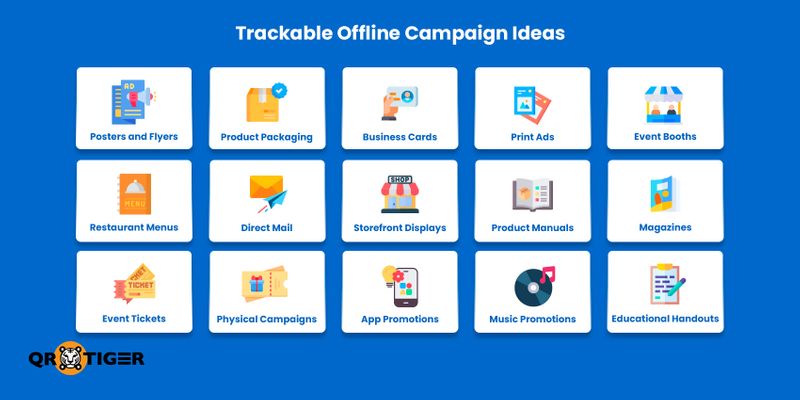
Businesses across industries continue to tap into traditional marketing channels, as time has shown their effectiveness in building awareness for a brand, product, or service.
But manual tracking can only do so much. Tapping into technologies, such as dynamic QR codes, will help us gather valuable data more quickly and accurately, enabling us to prove that they indeed have a real impact and a good return on investment (ROI).
These are some smart ways in which QR code technology assists in monitoring the performance of various physical marketing channels:
1. Posters and flyers
Turn every poster or flyer into a mini digital gateway. A URL QR code can lead people straight to your website, promo page, or online sign-up form. You’ll see how many scans were made and even where the scans came from.
Starbucks, for example, put QR codes on posters and flyers for their “Summer Refresher Campaign”.
Every customer scanning will be redirected to a mobile landing page that features new drink flavors, interactive visuals, and links to social media hashtags like #starbucksrefreshers.
With QR codes, this simple print transforms into a multi-channel experience that sparks online conversations.
Want to make yours even more effective? Add UTM tags to your QR codes. This helps you identify the exact source, channel, and campaign behind each scan.
It will give you a clearer picture of which offline materials drive the most engagement.
2. Product packaging
Give your packaging a digital touch. You can add a multi-URL QR code to direct buyers to localized websites, product instructions, ingredients, or even seasonal campaigns based on their language or location.
Nestlé is a great example that uses QR codes to share farm-to-shelf data and detailed nutritional information. Their approach shows how a QR code can have various data while adapting to different markets.
And brands that follow global standards use a GS1 digital link QR code to make their products’ packaging even smarter.
It connects one code to multiple types of data, including expiry dates, digital manuals, and brand pages, all while meeting GS1’s guidelines for digital product identification. It’s like turning every package into its own mini website.
3. Business cards
Want to skip the awkward “let me spell my email for you” moment? Networking made simple. Add a vCard QR code to your card. Every scan means a potential lead.
Did you know that out of almost 10 billion physical business cards, about 88% end up in the trash within a week? That’s over 8 billion business cards being thrown out.
That’s where QR codes turn that around by making it memorable and measurable. Once scanned, people can instantly save your contact details, such as phone number, email, and social media links, on their smartphones.
However, that’s not all; you can also track scan data, such as the number of times your card was scanned and where it was used.
4. Print ads
Add more depth to your posters and billboards using a landing page QR code. Instead of sending readers to a plain website, it opens a personalized landing page where they can learn more, sign up, or download a file, all while you track engagement.
IKEA showed how effective this was through their #IKEAEverywhere campaign. They placed QR codes in public spots like beaches and salons.
The effort boosted sales by 30% and drove 4.5 times more online traffic. This just proves how QR codes can turn quick interactions into measurable results.
5. Event booths and trade shows
Collect feedback on the spot using a QR code for Google Forms. It sends attendees straight to your digital form. You’ll know how many participants engaged with your booth and what information they shared.
A real example of this is the latest DigiCon 2025 by the Digital Marketing Association of the Philippines (DMAP).
QR TIGER partnered with the event to create dynamic QR codes for live feedback collection. These QR codes appeared on stage over 70 times, resulting in more than 11,500 scans and generating 7,425 responses with a 65% scan-to-submission rate.
This clearly demonstrates how QR codes can facilitate faster and more engaging feedback in large conferences.
6. Restaurant menus and table tents
Add a menu QR code so customers can browse your digital menu. You’ll instantly know which branches get the most scans, which is helpful if you’re testing out a new location or menu item.
An excellent example of this is the Entrecôte Petit Louis, a French chain in Jeddah, which uses QR TIGER’s QR code menus across its branches. They allow diners to scan, view dish details, and place orders directly from their tables.
For me, what made this a hit is that customers loved and valued convenience. The QR code menu removed friction, while also feeling modern and premium.
7. Direct mail campaigns
Mail might be old school, but a dynamic QR gives it a modern spin. Each scan tells you which batch of mailers actually worked, helping you refine future campaigns.
A Nellymoser report found that dynamic QR campaigns convert at a rate of between 4.5% and 6.4%, slightly outperforming traditional direct mail’s 4.4% response rate.
It’s proof that adding a small piece of code can make a significant difference in engagement.
8. Storefront displays
Put a Wi-Fi QR code near your entrance to offer instant access while customers wait or browse.
Offering Wi-Fi through QR codes does more than connect shoppers. It helps attract them to your store.
Data from Haptic Networks shows that 76% of shoppers use their phones in-store to check product details or reviews. Stores that provide guest WiFi also see a 25% increase in customer satisfaction scores.
Additionally, according to Cisco, 96% of consumers prefer shopping at stores with free WiFi, and they are more likely to return. That stat alone shows how important in-store connectivity has become for both convenience and loyalty.
So, placing a QR code for Wi-Fi also gives you a subtle way to track engagement while creating a smoother in-store experience.
9. Product manuals or warranty cards
Print and place a QR code sticker on your products to provide customers with direct access to user manuals, installation videos, or product registrations.
The well-known brand, LG, uses QR codes on its appliances. It provides customers with tips and useful information about their appliances.
Adding QR codes this way lets you track how customers interact with your product information while making it easier for them to access it.
10. Magazines and editorial features
Turn passive readers into active followers. A link page QR code can take them to your brand’s social media profiles, helping you track interest from print media.
11. Event tickets and printed invites
Include an event QR code so guests can confirm attendance or view event details instantly. You can track attendance rates with real-time scans.
The NBA has taken this to the next level by using QR codes for tickets. Fans scan their tickets for fast entry, which bypasses long lines and the risk of losing a physical ticket.
All in all, QR codes make the entire event experience smoother while also giving businesses to improve engagement and get valuable insights from the audience.
12. Stores and physical campaigns
If your campaign involves digital discounts, a coupon QR code can help you distribute promo codes easily. You’ll know which stores or locations generate the most redemptions.
A good example is Burger King’s “QR Whopper” giveaway, where a floating QR code appeared in TV commercials. Viewers who scanned it were directed to a webpage offering a free Whooper coupon as part of an in-app purchase.
The campaign gave away 10,000 Whoopers and turned TV screens into interactive ad spaces that boosted app engagement and in-store sales.
13. Posters for app promotions
Use an app store QR code to direct users to your app on Google Play or the App Store; they don’t need to search manually. Scan data helps track which platforms people prefer.
A retail brand like Belk did this. They placed QR codes on in-store posters and even on receipts. The result? These drove 12.5% of Belk’s total app installs.
Shoppers can scan to view more sizes or colors available exclusively in the app; meanwhile, store managers can track the data in real-time.
QR codes can turn any posters or signage into a powerful promotion tool.
14. Music or podcast promotions
Artists and podcasters can use an MP3 QR code to instantly let fans hear their tracks. You’ll also see which region your fans are tuning in from.
A notable example is Taylor Swift, who has used QR codes creatively. Her “Life of a Showgirl” campaign featured orange doors with QR codes across 12 cities, leading fans to puzzles and exclusive videos.
After 12 million digital interactions worldwide, the scavenger hunt concluded with the unveiling of the “The Fate of Ophelia” lyric video.
This campaign itself proved that QR codes can do more than share content. They can spark real-world interaction, build excitement, and connect online storytelling with real experiences.
Taylor’s QR code hunt turned a simple scan into a global fan moment.
15. Educational handouts and study guides
Schools and instructors can attach a YouTube QR code to printed materials, allowing students to access video lessons or tutorials with a single scan. Analytics will show which lessons get the most attention.
How to set up offline data tracking with dynamic QR codes (step by step)
1. Go to a dynamic QR code generator online.
2. Choose a QR code solution and select “Dynamic QR”.
3. Add the link, file, or information.
4. Click “Generate QR code”.
5. Customize the QR code design to match your branding.
6. Run a test scan, then “Download” and place it on your print material (flyers, packaging, banners, etc.).
7. Monitor scans in your analytics dashboard.
Benefits of trackable QR codes for marketers and businesses
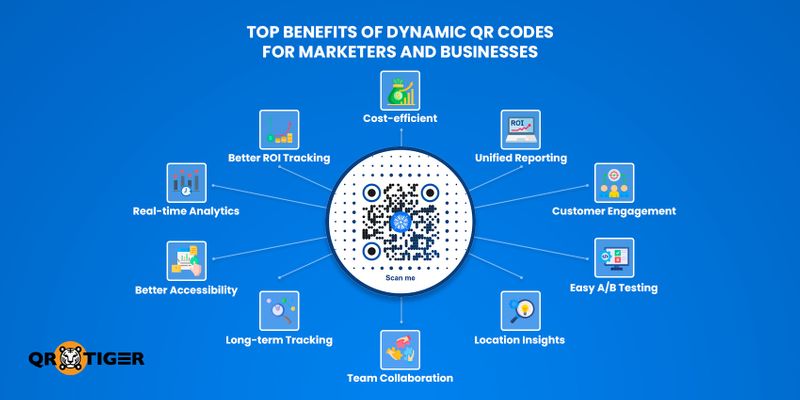
Dynamic QR codes give your offline marketing efforts a measurable edge. Here’s why marketers love using them:
1. Real-time analytics
You can track how many times people scanned your QR code, where they did it, when it happened, and what device they used. You can see this all in real-time; no manual counting is needed.
2. Better ROI tracking
You’ll know which print campaigns are driving action and sales. Whether it’s a flyer, poster, or billboard, you can compare performance and adjust your budget wisely.
Tracking and reporting with QR codes can boost engagement by up to 26%. In fact, over 60% of marketers say these codes help them fine-tune their campaigns and offers based on solid insights. (QR TIGER)
3. Cost-efficient
Does your QR code lead to the wrong content? No problem. When you use dynamic QRs, you can change your link or information at any time without reprinting materials. That’s savings right there.
4. Unified reporting
Combine your offline and online data live in one place. This gives you a clearer view of how your campaigns perform overall. You don’t need to piece data together from different tools.
5. Stronger customer engagement
People prefer scanning over typing or writing. A QR code gives them instant access to what you’re offering, and that ease often leads to more clicks, sign-ups, or purchases.
6. Easy A/B testing
You can create two different QR codes with different content to see which performs better. Perfect for testing ad layouts, messages, or designs.
Campaigns using QR code A/B testing typically see an 18% increase in conversions, a simple tweak that adds up to big results. (QR TIGER)
7. Location-based insights
Find out which locations perform best. You’ll see where people scan most often, helping you decide where to place more ads or pull back.
8. Team collaboration
If you’re running multiple campaigns, your team can monitor different QR codes from a single dashboard. Everyone stays on the same page (literally).
9. Long-term tracking
Unlike temporary promo codes or phone numbers, your QR code data stays with you. You can monitor engagement over time and compare past results easily.
10. Better accessibility and user experience
QR codes make information accessible to everyone, whether they’re on a phone or tablet. It’s quick, inclusive, and user-friendly for all audiences.
Best practices for effective offline conversion tracking
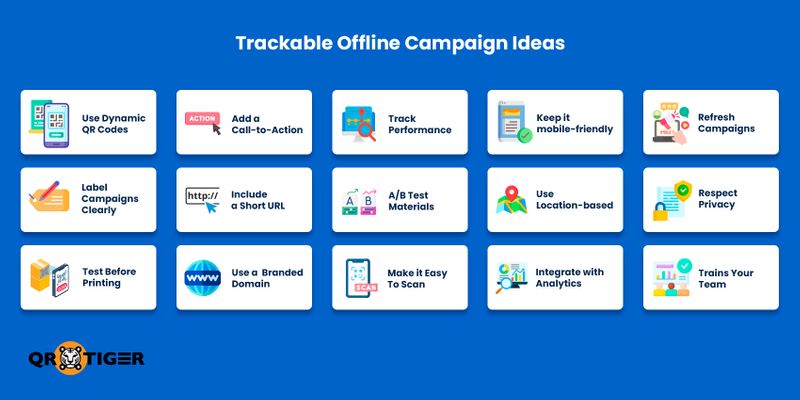
Offline tracking is straightforward once you know the basics, but doing it well takes a few smart habits. Here’s how to make your campaigns truly measurable and meaningful:
1. Use dynamic QRs always
Static QR codes can’t be edited or tracked, which limits their functionality.
2. Label each QR code campaign clearly
Create unique labels for each code (like “Poster - Coffee Shop”). It helps you organize your analytics and identify top-performing locations or materials later on.
3. Test before printing
Always scan your QR codes before you print them in bulk. A small testing round can save you from costly mistakes.
4. Add a clear call to action
Don’t just put a QR code on your poster and hope for the best. Tell people why they should scan (like “Scan to get 10% off” or Scan to watch the demo”). Always give them a reason.
According to a BlueBite report, QR codes with logos and clear calls-to-action get up to 80% more scans.
5. Combine with short URLs
If space allows, include a short, readable link below the QR code. It provides people with a backup option in case they are unable to scan.
6. Use a short custom domain
Instead of using a random or generic short link (like bit.ly/xyz123), use your own branded short domain, something like qr.brandname.com. It looks more professional, builds trust, and makes people more likely to scan or click.
A study by Rebrandly found that branded short URLs can increase click-through rates by up to 39% and improve trust by 25%.
7. Track and compare regularly
Check your analytics weekly or monthly. See which campaigns perform best and which need adjustments. The goal is to find patterns in your audience’s behavior.
8. A/B test different materials
Try using the same QR code on various print materials, such as flyers, posters, and packaging. Compare the data to see which format drives the most engagement.
9. Optimize design for scanning
Make sure your QR code has enough contrast and space around it. Avoid overly busy backgrounds or tiny sizes; if people struggle to scan it, they’ll give up.
10. Keep your landing page mobile-friendly
Most people scan using their phones. If your landing page loads slowly or appears poorly on mobile, your tracking data will likely show a decline in engagement.
11. Use location-based QR codes for local campaigns
If you’re marketing across different cities or stores, create multi-URL QR codes to help you pinpoint which areas bring in the most traffic.
12. Integrate tracking data with your CRM or analytics tools
By integrating offline conversion tracking with Google Analytics or your CRM, you can easily bridge the gap between offline actions and online conversions.
13. Refresh campaigns regularly
Don’t let old campaigns linger forever. Retire inactive codes, update content when needed, and keep your materials relevant to the season or audience trends.
14. Respect user privacy
Always follow data privacy rules. Track engagement metrics, but don’t collect personal data unless users provide it willingly (e.g., through a form or sign-up).
15. Train your team
Make sure your marketing or sales staff understand how offline tracking works. A quick briefing helps them explain QR codes to customers and gather better feedback.
Turn your offline efforts into real, trackable wins
Offline tracking reminds us that marketing doesn’t end once your campaign goes offline; it just changes how you measure success. Every flyer, poster, or business card still tells a story; you just need the right tool to listen.
With dynamic QR codes, you can finally see how those offline efforts perform. You’ll know which ad caught attention, which location worked best, and what drove people to take action.
It’s smart, measurable marketing made simple.
Start tracking your campaigns now with QR TIGER, the most advanced QR code generator for businesses that want to connect offline and online results.
FAQ
What does offline marketing mean?
Offline marketing is a form of advertising that uses traditional, non-Internet-based channels to reach customers.
Does offline marketing still work?
Yes, offline marketing still works. While digital strategies have grown, traditional methods like flyers, billboards, and print ads continue to effectively reach specific audiences and drive conversions, especially when paired with tracking tools like QR codes.
How can offline tracking improve my advertising campaigns?
Offline tracking helps you measure how printed marketing materials contribute to your campaign results. Placing a QR code on flyers, brochures, billboards, posters, or packaging lets you identify which offline campaign generates the most scans, website visits, leads, or sales.
Adding a QR code to your offline or printed campaigns lets you measure real performance, identify high-performing campaigns and locations, improve marketing ROI, understand customer behavior, and optimize future campaigns.
What are the best offline tracking tools for small businesses?
Small businesses don't need expensive tools to measure offline marketing. Tools like a QR code generator with dynamic QR codes can provide actionable insights at an affordable cost.
QR TIGER's dynamic QR codes work well for offline tracking. Their dynamic QR codes have advanced tracking and in-depth analytics that provide accurate data without a large budget. Their URL QR codes also include UTM parameters for better tracking in GA4 or other analytics tools. Their API-ready platform works well with CRMs such as Zapier, HubSpot, GA4, Canva, and more.
How does offline tracking work in digital marketing?
Offline tracking connects physical marketing materials to measurable digital campaigns or interactions. When you add a QR code to your offline campaign materials, the QR generator captures scan data, such as the number of scans, time, location, and device type (iOS or Android).