
New Guinness World Record for Smallest QR Code Sets Data Storage Breakthrough

The new Guinness World record for the smallest QR code developed by TU Wien researchers (Courtesy of TU Wien)
AUSTRIA — On December 3, 2025, researchers from TU Wien, an Austrian research and educational institution, set a new Guinness World Record for the smallest QR code. Covering an area of 1.98 square micrometers (1.977 μm²) and featuring 49nm pixels, the record-breaking QR code is 37% smaller than the previous world record for the smallest QR code.
To assist them in this endeavor, the country's premier institution for technology and natural sciences partnered with Cerabyte GmbH, a German data storage startup.
Because of its size, verification was performed at the University of Vienna using calibrated scanning electron microscopy. Afterwards, the QR code was entered into the Guinness World Records.
The creation of tiny QR codes is a part of ongoing efforts to increase data density using advanced thin-film materials.
Table of Contents
Ceramics and how they redefined QR code creation
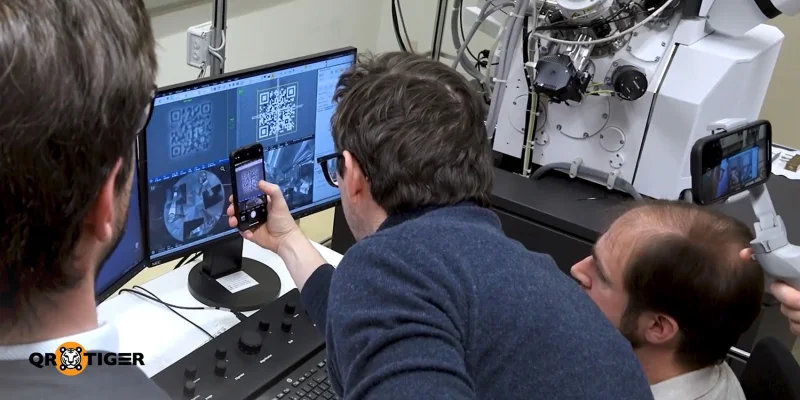
Researchers scanning the smallest QR code with a smartphone camera (Courtesy of TU Wien)
To create a QR code at the nanometer scale, the collaborators focused an ion beam on a chromium nitride thin film to form it.
Ion beams are streams of electrically charged atoms. The beam is steered and focused using magnetic fields inside a vacuum in a metal tube.
On the other hand, chromium nitride thin film is a ceramic, an inorganic material composed of metal or nonmetal compounds.
When explaining the process behind their work, Professor Paul Mayrhofer, one of the seven researchers involved in the project, details how structures of this scale aren’t a novel concept.
Patterns can even be created using individual atoms, but the problem arises when these atoms diffuse, move, or fill gaps, destroying the encoded data.
By creating a QR code generator using focused ion beams, they avoid this shortcoming altogether.
“What we have done is something fundamentally different,” the professor explains. “We have created a tiny, but stable and repeatedly readable QR code.”
As for why ceramics were used, researchers Erwin Peck and Balint Hajas explain that the materials have to remain stable during the process.
“For high-performance tools, it is essential that materials remain stable and durable even under extreme conditions,” explain the duo. “And that is exactly what makes these materials ideal for data storage as well.”
Cerabyte’s focus on using glass and ceramics made them the perfect partners for the research group’s goals. Established in 2022, the company developed Ceramic-on-Glass storage media for sustainable data storage without electricity.
What this development means for data storage
TU Wien’s success opens up several opportunities in sustainable data storage. For starters, the use of ceramics means that data storage can last for centuries, maybe even millennia.
This was demonstrated by Cerabyte during the Open Compute Project (OCP) summit in Dublin, Ireland, in 2025. At the summit, the company boiled the storage device in salt water for 7 days to test the durability of the technology. At the end of the testing period, the media remained undamaged and the data intact.
Being able to store data in materials that can resist such extremes means that information can remain accessible no matter the conditions. According to the institution, magnetic and electronic data carriers and systems designed to transport data between locations can lose information after a few years due to a lack of consistent energy input, cooling, and data migration.
“We live in the information age, yet we store our knowledge in media that are astonishingly short-lived,” says Alexander Kirnbauer, another researcher who helped create the QR code. “With ceramic storage media, we are pursuing a similar approach to that of ancient cultures, whose inscriptions we can still read today.”
The creation process developed by TU Wien’s researchers also enables higher data density. According to them, a single-layer A4-sized film completely covered with these minuscule QR codes can store over 2TB of data.
This is a significant upgrade over traditionally printed QR codes. The typical minimum size for QR codes is 2 cm by 2 cm for readability. However, this will only store 3KB of data.
That means an A4 sheet completely covered in QR codes will only store around 0.4 MB of data.
After entering the Guinness World Records, TU Wien’s researchers are now keen on studying more ways to optimize their work. Increasing writing speeds and scaling QR code applications upwards is in the works, making the future of QR codes as data storage a bright prospect.
The future of information shrinks for the better
The development of increasingly smaller QR codes has been a focus of research by many experts over the years. Before TU Wien’s and Cerabyte’s collaboration, the record holder for the tiniest QR code was held by physicists from Universität Münster in Germany.
Created in 2024, their QR code measured 5.38 square micrometres, which is seven times smaller than a human red blood cell. After a year, researchers have made the leap from micrometers to nanometers, a significant feat in the world of communications.
Reducing the size of QR codes on ceramic film has significant potential for sustainable data storage. By removing the need for magnetic and electronic systems, scientists continue to pave the way for data that can truly endure the tests of time.