
What We Learned from UK Brands’ GS1 Digital Link Success
QR TIGER partners with GS1 UK for an exclusive webinar on connected packaging and next-generation barcodes.
Hosted by David Andersen, Chief Brand Evangelist at QR TIGER, the session featured Camilla Young, Programme Lead for the Next Generation of Barcodes at GS1 UK.
The discussion covered the organization's role in global commerce standards, how the GS1 Digital Link syntax works, and how leading brands in the country are already using GS1-powered QR codes to transform the consumer experience.
In case you missed it, here’s a full breakdown of everything discussed.
Table of Contents
- Who is GS1 UK?
- The GS1 Digital Link: One scan, many possibilities
- What UK brands are already doing with it
- Why this matters for your business
- More insights from the QR TIGER X GS1 UK webinar
- Is shifting to 2D barcodes mandatory?
- Can I add my logo to a GS1 Digital Link QR code?
- Do we need new systems or software to support this?
- How do I choose the right GS1 member organization to get my GTIN?
- If I have five products, do I need five QR codes?
- Why do I still need dual marking after 2027?
- How long will the dual marking strategy last, and when can I print only the 2D barcode?
- Is the GS1 Digital Link QR code accepted for healthcare products?
- Is this only for large enterprise brands?
- Can this work for logistics and shipping?
- The bottom line
Who is GS1 UK?
GS1 UK is a neutral, non-profit organization. Their job is to set global standards for how products are identified, tracked, and shared across supply chains. They serve over 62,000 members. About 76% of those come from the retail sector.
Every day, roughly 10 billion barcodes are scanned according to the standards. That's not a small operation.
They don't sell products. They solve problems that individual companies cannot solve alone. Think of them as the grammar rules of global commerce.
Without GS1 standards, product data would be inconsistent across supply chains, making global commerce significantly harder to manage.
They are part of a global federation of over 120 GS1 organizations worldwide. Businesses typically join the GS1 in their local market to get their GTINs (Global Trade Item Numbers).
But membership also comes with access to broader services around data sharing and supply chain standards.
The GS1 Digital Link: One scan, many possibilities
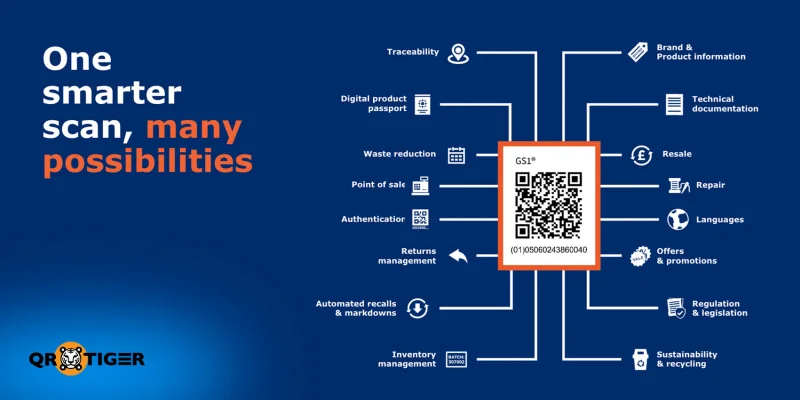
Traditional barcodes carry one piece of information: a product ID. A GS1 Digital Link QR code carries that same ID, plus a web address. That address becomes a gateway.
One scan from a shopper's phone opens up a world of possibilities, such as:
- Product details
- Allergen info
- Sustainability data
- Promotions
- Traceability
- Recycling instructions
- Digital product passports
The list goes on. Retailers get inventory management and automated markdowns from the same code. One physical label with multiple digital destinations. The technical term for this structure is GS1 Digital Link syntax.
It's a standardized URL format. This means the QR code works at the point of sale for checkout, and also works on a consumer's phone for product storytelling. Both, simultaneously. No compromise needed.
The structure of a GS1 Digital Link URL includes a domain, a primary identification key like GTIN, optional key qualifiers like product variant or batch number, and additional data attributes like expiry date or serial number.
That serial number, in particular, gives each individual pack a unique identity. This enables full supply chain traceability from production to the consumer’s hands.
What UK brands are already doing with it
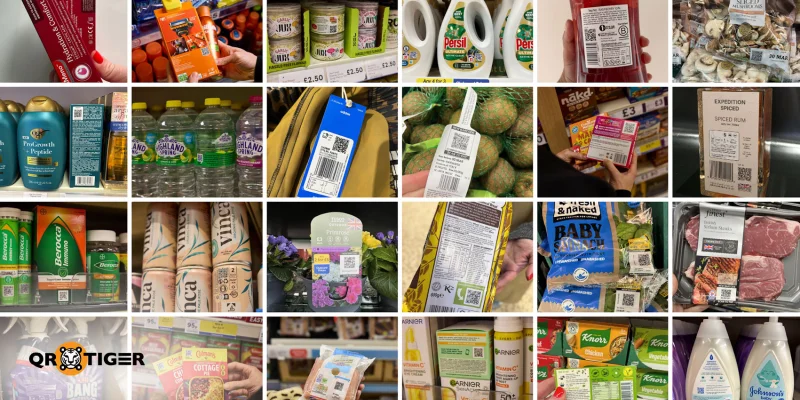
Tesco
One of the most prominent early adopters in the UK. Tesco is the first retailer in the UK to remove the traditional barcode from several of its own-label products, replacing it with a single GS1-powered QR code.
According to Isabela de Pedro, Supply Chain Development and Change Director at Tesco, their team has been testing how GS1 QR codes can help with traceability, strengthen compliance, support sustainability, and shelf-edge communication.
Kenvue
They took a different angle; they added GS1 QR codes to products like Listerine, Johnson’s Baby Shampoo, and OGX Pro Growth + Peptide Shampoo.
Shoppers scan and instantly add items to a digital basket. It bridges physical retail and e-commerce without asking the consumer to do extra work.
Little Bobby Jebb
They added GS1 QR codes linking to digital product pages and brand content. The codes connected packaging directly to online channels.
As a result, their packaging became an engagement platform, featuring flexible, updatable content that provided real insights into consumer behavior.
Creative Nature
They used the QR codes to communicate allergen information. For allergy-sensitive consumers, trust is everything. A scannable, transparent, always-updated label does more than packaging alone ever could.
Blenheim Palace
In a surprisingly elegant use case, they applied GS1 QR codes to reusable cups. Customers scan to return. The system tracked usage, returns, and behavior.
The return rate hit 94% — not just sustainability, but an actual impact, measurable and repeatable.
Why this matters for your business
If you sell physical products, you already deal with barcodes. The shift to 2D barcodes like QR codes is not a distant trend. The industry is moving toward a 2027 readiness milestone for point-of-sale scanning.
Dual marking, meaning a traditional barcode alongside a QR code, will be the norm during the transition period.
You can drop the traditional barcode only when all your retail partners are ready to scan QR codes. That timeline differs by retailer; larger retailers like Tesco are already ahead, while smaller independent retailers may take longer.
The practical advice from GS1 UK: start having those conversations with your retail partners now so you can plan accordingly.
And this isn’t just for large enterprise brands. As Camilla Young said during the webinar, GS1 QR codes actually open up a channel that smaller brands didn’t have access to before.
Big brands spend heavily on in-store displays and media. Smaller brands now have a direct digital connection to consumers, the ability to collect engagement data, and a way to build trust, all from one GS1 QR code on the pack.
The even better news: certified as a solution partner of GS1 US, UK, and Singapore, QR TIGER gives businesses direct access to a GS1-approved Digital Link QR code generator.
Sign up now, create up to three GS1 QR codes for free, and start testing today.
More insights from the QR TIGER X GS1 UK webinar
Camilla Young, Programme Lead for the Next Generation of Barcodes at GS1 UK, shares her expert take on the most important questions from businesses in various industries who are yet to or are already using GS1 QR codes:
Is shifting to 2D barcodes mandatory?
No, GS1 does not mandate the use of its standards. That said, many major retailers already require GS1 compliance from their suppliers for interoperability reasons. Whether individual retailers will mandate the shift in the future is their call, not GS1’s.
Can I add my logo to a GS1 Digital Link QR code?
Yes, but with conditions. The logo must meet specific size and ratio requirements to keep the code compliant and scannable.
GS1 UK recommends working with an approved solution partner, such as QR TIGER, to ensure your customization remains within standards.
Do we need new systems or software to support this?
It depends on what you already have and what you want to achieve. If you’re adapting an existing QR setup to include GTIN and comply with GS1 standards, the change is relatively small.
If you want full traceability across the supply chain, you may need more significant system upgrades.
How do I choose the right GS1 member organization to get my GTIN?
You can join any GS1 organization around the world. GS1 UK recommends joining the one in your local market, specifically where products are created or where your business is most prominent.
It’s worth comparing services across different GS1 organizations before deciding, as not every GS1 organization offers the same range of services. Costs and available services are typically listed openly on each GS1 website.
If I have five products, do I need five QR codes?
Yes, one QR code per product. But the point is that each code does multiple jobs. You don’t need separate codes for separate use cases. One code handles traceability, consumer engagement, promotions, and more.
The only exception is if local regulations in your market restrict a QR code to a single purpose.
Why do I still need dual marking after 2027?
Because not every retailer will be able to scan QR codes by 2027. You can only remove the traditional barcode when all your retail partners have the capability to scan QR codes.
If you supply a mix of large grocery retailers and smaller independent shops, the smaller ones may take longer to transition. The key is to think about the smallest retailer you supply. If they cannot scan the QR yet, the barcode stays.
How long will the dual marking strategy last, and when can I print only the 2D barcode?
There is no fixed date. GS1 does not mandate a deadline for removing the traditional barcode. The point where you can print only the QR code is when every retail partner you supply is ready to scan it.
Some retailers will get there sooner than others. GS1 UK's advice: open that conversation with your retailers now so you can align your packaging timeline with their readiness.
Is the GS1 Digital Link QR code accepted for healthcare products?
It depends on the regulation. Some healthcare products are required by law to carry a 2D data matrix code rather than a QR code.
If your product falls under that regulation, QR may not be the right option. If it's sold on a standard retail shelf outside that regulatory requirement, a GS1 QR code is likely fine. Check the rules in your specific market.
Is this only for large enterprise brands?
No. GS1 QR codes are for businesses of all sizes. As Camilla Young pointed out, smaller brands often have limited options for reaching consumers in-store compared to larger brands with bigger marketing budgets.
A GS1 QR code changes that. It gives smaller brands a direct digital channel to consumers, the ability to collect engagement data, and a way to build trust through transparency. The entry point is low, and the opportunity is open to everyone.
Can this work for logistics and shipping?
It can, but it may not always be the best fit. In logistics, where consumers aren't scanning the code, a data matrix or RFID may be more practical.
QR codes shine where consumer scanning is part of the experience. If you do go down the QR route for logistics, make sure every party along the chain has the capability to scan it.
Want more insights on GS1 Digital Link QR codes in other countries? Browse our webinar recaps for expert perspectives from GS1 organizations across the globe.
The bottom line
The traditional barcode served commerce well. But the next generation demands more from a label. GS1 Digital Link syntax turns a simple scan into a full data exchange.
- For brands, it means richer consumer engagement.
- For retailers, it means smarter operations.
- For consumers, it means more transparency.
The infrastructure is here, the standards are set, and the early movers are already ahead. The only question is where your brand stands.