Exploring NCAA Division I Football Bowl Subdivision Games
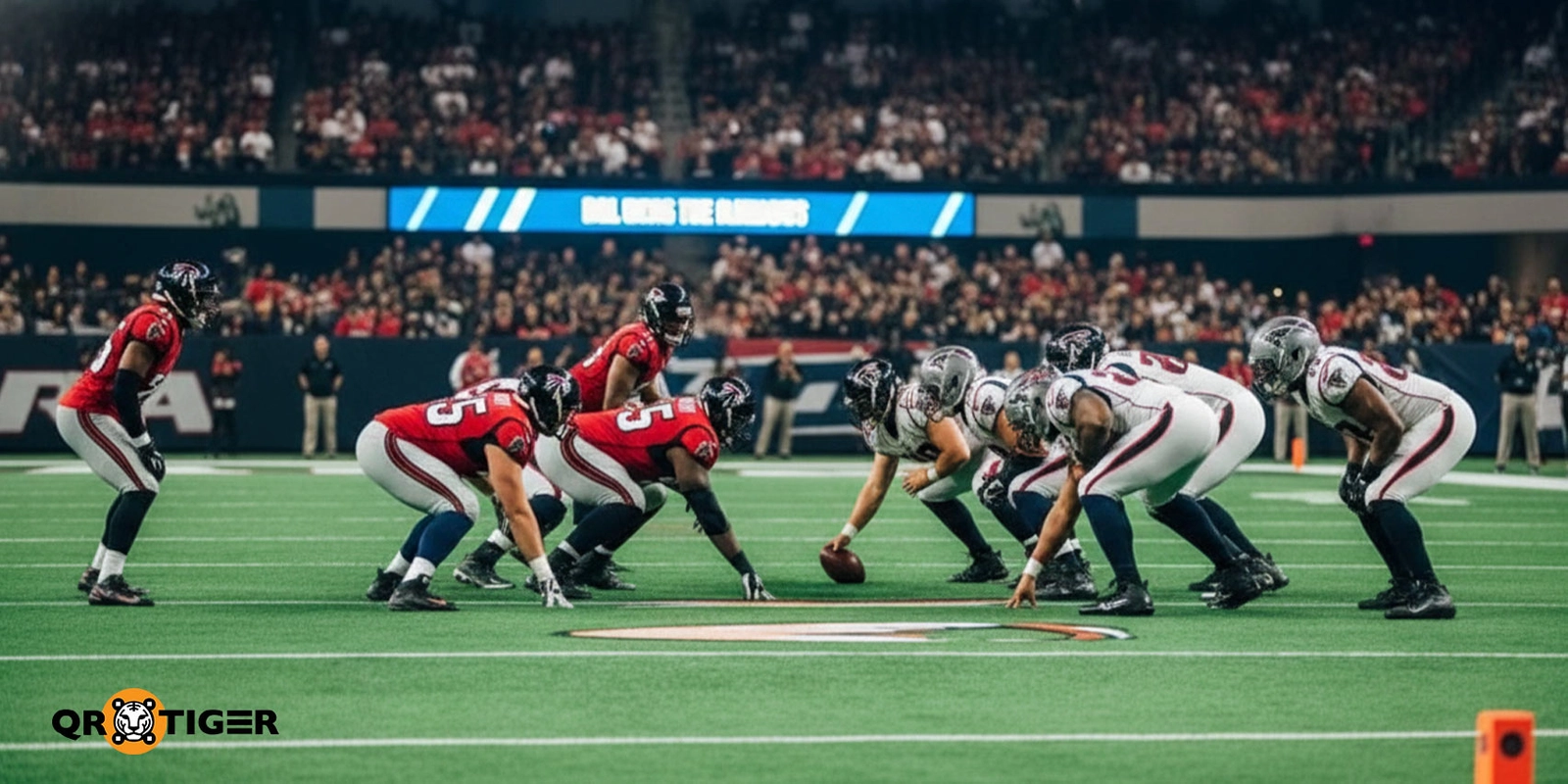
You know the pressure and tension are real when college football goes to Division I.
To many Americans, football isn’t just a sport. Legendary moments define the culture, and fiery rivalries keep all eyes glued to the field (or the screen).
And at the NCAA Division I Football Bowl Subdivision, you know things will get intense. The highest level of collegiate football, where the best of the best clash against each other.
What makes the FBS so different? How do the best teams make it to the very top? Whether you’re a football enthusiast or a novice, this article will guide you through every bit.
Table of Contents
- What is FBS (Football Bowl Subdivision)?
- History and evolution of the NCAA Division I Football Bowl Subdivision (FBS)
- How the NCAA Division I Football Bowl Subdivision works
- Integrating QR codes in the NCAA Football Bowl Subdivision
- Intriguing uses of QR codes at NCAA football playoffs
- Give your sports events a kick with the best QR code generator
- FAQ
What is FBS (Football Bowl Subdivision)?
The National Collegiate Athletic Association (NCAA) Division I Football Bowl Subdivision (FBS) is the highest level of college football in the United States.
Formerly known as Division I-A, Division I schools have the budget and the facilities to support their athletes. It also offers student-athletes a share of the revenue earned by their school’s athletic department.
Unlike Division I, Divisions II and III consist of smaller schools that offer fewer athletic scholarships (or, in the case of Division III, no athletic scholarships at all; only academic scholarships) to their student-athletes.
Did you know? A dynamic football QR code can be used to share all the information available about the FBS. From games to promotions, more eyes can be drawn to football with only a scan.
History and evolution of the NCAA Division I Football Bowl Subdivision (FBS)

The NCAA was founded in 1906 to regulate college sports rules and protect young athletes. However, its origins can be traced back a couple of years.
In the early 1900s, football was seen as a brutal sport. In fact, the 1904 season saw 18 deaths and 159 serious injuries in the field alone.
Additionally, teams were often filled out by players hired by the school, which gave an advantage to any college that could afford to hire the best players.
These factors contributed to calls for the reform or abolition of collegiate football, prompting President Theodore Roosevelt to ask athletics leaders from some of the top football schools to reform the sport at the collegiate level.
This ultimately led to the creation of the Intercollegiate Athletic Association of the United States (IAAUS), the precursor to the NCAA, on December 28, 1905.
Here is a timeline of events since the founding of the IAAUS:
- The IAAUS was constituted as a rules-making body on March 31, 1906.
- The IAAUS was renamed to the National Collegiate Athletic Association (NCAA) in 1910
- In 1935, the Heisman Trophy was presented for the first time.
- In 1965, the NCAA voted to allow the platoon system, in which different players played on offense and defense.
- In 1968, the NCAA began allowing freshmen to compete in games.
- In 1975, the NCAA voted to limit the number of athletic scholarships each school could offer.
- In 1968, the NCAA required all teams to identify as members of either the University Division or the College Division.
- In 1973, the NCAA was divided into three divisions.
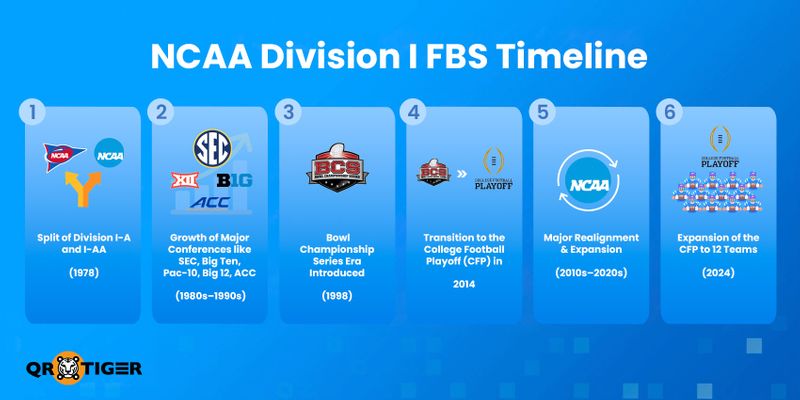
- In 1978, Division I-A was formed. The remaining teams in Division I formed Division I-AA, which would eventually become the NCAA Division 1 Football Championship Subdivision (FCS).
- In the 1992 season, the SEC split into divisions and played the first FBS conference championship game.
- In 1998, seven conferences formed the Bowl Championship Series (BCS).
- In 2014, the College Football Playoff was formed to replace the BCS.
- In 2021, the Supreme Court declared that restrictions on name, image, and likeness compensation are a violation of the antitrust law. This allowed players in the FBS to make money from sources other than college scholarships.
How the NCAA Division I Football Bowl Subdivision works

A lot went into the creation of a regulatory organization for college-level football. With such a long and rich history, many things have changed when it comes to being in the FBS.
We’ve broken down how things are working at the highest level.
Membership in the NCAA Football Bowl Subdivision
For a school to join and remain in the FBS, it must meet the following requirements:
- Sponsor at least 16 varsity intercollegiate teams.
at least six men’s or co-ed teams
at least eight all-female teams
- Offer at least 200 athletic scholarships (or spend at least $4 million on athletic scholarships) per year.
Football teams must provide at least 90% of the maximum number of football scholarships (which is 85 as of 2025).
However, this is all expected to change between 2027 and 2028. First, the minimums for the total number of athletic scholarships will increase to 210. The annual spending requirement will also be increased to $6 million.
Additionally, FBS programs must provide at least 90% of the maximum number of scholarships across a total of 16 sports, instead of just football.
NCAA Division I Football Bowl Subdivision teams and conferences

We’ve mentioned the term “conferences” several times, but what are they exactly?
Because the FBS has more than a hundred teams, there must be a way to organize them all. A conference is a group of schools that agree to compete against each other on a regular basis.
Member schools are often located in the same area and share a common history, which makes it easier to schedule matches and create rivalries.
Conferences often have their own rules while still adhering to the NCAA’s rules. They also schedule games their way and determine their own champions. These champions then go on to play in the College Football Playoffs.
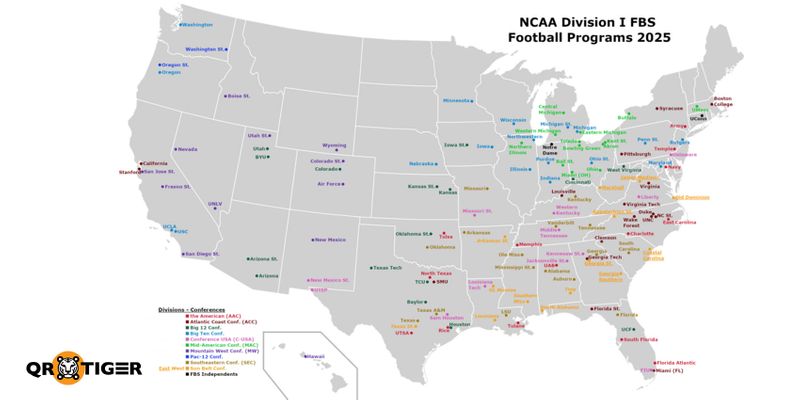
As of 2025, there are 10 conferences and 136 NCAA Division 1 football teams.
💡Did you know? Whether you are trying to share conference match schedules or the latest local rankings, a QR code for multiple links can be used to share that information easily.
The structure of an FBS season
The FBS season typically begins in late August or early September and concludes in mid-January with the College Football Playoff National Championship game.
During the season, teams can expect to play 12 regular games, with eight or nine of those games against conference opponents.
To determine a winner for every conference, all active conferences hold a championship game. Twelve teams are then selected to compete in the College Football Playoff, which culminates in the College Football Playoff National Championship.
Outside of the NCAA football playoffs, other teams are invited to exhibition games, otherwise known as bowl games.
Integrating QR codes in the NCAA Football Bowl Subdivision

Football season is a very intense time for most sports fans, so any method of communicating needs to be instant and convenient to keep everyone in the game.
Fortunately, football games today offer several opportunities to do so with quick-response (QR) codes.
Whether it’s college football or any other conference, subdivision, or division, integrating QR code technology into the game is possible in many different facets.
One of these is using a QR code ticketing system for game events, sports merchandise campaigns, players’ jerseys, and more. Learning how to use QR codes on tickets is simple enough, with many examples available across industries.
For fan clubs that want to support their favorite NCAA Division I Football Bowl Subdivision team, QR codes for sporting events can offer advanced solutions to boost fan engagement, organize pep rallies, and attract more fans through a range of activities.
Otherwise, brands can run QR codes on TV commercials to help sponsor players’ needs to play even better in their next games.
The great thing is that the versatility of QR codes—whether implemented online or offline—can unveil many creative possibilities and applications to make college football events a major success.
Intriguing uses of QR codes at NCAA football playoffs
Some college football teams have already made the first steps in using them to promote their athletes and gather support from their fans.
Here is how these Division I universities leveled up the field through QR code technology.
Oklahoma State University QR code on helmets

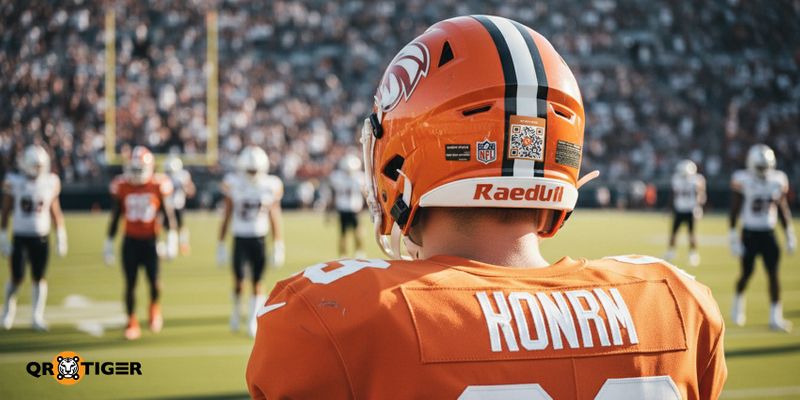
Back in 2024, Oklahoma State University (OSU) debuted its players’ QR code helmets. Covering an area of 1.5 square inches, these QR codes link fans to a general team fund, to which they can make donations.
Through this application of a dynamic QR code generator online, OSU hoped to keep its team supported even during games.
While the NCAA has blocked this move due to the QR codes being considered advertising or commercial marks, the inclusion of QR codes on player helmets and merch demonstrates the versatility and practicality of the technology, even in football.
Jacksonville State football team QR code for Digital Gameday
In 2023, the Jacksonville State football team made changes to the Burgess-Snow Field in preparation for its match against the UTEP Miners. One of these changes was the addition of QR codes in different areas of the stadium.
These QR codes are embedded with a link to the team’s Digital Gameday Information Hub, where attendees can access up-to-date information on the competitors.
⭐Best tip: Serving food during the playoffs? Deploy QR code menus throughout the stadium to make snacking convenient during the game!
University of Central Florida QR code jerseys
Another way to leverage player name, image, and likeness (NIL) through QR codes was innovated by the University of Central Florida (UCF) in 2022. In place of X usernames or roster numbers, the university added QR codes to its players’ football jerseys.
When scanning a player’s QR code, fans would be directed to the player’s online bio pages, social media platforms, and branded merchandise. Through this strategy, student-athletes can establish a name for themselves early in their careers while boosting the sales of their branded merchandise.
Give your sports events a kick with the best QR code generator
QR codes can do wonders for sporting events, such as the NCAA football games, proving their versatile functions and limitless applications.
Aside from crowd management and ticketing systems, it can help fans connect with their idol players, aid in emergencies, and increase revenues for sports organizations and retailers.
If you unlock the brightest way of using QR codes during NCAA Division I Football Bowl Subdivision events, you can surely enhance fans’ experience during game days.
Get acquainted with the best QR code generator, QR TIGER, with top-of-the-line specs and features you can use to produce high scan rate QR codes for your game days.
Sign up today and kickstart your journey in the world of QR codes.

FAQ
How many teams are in the Football Bowl Subdivision?
As of 2025, the NCAA Division I Football Bowl Subdivision has 10 conferences and 136 schools.
What is the difference between FBS and FCS schools?
The difference between FBS (Football Bowl Subdivision) and FCS (Football Championship Subdivision) is that the former is the highest level of Division I football. FCS, on the other hand, is the second tier.
How do NCAA football playoffs work?
The College Football Playoff selection committee ranks the top 25 teams at the end of the regular season.
The five highest-ranked conference champions and the subsequent seven teams with the highest College Football Playoffs ranking will be seeded into a 12-team bracket based on the final ranking.
Among these teams, four of the highest-ranked teams automatically advanced to the quarterfinals.