Pakistan Rolls Out QR Codes on National ID Cards, Replaces Microchips

PAKISTAN — The National Database and Registration Authority (NADRA) launches QR code-based verification for its National Identity Cards (NICs) and Pakistan Origin Cards (POCs) on February 24, 2026.
The amendments to the National Identity Card Rules, 2002, and the Pakistan Origin Card Rules, 2002 define the Quick Response (QR) codes as a “secure, machine-readable, two-dimensional barcode capable of storing encoded information and converting it into usable identity verification data when scanned.”
These replace the microchips that the NICs and POCs currently have to store information.
The NADRA aims to strengthen authentication across digital services, expand biometric recognition, and update card formats for citizens with the new Pakistan QR code national ID cards.
Table of Contents
A move toward a faster and foolproof system
The integration of a QR code generator will significantly improve the NADRA ID card system by supporting interoperability with the country’s National Data Exchange Layer (NDEL).
This framework allows different government organizations to seamlessly exchange data while maintaining security and scalability. It also enables the NDEL to quickly verify citizens' identities while allowing back-end systems to securely confirm the authenticity of the information.
Other benefits of using QR codes, according to the Gazette of Pakistan, include the transparency they provide. By scanning the card's code, information is swiftly read with no manual handling or tampering.
This greatly reduces the risk of fraud or impersonation, further increasing the protection provided to citizens. QR codes are also part of the modernized specimen formats for various ID categories, which now cover:
- resident citizens
- overseas Pakistanis
- child registration certificates
- persons with disabilities
- organ donors
- combined categories
- residents of Azad Jammu and Kashmir (AJK)
Lastly, adding QR codes to the current system eliminates the need for citizens to carry two national ID cards, since one version of the card already includes a microchip.
NADRA also authorizes the adoption of other technologies without the need for additional amendments, ensuring the system can quickly adapt to new developments.
Additional safeguards for citizens
While QR codes form the core of these new changes, NADRA also updates various other aspects of its ID system.
One such improvement is the suspension of ID cards. Due to the risk of data breaches and fraud, any suspended card will be cut off from verification and authentication processes. This ensures that the card isn’t used for malicious purposes, even if PAK ID login details are leaked.
Updates on the biometrics include formal recognition of fingerprints and iris scans, which is a more modern, multi-modal approach to authentication and security.
Senior citizens are also beneficiaries of NADRA’s amendments. According to the Gazette of Pakistan, upon reaching the age of 60, a resident or non-resident citizen will receive a new card that remains valid for life.
These new cards carry the senior citizen logo and are meant to improve the agency’s approach to serving the country’s elderly.
Lastly, AJK residents will now have an inscription on their cards identifying them as “Resident of Azad Jammu and Kashmir”, allowing for proper geographic information to be included in their NADRA CNIC details.
Pakistan’s relationship with QR codes
The QR code improvements to PAK ID tracking are part of the country’s goal toward being digital-first.
Just a month prior, the federal government mandated nationwide QR code payments to reduce cash payments, deter tax evasion, and enforce good documentation practices, thereby aiming to become a “Cashless Pakistan.”
The same move was made by Aik, Pakistan’s first Islamic digital bank, when they enabled fully digital payments at Islamabad International Airport. This action not only provided travelers with a secure payment method but also ensured compliance with Shariah.
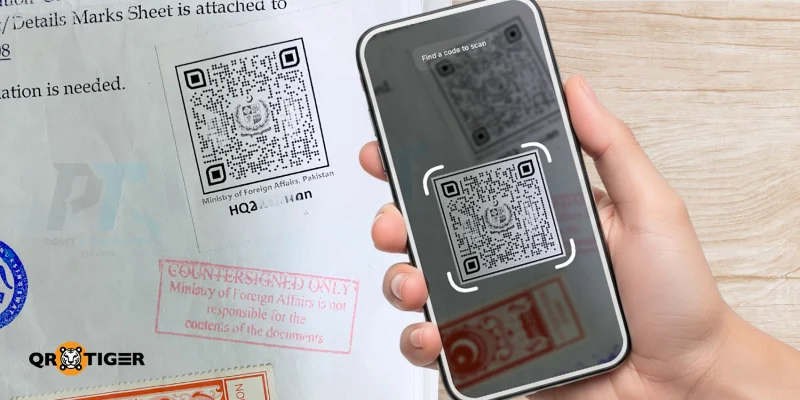
In 2019, the Ministry of Foreign Affairs (MOFA) also launched QR-enabled digital attestation to improve its Consular Services.
QR code technology allows the Ministry to quickly confirm, authenticate, and verify documents, helping curb forgeries and malpractice and creating a paperless environment, which aligns with global sustainability goals.
Additionally, the integration of QR codes on eSIM packages also enables travelers to and from Pakistan. Simply scanning the codes activates the eSIM, eliminating the need to swap SIMs upon arrival.
QR codes for Pakistan’s citizen identification
An organized, efficient system enables any entity to perform its tasks competently. The government of Pakistan recognizes this, hence their implementation of QR codes in a strategic, standardized, and reliable manner.
Should the new and improved QR-powered national ID card system prove effective, Pakistani citizens can expect to be protected from fraud while enjoying smooth identification processes from now on.