Sample QR codes for testing are pre-built QR images you scan with your smartphone to see how each QR code solution works before creating your own.
20+ free scannable examples are available here; Multi-URL, vCard, App Store, and Social Media QR codes are included. Scan each one to see exactly what triggers on the other end.
Every example here was generated using QR TIGER QR Code Generator. A QR code looks identical whether it works or not. The difference only shows up on a live scan, which is why testing before deployment is non-negotiable.
File QR code lets you convert any type of file into a QR code, such as a PDF, Word, PowerPoint, Excel, MP4, MP3, and many others.
In addition, a file QR is a dynamic QR code solution that allows a user to replace or edit the content of their QR code with another file, without reprinting or reproducing a new QR code, saving time and money.
The user can also track their QR code scans with dynamic QR codes, which include a built-in QR code tracking feature.
You can do a dynamic QR code example test scan on the above QR codes and get redirected to file content, contact number, and URL.
To confirm the code works, check that the file loads completely and that the download or preview triggers correctly. If the file stalls mid-load, the issue is usually the hosting server, not the QR code itself.
Best for: Product manuals, portfolios, media kits, and any documents
vCard QR code (Dynamic QR)
A vCard QR code displays your digital contact details on the scanner's screen. The viewer saves your information directly to their phone with one tap, no manual input required.
They can also choose to save your contact information right away to their mobile device, which makes it convenient to maximize your contacts on the spot.
Scan the sample vCard QR code template above to see a live digital contact card. Confirm the name, phone number, email, and any social links all fill in correctly. Missing fields point to a data entry issue in the generator, not a scan failure.
vCard QR codes let you update contact details after printing. For anyone whose role, number, or email changes over time, the dynamic format avoids reprinting costs.
Best for: Business cards, networking events, resumes, and email signatures
URL QR code (Static or Dynamic)
A link QR code solution converts any web address into a scannable QR code. Static versions are free, but the destination is fixed from the moment they are generated. Dynamic versions are editable and include scan tracking.
Test your URL QR code across at least two scanner apps. Some handle redirects or long URLs differently. Also, confirm the destination loads on mobile.
Most scans happen on a phone, not desktop, so a page broken on mobile is a failed deployment regardless of how clean the QR code itself looks.
Best for: Landing pages, online catalogs, and promotional campaigns
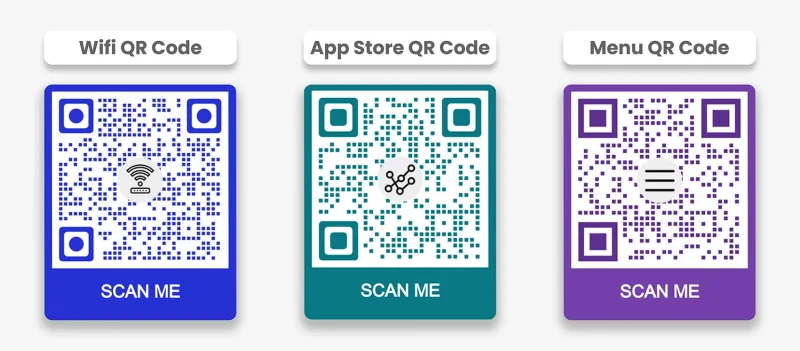
WiFi QR code (Static QR)
A WiFi QR code connects the scanner directly to your network without typing a password. Scan once and the connection triggers automatically.
WiFi QR codes are static. The network credentials are fixed at generation. If your network password changes, you need a new QR code.
Test on both Android and iOS. Android 10 and later and iOS 11 and later both support native WiFi QR scanning through the default camera.
Older devices require a dedicated QR code scanner app. Skipping this cross-device check is the most common reason WiFi QR codes fail in the field.
Best for: Restaurants, hotels, offices, and event venues
App Store QR code (Dynamic QR)
App Store QR code sends the scanner straight to your app listing in Google Play or the Apple App Store.
The dynamic version detects the device OS and redirects accordingly. One QR code handles both Android and iOS users without extra setup on the scanner's end.
Test on both platforms before publishing. The Android and iOS redirects are configured separately.
A misconfigured redirect sends half your audience to an error page. Scanning once on one device and calling it done is not a complete test.
Best for: App launches, product packaging, and marketing materials
Menu QR code (Dynamic QR)
Menu QR code solution enables you to create a digital menu QR code for your restaurant. To do this, you can upload the image file of your menu or the PDF file of your menu.
Test the menu display across multiple phone screen sizes. A PDF layout clean on one device sometimes breaks on another. Confirm the file loads fully on a mobile connection, not only on WiFi.
Best for: Restaurants, cafes, bars, and food stalls
Social Media QR code (Dynamic QR)
A social media QR code or a link page QR code links all of your social media platforms and online resources into one QR code. This displays all your social media profiles and online resources when scanned.
After generating, scan the code and confirm every linked profile opens correctly. Also scan in different lighting conditions to verify the QR code platforms consistently.
A social media QR code placed in print at an event needs to work under stage lighting, dim overhead lights, and direct sunlight.
Best for: Influencers, brands, and businesses
MP3 QR code (Dynamic QR)
An MP3 QR code plays an audio file or a podcast once the QR code is scanned. You can create your own MP3 QR code with QR TIGER to instantly share your music or soundtrack.
Test audio playback on both WiFi and mobile data. Files buffering poorly on slower connections make users assume the scan failed.
If playback takes more than three seconds to start, check the file size and hosting response time.
Best for: Album releases, podcast promotions, and audio sharing
Pinterest QR code (Static or Dynamic QR)
Pinterest QR code redirects scanners to your Pinterest profile or board. Static versions are free to generate but locked once created. Delete or change the linked page, and the code leads nowhere.
With a dynamic QR, the destination stays editable even after the QR code is printed and distributed.
Test on a device where Pinterest is not already running in the background. Some phones auto-launch the Pinterest app instead of opening a browser link. Both experiences need to work correctly, because your audience comes from both.
Best for: Creators, bloggers, and brands
Instagram, YouTube, Facebook, TikTok, and Twitter QR codes (Static or Dynamic QR)
Individual social platforms for QR codes point directly to one specific social media page. They differ from the Social Media QR code, which links everything into a single landing page.
Use individual platform codes when the goal is to grow one specific channel.
Use the Social Media QR code when distributing attention across multiple platforms.
Social media platforms sometimes change their URL formats. When that happens, older QR codes linking to those URLs stop working.
The QR code still scans, but the destination is invalid. So testing after generating confirms the link still works at the time of deployment.
Best for: Brands, influencers, and creators
Text QR code (Static QR)
A text QR code displays a plain text message when scanned. No internet connection is required. The message appears directly on the scanner’s screen.
QR TIGER’s text QR code generator supports words, numbers, punctuations, and emojis, up to 1,268 characters.
Keep the message short. Longer text creates a denser, more complex QR code; dense QR codes are harder to scan from a distance or under poor lighting.
Text QR codes are static, so the message is fixed after generation. Choose this type only for information that will not change.
Best for: Instructions, short announcements, and offline messages
Email QR code (Dynamic QR)
An email QR code opens a pre-addressed email draft on the scanner’s device. The recipient address is pre-filled; the user writes the message and sends.
This removes friction in situations where someone needs to contact you quickly: customer feedback, support requests, and event follow-ups all benefit from this format.
Test on both iOS Mail and Gmail before deploying. Different email clients handle the pre-fill differently, so confirm the address fills in correctly. A blank address field means the email goes nowhere.
Best for: Business cards, resumes, business materials
H5 Editor QR code (Dynamic QR)
H5 Editor QR code allows you to create a webpage or customized landing page readily optimized for mobile users. This is the best alternative if you don’t have online information/website for your products or services.
For businesses planning to scale their QR code campaigns with a permanent web presence, you'll eventually need your own domain.
Best for: Businesses and individuals that need custom, mobile-optimized pages
Multi URL QR code (Dynamic QR)
A Multi URL QR code supports five redirection types: Language redirection, Time redirection, Number of scans redirection, Location redirection, and Geo-fencing redirection.
Language redirection
Using the Language Redirection feature of the Multi URL QR code redirects scanners to different languages using one QR code.
Time redirection
The time redirection feature redirects scanners to a different destination based on when they scan. Morning, afternoon, or evening, each time window points to a separate URL.
This works well for time-sensitive campaigns, rotating promotions, or any situation where the relevant content changes throughout the day.
Number of scans redirection
Once a set scan count is reached, the QR code switches to a new destination automatically. The first batch of scanners lands on one page; everyone after lands on another.
This suits limited-time offers, early access campaigns, or any promotion where the message changes after a certain number of people have responded.
Location redirection
These QR codes can redirect on the basis of location and geographical position.
A user in New York and a user in London scan the same code but land on region-specific pages. This removes the need to create separate codes per region.
Geo-fencing redirection
Geo-fencing takes location redirection a step further. Instead of redirecting based on a broad region, the QR code only works within a defined physical boundary.
Scanning inside the boundary shows the intended content correctly, but if you’re outside, it either shows a different page or restricts access entirely.
Test geo-fence on-site before the event or promo. A boundary set too tightly misses scanners standing just outside the designated area.
Confirm the fence radius covers the intended space correctly.
Best for: Global campaigns, time-sensitive promotions, exclusive location-based offers, and businesses targeting audiences across multiple regions or languages
GS1 Digital Link QR code (Dynamic QR)
A GS1 Digital Link QR code is a product-grade QR code built on the GS1 standard, the same global system used for barcodes on retail packaging. It stores a product identifier, typically GTIN, and links it to a web-based destination carrying product information.
Unlike standard URL QR code, a GS1 Digital Link encodes structured data directly into the URL itself. One code carries the product ID, batch number, expiry date, and destination link simultaneously.
Scanners at retail checkout, supply chain checkpoints, and consumer-facing packaging all read the same code differently depending on what they are looking for.
This is the format retailers, manufacturers, and healthcare distributors use when a QR code needs to serve both operational and consumer-facing purposes at once.
Test across multiple scanning environments. A point-of-sale scanner, a smartphone camera, and a logistics reader each extract different data layers from the same code. Confirm each use case resolves correctly before committing to a print run.
Best for: Retail packaging, supply chain management, healthcare products, and any industry that requires product-level traceability
Video QR code (Dynamic QR)
A Video QR code links directly to a video file and plays it on the scanner's device upon scanning. No app download needed; the video streams through the phone browser.
This works well for product demos, tutorials, event recaps, or any content where showing is more effective than telling. Dynamic versions let you swap the linked video without reprinting the code, which is useful for campaigns that rotate content over time.
Test playback on both WiFi and mobile data. Large video files buffer poorly on slower connections.
If the video takes more than three seconds to start, check the file size and hosting response time. Also, confirm the video displays correctly on both Android and iOS before deploying.
Best for: Product demos, how-to content, and event recaps
SMS QR code (Static QR)
An SMS QR code opens a pre-addressed text message draft on scanner’s device. The recipient number is pre-filled; the user writes the message and sends.
This works well for customer support lines, appointment confirmations, or any situation where a text is faster than an email. No internet connection is required to trigger the message draft.
Test on both Android and iOS. The two platforms handle pre-filled SMS differently depending on the OS version. Confirm the number fills in correctly and the message app opens without errors before deploying.
Best for: Receipts, packaging inserts, and signages
Google Form QR code (Static or Dynamic QR)
A Google Form QR code gives scanners direct access to forms without needing a URL, a search, or a shared link.
This is practical for event registrations, surveys, feedback collection, and order forms. Any situation where you need responses from a physical audience benefits from this format.
Test the form on mobile before printing the QR code. Google Forms renders differently on small screens depending on the question types used. A form that looks clean on desktop sometimes stacks awkwardly on a phone.
Best for: Surveys, feedback, posters, booth displays, and signages
Event QR code (Static QR)
An event QR code stores event details, including the name, date, location, and description. Scanning it adds the event directly to the scanner’s device calendar.
No app download is needed. The event data transfers through the native calendar on both Android and iOS.
Test on both platforms. Android and iOS calendar apps accept the event data format differently. Confirm the data, time, and location all fills in correctly. A wrong timezone or missing venue detail turns useful QR code into a scheduling problem.
Best for: Event tickets, printed programs, and promotional flyers
Location QR code (Static QR)
A location QR code links to a specific address or set of coordinates in Google Maps or Apple Maps. Scanning it opens the location directly in the device’s default map app.
This is different from the location redirection feature inside the Multi URL QR code. A location QR code is purely for sharing a physical place. Restaurants, event venues, retail stores, and delivery drop-off points are common use cases.
Test on both Android and iOS. Android defaults to Google Maps and iOS defaults to Apple Maps. Confirm the pin drops at the correct address on both.
A misplaced pin sends someone to the wrong building, which is the kind of mistake QR code testing exists to catch.
Best for: Retail stores, restaurants, event venues, and any businesses that need direct foot traffic
What affects QR code scan reliability
Here are a few technical factors that determine how reliably a QR code performs in real-world conditions.
Error correction levels:
Every QR code has one of four correction levels: L, M, Q, or H.
Level L tolerates up to 7% data loss while level H handles up to 30%.
Higher levels produce denser, more complex codes that are harder to scan from a distance.
For printed materials or outdoor displays, Q or H is the safer choice.
Color contrast:
Dark modules on a light background is the standard for a reason.
A contrast ratio below 4:1 between module color and the background causes scan failures in variable lighting conditions.
Print a test copy before committing to a production run. Screen testing alone does not catch this.
Versions:
Each QR code version determines the code's size and how much data it holds. Version 1 is the smallest; Version 40 is the largest and most data-dense.
Higher versions store more data but produce denser, harder-to-scan patterns.
Shorter URLs and learner data inputs result in simpler, more reliable QR codes.
Create custom-made QR codes with QR TIGER QR Code Generator today
Every QR code solution serves a different purpose. The best way to know which solution fits your use case is to scan the examples, test the behavior, and build from there.
Ready to generate your own? QR TIGER covers all QR code solutions. Create a free account and start testing static or dynamic QRs with your own content.
FAQ
Which QR code type has no expiration date?
Static QR codes do not expire. They work indefinitely as long as the destination remains active. Dynamic QR codes, on the other hand, are tied to an active subscription/plan.
Can anyone create a QR code without coding knowledge?
Yes. QR code generator like QR TIGER lets you create both static and dynamic QR codes without any technical knowledge needed.
What program is used to generate QR codes?
QR TIGER is a dedicated QR code generator that covers over 20+ QR code solutions. It runs entirely in the browser and requires no software installation.
Disclaimer
This article is for general informational purposes only and does not constitute legal, financial, or other professional advice. For questions about QR TIGER's products or services, please contact our support team at [email protected].
Frequently Asked Questions (FAQ)
Which QR code type has no expiration date?+
Static QR codes do not expire. They work indefinitely as long as the destination remains active. Dynamic QR codes, on the other hand, are tied to an active subscription/plan.
Can anyone create a QR code without coding knowledge?+
Yes. QR code generator like QR TIGER lets you create both static and dynamic QR codes without any technical knowledge needed.
What program is used to generate QR codes?+
QR TIGER is a dedicated QR code generator that covers over 20+ QR code solutions. It runs entirely in the browser and requires no software installation.
Was this article helpful?
Enterprise Ready
Maximize Scans with the Best QR Code Generator
Join thousands of global brands using QR TIGER to manage dynamic routing, bulk creation, and deep attribution analytics.
Vall, Head of Content, has 5+ years of experience in digital marketing and 8+ years in journalism. With an AB Mass Communication degree, she writes content on marketing and innovations. Her extensive QR code knowledge helps businesses maximize their potential in modern marketing and operations.






jpg_800_21.jpeg "Multi-URL QR code redirections")
jpg_800.jpeg "QR codes for GS1, messaging, and video")
jpg_800.jpeg "QR codes for forms, events, and locations")