
QR Codes in Italy: Popularity, Usage, and Key Brands
 By Ashley P.
The use of the QR code in Italy was primarily to combat the spread of COVID-19, but it has grown to be one of the most essential tools in the country, much like in the entirety of Europe.
More applications of QR codes continue to appear, thanks to the ingenuity of both industry leaders and various governing bodies.
In this article, we take a look at how this beautiful country uses QR codes to its advantage.
Table of Contents
QR code popularity in Italy
QR code statistics before and after COVID-19 show us that 17.8% of mobile users across Europe have scanned a QR code, particularly in retail stores. But in Italy, they do more than just scan retail QR codes.
Quick response (QR) codes, a type of two-dimensional barcodes, are gaining popularity across various sectors in the country.
A 2020 Statista report found that over 30% of museum galleries in Italy use QR codes, while 41% are interested in implementing them in the future.
Italians’ search interest for QR codes has been high since 2021, mostly associated with the roll-out of COVID-19 certifications.
The government is also heavily promoting digital and mobile wallet payments in Italy, which only require QR code scanning, in order to lower fees in payments, an enduring issue in card transactions.
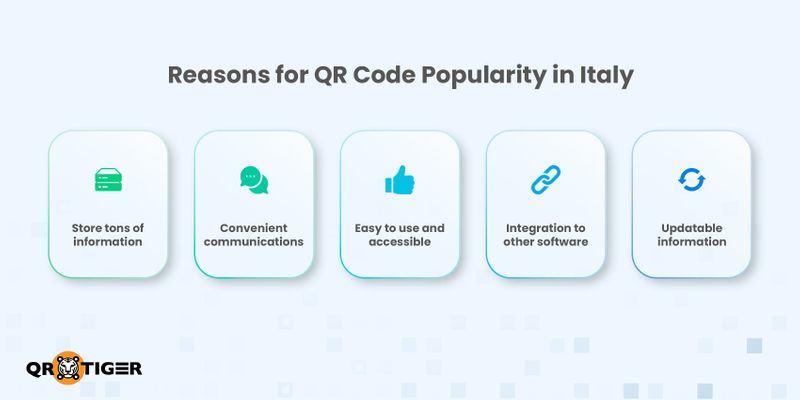
Based on these different QR code applications in the country, a few more reasons can be surmised for their popularity:
- They store tons of information
- They offer convenient communications
- They are easy to use and access
- They can be seamlessly combined with other technologies
- They make it easy to update older information
All of these benefits allow the QR code to be used in creating an efficient system anywhere in Italy.
How Italians use QR codes
QR codes aren’t new in Italy. The country has found different ways to use them effectively that other countries can learn from. Let’s take a look at seven of them.
Company registration
In Italy, information on various businesses can be found in the Italian Business Register, a public register that stores records on companies and sole proprietorships that are registered.
In exchange for registering, establishments can receive the support of their local Chamber of Commerce, which is an institution that promotes both regional and national economic growth.
Information that can be found in the Business Register includes:
- main business data of registered businesses in Italian territory
- records of the establishment, modification, and cancellation of any business
- all modifications done after registration (transfers, liquidations, business activities carried out, etc.)
Requiring a company registration in Italy helps consumers, other businesses, and the authorities verify the legitimacy of any business in question.
To add authenticity to documents from the Business Register, a QR code is added. When scanned, the document identification data, like the company name, registered offices, and tax code, will be displayed on the mobile device.
Tourism management and the Venice Access Fee
Italy is famous for its tourist attractions and landmarks, making it a common destination for travelers. Naturally, parts of the country were bound to find ways to handle the influx of visitors.
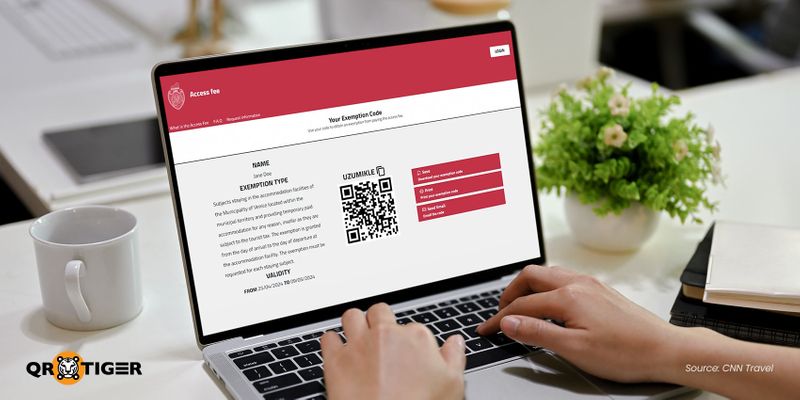
An example of this was the Venice Access Fee. To limit the number of day tourists and support the upkeep of the city, Venetian governing bodies implemented the temporary fee between April and July 2025.
Under this system, visitors will have to register and pay a fee of 10 euros to enter the famous city. Once paid, a travel QR code will be sent via email, which can then be scanned at checkpoints into the city.
Note: The Comune di Venezia (City of Venice) has announced that the access fee is no longer in effect starting from July 28. Changes regarding this rule beyond 2025 will depend on the local government’s decision. Visit the city’s official website for accurate updates.
Digital ticketing on trains
Trains are commonplace all over Europe, and Italy is no exception. Given the existing uses of QR codes in the country, it makes sense that railway companies would also implement QR codes into their ticketing systems.
This is exactly what Trenitalia did with their mobile ticketing system. With the Trenitalia Regional Digital Ticket, travelers can avoid checking in and enter their scheduled train ride.
What’s more, an unlimited number of changes to the departure date and time can be performed before the day of a trip.
It should be noted that showing your Regional Digital Ticket when requested is still mandatory.
Health and safety (Green pass and travel forms)

During the COVID-19 pandemic, the Italian government created methods to combat the spread of the virus, such as requiring people to have a QR code to enter Italy.
The Digital Passenger Locator Form is meant to be filled up by visitors to the country, and provides health authorities with a means of effective contact tracing. And much like the Venice Access Fee, a QR code would be sent to the traveler after submitting the form.
The Italy Green Pass QR code, a digital COVID certificate, was also required for traveling between countries in the European Union (EU). This pass provided proof to authorities that the holder:
- was vaccinated against the COVID-19 virus
- had recently recovered from it
- tested negative within the last 48 hours
While both traveling documents are no longer in use, these use cases demonstrate the QR code’s usefulness in ensuring the health and safety of the country’s citizens.
💡Did You Know? In 2021, well into the COVID-19 pandemic, an Italian man had his Green Pass tattooed on his arm. His QR code tattoo was applied so well that it was enough to get him a seat in a McDonald’s.
Sustainability initiatives (EPREL labels)
Aside from the Italy vaccine QR code, the technology can also act as a storage space for eco-friendly information, something that this new initiative by the EU will show.
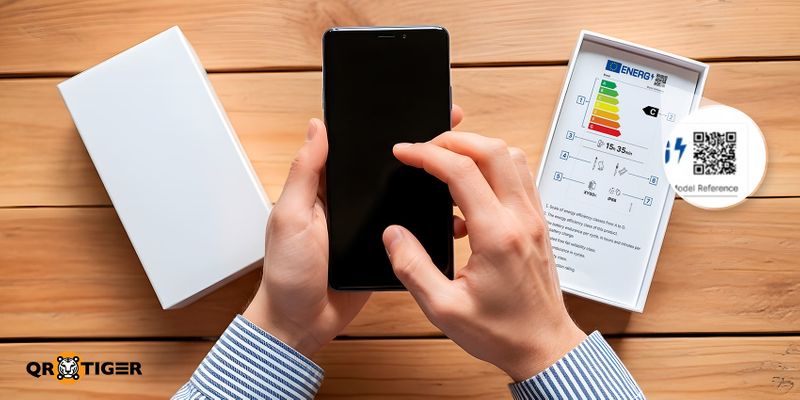
From June 20, 2025, onwards, smartphones and tablets sold throughout Europe will come with EPREL energy labels detailing their environmental impact.
EPREL, or the European Product Registry for Energy Labelling, is a database containing information about the energy efficiency of products sold in the EU.
Included in these labels are QR codes embedded with all the information an eco-conscious consumer would ever want:
- Scale of energy efficiency (from A to G)
- Energy efficiency class of the device
- The battery endurance per cycle(in hours and minutes per full battery charge)
- Repeated free-fall reliability class
- Battery endurance in cycles
- Repairability class
- Ingress Protection rating
Enhancing cultural experiences
Another way Italy uses QR codes is to improve the experience of local and foreign visitors when exploring the country’s art, culture, and history.
Banco di Napoli Historical Archives, for example, has added QR codes to its displays.
With QR code stations placed at specific points along the museum tour, visitors can access audio tracks (in Italian and English) to hear more historical context during their visit.
QR codes can also be used as tourist passes, as demonstrated by Omnia Vatican & Rome. With their OMNIA Smart, a digital pass in the form of a QR code, tourists can visit the following attractions:
- The Vatican Museums
- The Sistine Chapel
- The Mamertine Prison
- The Colosseum, Roman Forum, and Palatine Hill
- The Lateran Palace
Users also get several multilingual audio guides that can be listened to while traveling through the cities.
Supporting cashless payments
QR code payments have also made their way to the Italian peninsula thanks to digital wallets like Apple Pay and Google Pay. QR codes can also be used to pay with prepaid cards or transfer money between banks.
Even the Italian postal service uses QR codes. In 2020, Poste Italiane launched the payment system to support more small businesses in Italy.
Italian brands using QR codes
QR code potential has also been recognized by several of Italy’s biggest brands. Let’s dive into how they use the technology to their benefit.
Damiani
Damiani is an Italian brand known for designing and producing unique luxury jewelry. Hailing from a family with a tradition and passion for goldsmithing, customers can expect only the best jewelry and services.
With their dedication to their craft, the company employed the use of a dynamic QR code generator to better serve their customers.
If jewelry is lost or stolen, buyers can activate a replacement certificate by scanning a QR code that comes with their purchase.
The link embedded in the 2D barcode will redirect to an online form where users can enter the jewelry’s material and equipment code, details that can be acquired from the shipping confirmation e-mail.
Piquadro
Piquadro, an Italian brand recognized for its high-quality leather products, secures its products with its line of Connequ devices. This technology uses GPS and Bluetooth to communicate its location to a smartphone, allowing users to locate their bags easily.
While it is a system that allows Piquadro’s customers to connect their business bags and suitcases, the lynchpin to all of it is the Piquadro Connequ app. Available in both the App Store and the Play Store, manually searching for it on both platforms should be quick and easy. However, Piquadro knows that it can be even faster.
Using both an App Store QR code and a Google Play QR code, Piquadro saves its customers a lot more time by bringing them straight to their app, potentially increasing app downloads.
Banca Sella
In October of 2024, Banca Sella became the first bank to adopt the technology known as TQ Braille.
Designed to help the blind and visually impaired, TQ Braille is a tactile identification tool that uses a QR code frame in Braille font to help make locating QR codes easier.
Through this, a QR code embedded with information on products, services, and initiatives is made more accessible.
Banca Sella uses the QR code to direct users to a webpage or documents that are accessible using screen reader systems like iOS's VoiceOver and Android's TalkBack. This allows the bank to share its offerings and services with visually impaired individuals.
Lunelli Group
Lunelli Group, a major wine brand in Italy, also uses an approved Italy QR code in its products.
In accordance with Regulation (EU) 2021/2117, commonly known as the “EU Wine Regulation,” prosecco brands Bisol1542 and Jeio encoded ingredient and nutritional information into a QR code.
Through these QR codes, the product information can stay up-to-date and accurate whenever changes are made.
Barilla
Barilla, an Italian food company best known for its pasta, partnered with the Be My Eyes organization to assist visually impaired customers when purchasing Barilla’s products.
The company rolled out its new QR codes on select pasta products back in 2022. Unlike Banca Sella’s QR codes, these direct shoppers to a Barilla representative, where they can ask for visual information, such as information on pasta cuts, recipes, or expiration dates.
Additionally, the company has also signed a joint statement from other industry leaders calling for the shift to Digital Link QR code usage across the globe.
Tips for safe QR code usage in Italy
Generally speaking, QR codes are inherently safe. They were first invented for the purpose of storing vehicle component information. However, malicious actors are there to put harmful content in them, placing scanners at risk.
In 2024, the Italian Postal and Communications Police issued a warning regarding the growing threat of QR code insurance scams.
According to their statement, malicious actors would contact citizens and release ads promoting car insurance deals. They would then send victims a message containing a QR code which can be used to pay for insurance.
However, this QR code sends the money to the scammers instead, effectively stealing the money from right under their noses.
Avoiding these kinds of incidents requires constant vigilance and the right kind of knowledge. If you see a suspicious QR code, always do the following:
- Check who is displaying the QR code
- Confirm the existence of the QR code’s owner or the promotion
- Consider where the QR code is being displayed
- Look for signs of QR code tampering
- Evaluate the link shown in the preview after scanning the QR code
By performing these actions, spotting a malicious QR code becomes easier than you think.
Cosa stai aspettando? Generate QR codes from the best QR code generator
Like in the rest of Europe, QR codes have found their place in the Italian peninsula. Government and non-government bodies have implemented the technology in many ways that help the country, while iconic brands use it to improve their goods and services.
The many applications of QR codes in the country serve as an example of seamlessly integrating the technology into existing systems and protocols while also creating new ones.
If you’re feeling inspired, we have a dynamic QR code platform with everything you will need to follow in Italy’s footsteps.
Begin with QR TIGER’s freemium plan and see what dynamic QR codes can do. Sign up today — no credit card information is needed.
FAQ
Can I pay with a QR code in Italy?
Yes, it is possible to pay using a QR code while in Italy. Several payment gateways, from digital wallets like Apple Pay and Google Pay, are available in the country. The Italian postal service has also opened a QR code payment system for Italians and travelers to use.
What is the most popular payment method in Italy?
While payment preferences vary by generation, cash remains the most common payment in the country, especially amongst Italians ages 65 and above. Debit cards, on the other hand, are more popular with locals between the ages of 18 and 24.
This article is for general informational purposes only and does not constitute legal, financial, or other professional advice. For questions about QR TIGER's products or services, please contact our support team at [email protected].
Was this article helpful?
Maximize Scans with the Best QR Code Generator
Join thousands of global brands using QR TIGER to manage dynamic routing, bulk creation, and deep attribution analytics.
Get Started For Free