
vCard QR Code: How to Share Your Contact Information With One Scan
 By Ashley
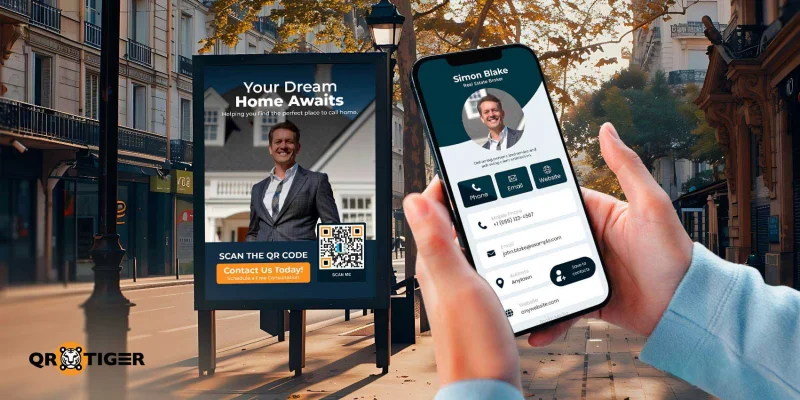
To share your contact information in one scan, create a vCard QR code and put it on your business card, email signature, or phone screen. When someone scans it, their phone opens your details, and they can save them to their contacts in a few taps.
A standard vCard QR code stores your details in the vCard format that phones read as a contact card. QR TIGER’s dynamic vCard opens a mobile page instead, with your photo and social links, and you can edit it after printing.
QR codes already fit most people’s routines. In QR TIGER’s QR Decoded Industry Report 2026, 47% of respondents said they scan QR codes daily or several times a week, and 16% scan them to open digital business cards.
Key takeawaysFollow these steps to share your contact information with a vCard QR code:
|
What is a vCard QR code?
A vCard QR code shares your contact details through the vCard format (.vcf), the standard file type phones and email apps read as contacts. The Internet Engineering Task Force maintains the current version, RFC 6350.
When the QR code is scanned with a smartphone, the details are displayed on a vCard page. The .vcf file is then imported as a contact card on the user’s address book when they choose to save it.
Your new contact skips the typing and the typos.
What happens when someone scans a contact QR code?
The scan takes a few seconds on most phones. Here’s the typical flow:
- The person opens the camera app on an iPhone or Android phone and points it at the code.
- A link preview appears on screen. One tap opens your vCard page.
- Your vCard page shows your photo, name, position, company, contact buttons, and social links.
- Tapping “Save to contacts” opens a Save vCard panel with five options: Save to phone, send to email, send from your email, leave your contact info, and a link to copy.
- “Save to phone” adds your details to their phone’s contacts.
“Leave your contact info” turns the scan into a two-way exchange. If the person taps this option and fills in the form, they share their details with you, so the scan doubles as lead generation, not just a new contact on their side.
How do you create a vCard QR code?
- Go to QR TIGER’s vCard QR code generator online.
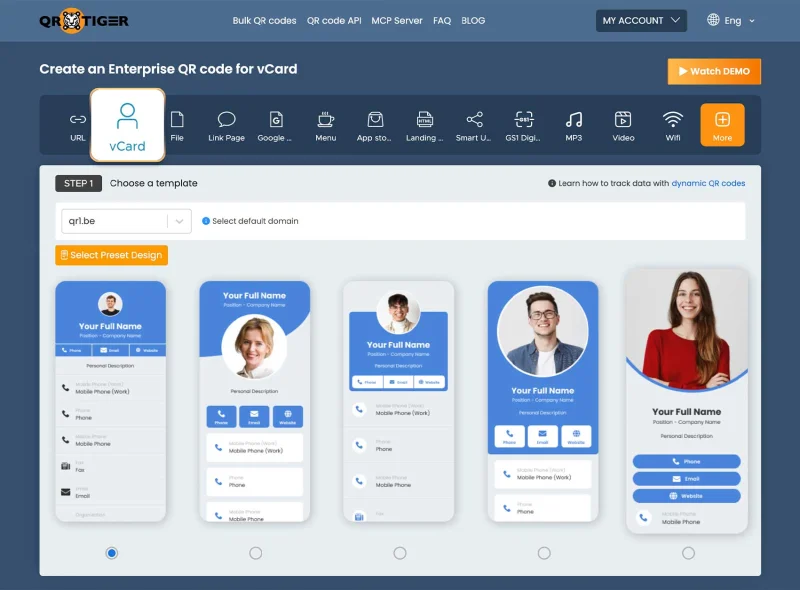
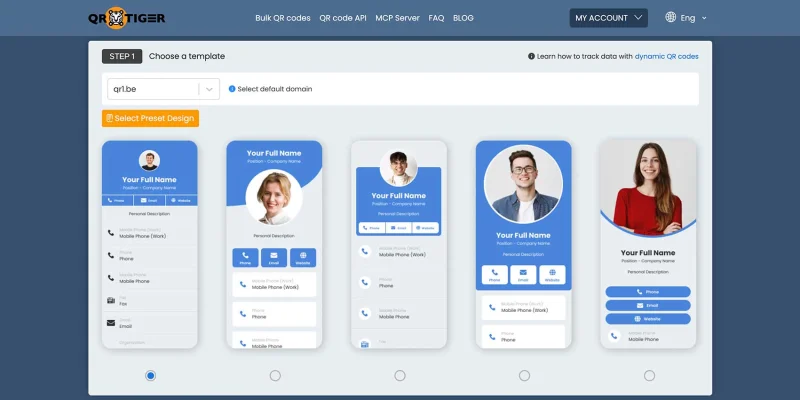
- Choose one of the five vCard templates.
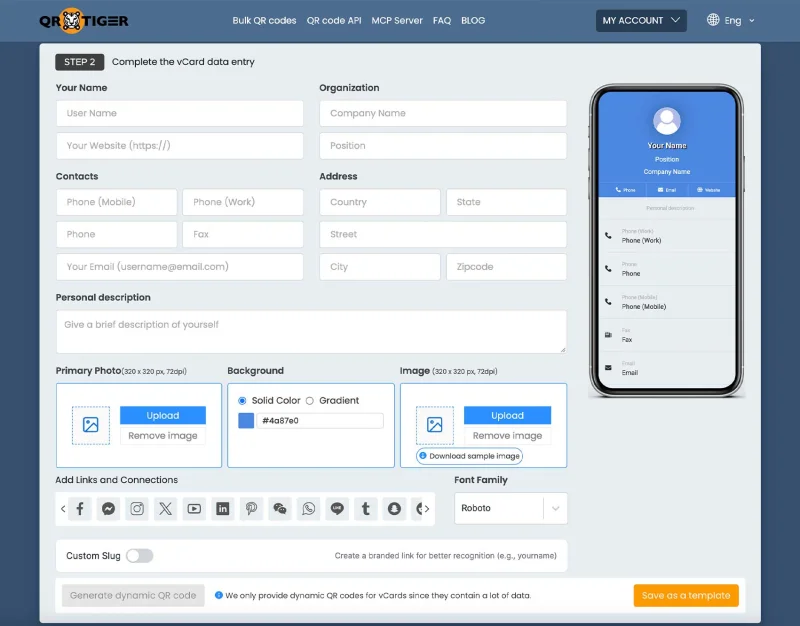
- Complete the vCard data entry: add your name, organization, contact details, address, and a short description. Upload a 320 x 320 px photo, add your social links, and set your background and font.
- Click “Generate dynamic QR code” and customize the QR code with patterns, eyes, colors, a logo, and a frame. Saved templates speed this step for teams.
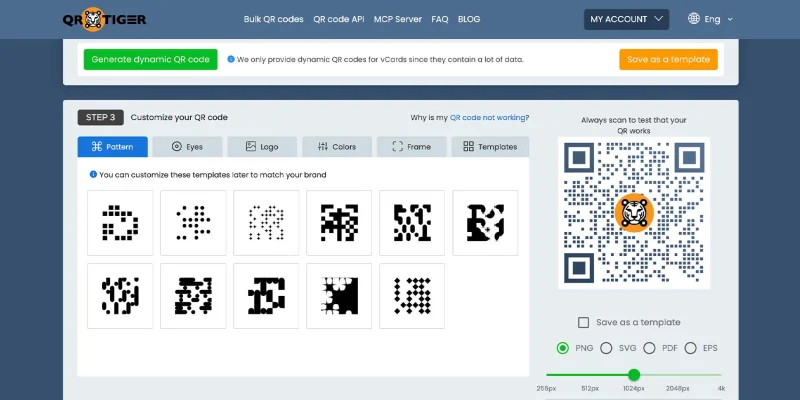
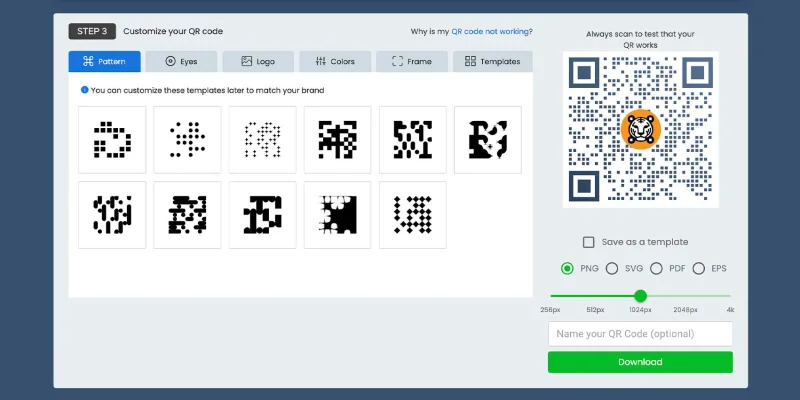
- Scan the code with your phone to confirm your vCard page loads, pick a file format (PNG, SVG, PDF, or EPS), and click Download. Choose SVG or EPS for high-resolution prints.
Equipping a whole sales team? The bulk QR code generator creates a separate virtual business card for each employee from a single CSV file. Bulk generation comes with the Advanced plan and higher.
Why use a QR code for contact info?
- Faster, contactless saves: People add you in a few taps instead of typing.
- More room: A vCard holds a photo, bio, and links that no 3.5 x 2-inch card can fit.
- Fewer reprints: Edit details online after a job change or a new number is assigned.
What can you store in a contact QR code?
A vCard works as a QR code for contact details, links, and your photo in one. Fill in only the details you want people to know and save.
| Section | Fields | Tip |
| Your name | Name | Use the name people know you by at work. |
| Organization | Company name, position | Spell out the full company name. Abbreviations confuse new contacts. |
| Contacts | Mobile phone, work phone, phone, fax, email | Add the country code if you network across borders. |
| Address | Country, state, street, city, zip code | List a work address, not a home address. |
| Personal description | Short bio | Keep the bio to one or two lines: your role and who you help. |
| Primary photo | Profile image, 320 x 320 px at 72 dpi | Use a clear, well-lit headshot. |
| Links and connections | Website, Facebook, Instagram, X, YouTube, LinkedIn, Pinterest, WhatsApp, and more | Add two or three platforms you check often. |
Design settings sit apart from your details: pick a solid or gradient background and a font family to match your brand colors for consistent personal branding.
Our take: fewer fields win. A vCard with a clear photo, one phone number, one email, and a LinkedIn link beats a card crammed with every field the form offers.
Think about where the code will stay, too. For data privacy on a public yard sign, list a work number and office address instead of personal ones.
How do you use a vCard QR code on a business card?
A standard US business card measures 3.5 x 2 inches, or 89 x 51 millimeters. Your name, title, and logo already claim most of the space. A vCard QR code carries the rest: photo, bio, social links, and all the numbers.
Start with a QR code size of about 2 x 2 cm (0.8 x 0.8 in), and go larger if test scans struggle. Place the code in the middle for portrait cards and on the right side for landscape cards. Both spots keep the code clear of the thumb holding the card.
Many professionals put the QR code for contact info on the back of the card and keep the front for branding. Leave a blank margin or quiet zone around all four sides.
Test the code on two or three phones before a full print run. QR TIGER’s QR Decoded Industry Report 2026 found that nearly 4 in 10 users struggle at the moment of scanning. Device or camera quality tops the list at 39%, followed by poor placement, small size, or bad lighting at 25%.
For design ideas and use cases, read our guide to QR codes for business cards.
Where else can you use a QR code for contact information?
Other placements you can try for your business card QR code are:
- Email signatures, so every reply carries your contact card.
- Event badges, name tags, and lanyards at conferences and trade shows, where visitors scan the code instead of dropping cards in a fishbowl.
- The closing slide of a sales pitch or keynote.
- Real estate yard signs, flyers, and open-house handouts, so buyers save the agent’s details on the spot.
- Resumes, portfolios, and job applications, so recruiters reach your contact details and LinkedIn profile.
- Consultant and freelancer proposals, with a vCard that links to a portfolio, case studies, or a booking page.
- Your phone’s lock screen, for card-free business networking.
- Chat apps and social posts, through the vCard share link on WhatsApp, LinkedIn, X, or Gmail.
How to add your vCard QR code to your wallet
You can add your vCard QR code to Apple Wallet or Google Wallet from your dashboard, so it’s on your phone whenever someone wants to scan it.
Add your vCard QR to Apple Wallet
- In your QR TIGER dashboard, find the vCard QR code you want.
- Click Wallet.
- Install the pass: scan the QR code, click Add to Apple Wallet Pass, or copy and share the URL.
- Optional: change the background and foreground colors, and save.
To set a default logo for every Apple Wallet pass, scroll to the logo integration section, upload a logo, and save. Turn off the toggle to use a unique logo per vCard.
For screenshots of each step, see our Apple Wallet digital business card guide.
Add your vCard QR to Google Wallet
- Click Wallet on your vCard QR code.
- Install the pass by scanning the QR code, clicking Add to Google Wallet Pass, or copying and sharing the URL.
- Optional: Change the pass background and save.
Our Google Wallet digital business card guide walks through each step with screenshots.
How do you track and manage QR codes for business cards?
Every vCard QR code comes with tracking analytics in the dashboard. Click Stats to see total scans, unique scans, scan locations, scan times, and the devices people used.
The data shows which cards, badges, or events get the most scans. Compare scan results from two print runs to see which performs better.
Dashboard tools depend on your plan:
Regular plan and higher:
- Edit: Push real-time updates to your phone number, title, or photo without reprinting.
- Clone: Copy a vCard QR code to set up a new one faster.
Advanced plan and higher:
- Notify: Receive scan reports by email daily, weekly, or monthly.
- Password: Lock your vCard page behind a password that only invited contacts know.
- Expiry: Set a scan limit (total, per day, week, month, year, or custom), a time limit, or a one-scan-per-IP rule.
- Retarget: Add a Google Tag Manager ID or a Facebook Pixel ID to reach scanners with ads later.
- Edit design: Change your QR code’s colors, pattern, or frame anytime.
Premium plan and higher:
GPS: Turn on GPS tracking for precise scan locations, or switch on Geo Fence to limit scans to a set location.
Want deeper analysis? Connect your scan data to GA4. Learn how through our QR code Google Analytics tracking guide.
Share your contact info in one scan
A vCard QR code puts your photo, numbers, and links one scan away, with zero typing.
The bigger payoff comes after printing. Change jobs, numbers, or headshots, and the same code keeps working, while scan data shows which events draw the most scans.
Pick a template, add your details, and print the code on your next batch of cards.
Want more details on vCard QR codes? Visit QR TIGER or contact our support team.
This article is for general informational purposes only and does not constitute legal, financial, or other professional advice. For questions about QR TIGER's products or services, please contact our support team at [email protected].
Frequently Asked Questions (FAQ)
Can I create a vCard for free?
How can I convert a VCF file to a QR code?
Can I update a contact someone already saved using my vCard QR code?
Does a vCard QR code work offline?
Was this article helpful?
Maximize Scans with the Best QR Code Generator
Join thousands of global brands using QR TIGER to manage dynamic routing, bulk creation, and deep attribution analytics.
Get Started For Free