2026 QR Code Industry Report Reveals the Real State of QR Codes

QR DECODED is an official report by QR TIGER that explores consumers’ actual perceptions, levels of trust, and the barriers that affect their scanning behavior, guiding business leaders on what to do next to improve their QR code strategies.
QR TIGER’s official report found that 47% of users now regularly scan QR codes. This is based on the survey of 1,548 participants across the United States, Europe, and Asia-Pacific.
As of 2026, the QR code market is valued at $15.23 billion and is predicted to grow further to $33.14 billion by 2031, with a CAGR of 16.82% (Mordor Intelligence).
Driven by massive smartphone usage (95% penetration rate according to the International Telecommunication Union) and the Global Standards 1’s initiative to switch to two-dimensional barcodes (Sunrise 2027), QR code usage is expected to steadily rise, not just a simple add-on, but a tool that consumers expect to benefit from.
Table of Contents
QR code usage becomes routine
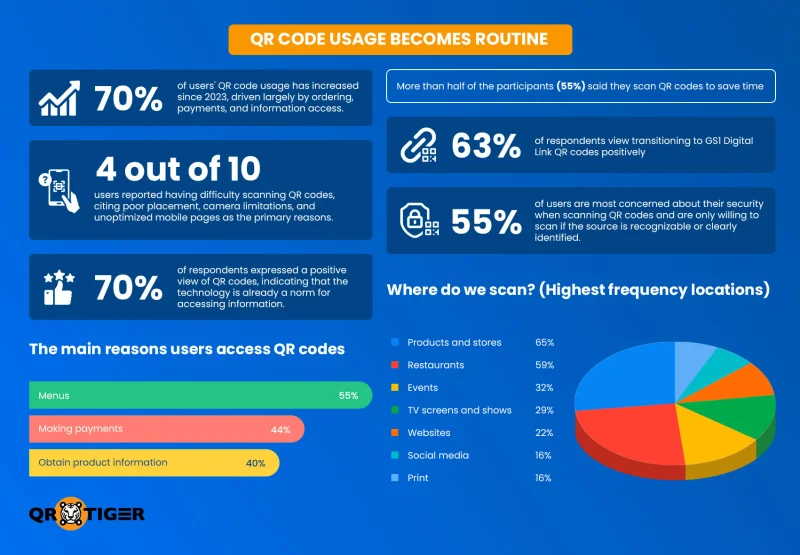
The study found that the respondents’ QR code usage has increased by 70% since 2023, driven largely by ordering, payments, and information access.
However, 4 in 10 users reported having difficulty scanning QR codes, citing poor placement, camera limitations, and unoptimized mobile pages as the primary reasons.
Common scanning environments and purpose
Respondents reported scanning QR codes most frequently in products and stores (65%), restaurants (59%), and events (32%). The rest scan them on TV screens and shows (29%), websites (22%), social media (16%), and print (16%).
They scan QR codes mainly to access restaurant menus (55%), make payments (44%), and obtain product information (40%).
Trust remains a key factor for scanning a QR code
Seventy percent of respondents expressed a positive view of QR codes, indicating that the technology is already a norm for accessing information.
Still, concerns about safety persist. According to the survey, 55% of users are most concerned about QR code security and are only willing to scan if the source is recognizable or clearly identified.
The results suggest that credibility signs, along with clear labeling and transparent communication, affect users' willingness to scan.
Reinforcing QR code security by using a data privacy regulation-compliant QR code generator helps ease users' cybersecurity anxieties when creating or scanning QR codes.
Business value is tied to convenience
More than half of the participants (55%) said they scan QR codes to save time, highlighting the importance of immediate access to relevant content.
Meanwhile, 44% of users believe QR codes provide equal benefits to businesses and consumers, suggesting a balanced value perception.
As for transitioning to GS1 Digital Link QR codes, 63% of respondents view it positively, suggesting opportunities for deeper product engagement.
These numbers tell businesses to continue leveraging QR codes and partner them with strong incentives to provide clear value and guaranteed benefits to users.
Industry implications
QR codes redefine how businesses connect with their audiences by being effective links between physical and digital (phygital) experiences.
Based on the official QR Decoded findings, usability and trust are the main drivers and obstacles to QR code adoption. This tells businesses to treat QR codes as assets, not just mere add-ons.
Reducing scan friction and emphasizing clear benefits and safety are therefore top priorities to reinforce their adoption among users, according to the report.