
17 Mobile Marketing Trends for Businesses to Explore in 2026
Over five billion mobile users worldwide — and growing fast.
A vast majority of us own at least one or two mobile devices, and whether conscious of it or not, we rely on them for almost everything: to search, shop, stream, and socialize.
They are no longer gadgets we carry around; we live on them.
And if that’s where people are looking, tapping, and spending, then brands need to be there, too.
To lead the race, learn and master these 17 mobile marketing trends that are working now and what's next, so we can meet our customers where they are most active.
Here's a quick overview of the topics we are covering:
Let's dive right in.
What is mobile marketing?
Mobile marketing is a strategy that targets people using smartphones, tablets, and laptops.
We can reach our audience through various channels, such as apps, ads, social media, websites, Google searches, AI chatbots, and QR code campaigns.
What is the goal of mobile marketing?
Mobile marketing targets consumers who primarily rely on their mobile devices for their day-to-day activities and transactions.
It is achievable by delivering personalized and timely content, enhancing their mobile experience, and building stronger relationships by being authentic to them.
Prioritizing mobile in our marketing efforts is another way of saying we prioritize our customers.
Because we think like them, design for them, and appear in the spaces where they spend their time the most, our brands will naturally draw them.
In short, we simplify and humanize our content.
The best course of action is to cut the fluff and focus on what matters most to people: clear messages, fast responses, and smooth journeys.
How effective is mobile marketing?
Mobile marketing is highly effective because it’s personal, immediate, measurable, and built into the way people live today.
Here’s how effective it is, with mobile marketing statistics to back it up:
- 61% of website traffic comes from mobile phones. (Statista)
- Mobile users are 40% more likely to make impulse purchases.
- 67% of consumers prefer to buy from mobile-friendly websites. (Think with Google)
- Mobile makes 55.25% of sales. (LinkedIn)
- 42% of mobile purchases take place on social media and e-commerce sites. (Vidico)
- 91% of smartphone users made a purchase after seeing an ad. (SixthCityMarketing)
- According to 60% of American adults, mobile shopping is necessary for online shopping. (eMarketer)
- Mobile generates 52% of pay-per-click (PPC) traffic. (WordStream)
- Dynamic QR code campaigns accumulated 7,181,345 global scans. (QR TIGER)
- A majority of social media users access the platforms through mobile devices.
- 70.29% of all YouTube visits come from mobile devices. (Sprout Social)
- 61.9% of email opens occur on mobile devices. (Email Monday)
- 75% of users agree that SMS messages encourage them to make a purchase. (Vibes)
What are the latest trends in mobile marketing?
Mobile marketing strategies refer to the plans and tactics businesses employ to engage customers on their smartphones.
The tools and techniques used in mobile marketing work almost the same as those used in web marketing, only that they are designed to cater to mobile user behaviors. We leverage them based on how people use their mobile devices: quickly, personally, visually, and socially.
These are the trends in mobile marketing that businesses and marketers need to master:
- QR code marketing
- Search Engine Optimization (SEO)
- AEO and GEO
- Accelerated Mobile Pages (AMP)
- Artificial Intelligence (AI)
- Mobile commerce
- Mobile app marketing
- Push notifications
- Mobile email marketing
- Augmented Reality (AR)
- Mobile-optimized PPC ads
- Retargeting
- Location-based marketing (Geofencing)
- Social media marketing
- Short-form vertical video
- User-generated content
- SMS (Short Message Service)
17 mobile marketing trends that businesses must adopt
1. QR code marketing
Quick response codes (QR codes) are a mobile-first technology that is crazy convenient.
They can be in physical or digital format, allowing brands to bridge offline interactions to online simply by scanning them with a mobile device.
These codes are also accessible to everyone. The majority of the audience, if not all, know how to scan them using a dedicated QR code generator software scanner and tools available online.
Since we commonly access them through a smartphone, QR codes are excellent tools to pair with various mobile marketing techniques, such as app downloads, AR experiences, mobile commerce, and social media exposure. 
Dynamic QR codes are particularly advanced, flexible, and trackable. They can:
- direct the audience to content or experience tailored for them;
- track campaign performances via scans;
- collect data on user behavior and preferences;
- retarget audience through ads or email;
- integrate with CRM and ERP systems, and
- strengthen brand identity through customization and white labeling.
A QR code statistics report reveals that dynamic QR code campaigns around the globe garnered over 7 million scans from 2021 to 2025.
And this is not an impulse.
Mobile devices — from smartphones to laptops — are already built with QR code scanners, recognizing that their presence has become an essential part of everyone’s lives today.
The future of mobile marketing will further revolve around QR code technology.
The Global Standards 1 (GS1) organization has launched an initiative for businesses to use QR codes and replace linear barcodes by 2027.
Companies like Emart have already achieved success with QR codes by launching a creative marketing campaign.

The retail store displayed a whiteboard composed of blocks outside the store.
Called the “Sunny Sale,” the campaign aims to address lunchtime downtime by letting people scan the shadow QR code from 12 to 1 o’clock in the afternoon.
The result? Issuance of 12,000 coupons, expansion of membership, and a 25% increase in mid-day sales!
QR code marketing expert Benjamin Claeys shares that customizing the QR code, such as placing a logo at the center and using the brand's colors, helps strengthen brand identity.
Additionally, having a clear call-to-action (CTA) makes it 80% more credible and effective than the typical black-and-white QR codes.
2. SEO (Search Engine Optimization)
Making sure that your content appears when people search for information, products, or services related to your business remains relevant, not just on desktops but also on mobile devices.
Search Engine Optimization (SEO) revolves around improving your site’s content, structure, design, page speed, and credibility so that search engines like Google can easily understand it, summarize it, and rank it higher in search results.
Despite the rise of AI-driven search and voice assistants, SEO remains essential as people continue to rely on search engines to find credible answers.
The only change is that it prioritizes intent, experience, and context, in addition to keywords and backlinks.
For instance, Google’s algorithm updates in recent years have focused heavily on E-E-A-T (Experience, Expertise, Authoritativeness, and Trustworthiness), which means that well-researched, user-centered content wins.
💡 Fast Fact: Search Engine Journal highlights that high-quality content, strong page experience, and credible backlinks are the three most important factors influencing Google’s search rankings.
In particular, mobile SEO is crucial if you want your site to rank well in mobile searches.
Google uses mobile-first indexing, which stores your website’s mobile version in the database for possible ranking.
Ignoring these means losing opportunities in a space where a massive chunk of people (60%) search and purchase.
To optimize your website for mobile search, start by creating mobile-friendly content.
This can be writing articles with shorter paragraphs, using bullets and numbered lists, and answering questions right on the spot.
3. AEO and GEO
In relation to SEO, you also need to be aware of AEO (Answer Engine Optimization) and GEO (Generative Engine Optimization).
AEO focuses on optimizing content for AI-driven search tools, such as ChatGPT, that deliver direct answers rather than just a list of links.
For this strategy to work, you need to:
- create concise, factually accurate answers to common questions;
- use structured data (schema markup) so as to allow AI to interpret the content easily, and
- focus on conversational keywords used in everyday language.
Meanwhile, GEO concentrates on enhancing content for AI-powered search engines that generate answers using large language models, such as Perplexity AI.
Unlike the former, GEO summarizes multiple web sources into one answer and displays fewer clickable links, which means fewer opportunities for visibility.
Since AI tools tend to pull from reputable sources, you need to publish high-quality, well-structured, and source-worthy content with up-to-date information and build brand authority through mentions, backlinks, and social proof.
To differentiate the two:
- AEO ensures your brand appears in voice or AI-driven Q&A responses.
- GEO prepares your content to be recognized, cited, and recommended by generative AI systems.
Businesses that don’t optimize for search increase risks of becoming invisible in the new ecosystem, where people are searching more, using more devices, and relying on AI-powered tools.
Conversely, businesses that understand and integrate all three — SEO, AEO, and GEO — will remain credible, visible, and competitive.
“Good SEO is good GEO, or AEO…Good SEO is really having good content for people.”
- Google’s Danny Sullivan during his keynote speech at WordCamp US
4. Accelerated Mobile Pages (AMP)
64% of smartphone users expect mobile websites to load within four seconds.
If the loading time is too slow, customers (46%) state that they will not revisit the website. (Thrive My Way)
Brands need to go beyond “mobile-friendly.” They need to be mobile-fast, which is possible with AMP.
Accelerated Mobile Pages (AMP) is an open-source framework created by Google to help web pages load almost instantly on mobile devices.
Since pages load in under a second, we prevent impatient users from bouncing, the act of leaving a webpage without taking any action.
Brian Dean of Backlinko shares that when visitors can stay longer and interact with the page effectively, the chance of them converting increases (e.g., purchasing or signing up).
💡 Fast Fact: Think with Google highlights that 67% of consumers prefer to buy from mobile-friendly websites.
Moreover, AMP-powered content often gets priority placement in mobile search results and snippets. That means more visibility, higher click-through rates, and more traffic for websites.
It also supports optimized ad loading, allowing our ads to show up faster and more reliably without slowing down our pages.
Is AMP worth it?
Yes, but with a strategy.
AMP isn’t a magic bullet. When implementing it, you still have to manage a standard (non-AMP) version of your sites.
It requires extra effort from your dev team to ensure design and content stay consistent across both versions.
AMP is especially valuable if:
- you publish a lot of heavy content (like articles, videos, or tutorials);
- your audience accesses our sites primarily through Google search;
- you’re running a content or product marketing campaign that demands high mobile performance, and
- your pages are heavily affected by load speed, such as product listings, landing pages, or ad-heavy articles.
When we use it smartly, our pages will deliver a seamless, speedy experience and consumable content that boosts visibility and drives conversions.
▶ Businesses that implement AMP for their QR-linked content experience a 30–50% boost in engagement, according to G2. Use QR TIGER’s HTML5 QR Code Generator to create a custom page fully optimized for mobile view.
5. Artificial Intelligence (AI)
Have you noticed your smartphone’s new voice search function?
Do you rely on Siri to find answers or let Alexa wake you up in the morning? That’s all AI working its magic.
Artificial Intelligence (AI) is leading the future of mobile advertising and marketing.
Focusing on its advantages, AI helps boost productivity, automate tasks, and drive innovation across industries.
💡 Fast Fact: An article by Tableau from Salesforce highlights that 77% of the 6,000 consumers surveyed have AI-powered devices, but only 33% of them are aware that they use AI.
Tools like ChatGPT, Jasper, and Canva Magic Studio, for instance, can quickly create or refine our ad and email copies, product descriptions, and even videos without sacrificing quality.
It’s also capable of tracking and analyzing user mobile behavior, which we can use to create personalized content, offers, recommendations, and various re-engagement campaigns.
About 77% of companies are already using or exploring it, as highlighted by a study published by Exploding Topics.
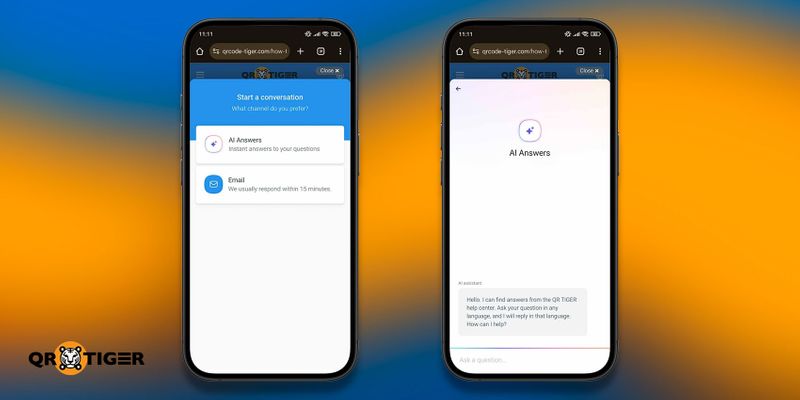
In fact, if you visit our website, you will see that we have an AI chatbot to support users who need quick answers (shown in the image below). This enables our 24/7 human support team to focus more on resolving technical issues that require urgent attention.
It’s recommended to use AI in your mobile strategies as long as it serves a purpose. AI is not a tool to replace us but an amplifier for our efforts.
At the same time, brands should use an AI detector to ensure that AI-generated content maintains originality and accuracy and aligns with their brand voice before publishing.
Always find the right balance between automation and authenticity in order to provide clear value and build meaningful connections with your audience.
6. Mobile commerce
Mobile commerce (m-commerce) happens directly on our smartphones or tablets, which we use to buy or sell goods and services, manage our finances, pay our bills, or book experiences.
It’s part of electronic commerce (e-commerce), which broadly takes place on desktop, laptop, and smartphone devices.
💡 Fast Fact: A Pew Research Center mobile ownership report highlights that 91% of Americans own a smartphone and depend on it for online access.
M-commerce effectiveness is amplified when paired with fast-loading or mobile-first web pages and mobile apps.
For example, digital wallets like Apple Pay and payment apps like PayPal allow customers to facilitate transactions just through their smartphones. And thanks to biometric authentication and QR codes, they have become even safer to use.
Amazon, DoorDash, and Meta are among the most prominent companies that have achieved success through mobile commerce.
According to Koen van Gelder, Statista’s e-commerce research expert, online retailers who adopt a mobile-first approach are more successful in providing customers with better purchasing experiences since they are more convenient.
As of 2025, the estimated revenue of m-commerce is $2.5 trillion, which encompasses nearly 63% of retail e-commerce.
7. Mobile app
Many brands stop at having just a website. But what most of them do not know is that a mobile app on top of it brings unique advantages for them.
First, an app sits right on our phones, just one tap away. It doesn’t need constant searches or link clicks.
Second, it provides our brand with a direct, personal, and ongoing connection to our audience.
Customers are eager to download them because this is where they can apply for loyalty programs, access exclusive content, and experience faster checkouts, which a website alone can’t consistently deliver.
💡 Fast Fact: 88% of people’s time is spent on mobile apps, according to eMarketer’s US Mobile Time Spent 2020 study.
Third, once people download our app, our brand logo appears on their home screen every day. That’s premium visibility that no billboard or social ad can match.
Here’s more:
- Builds loyalty through better experiences: Apps are designed to be faster, smoother, and more personalized than websites. That seamless experience makes people want to come back.
- Facilitates in-app promotions: With apps, we can show ads and send push notifications — timely and personalized updates, offers, or reminders that drive action (without relying on email or social algorithms).
- Compatible with mobile device functions: Apps can integrate with the camera, GPS, AR, or QR code, which encourages customers to use the app and engage with it for a longer period.
- Unlocks first-party data: Mobile apps give us direct access to first-party data (user behavior, preferences, location) without requiring cookies. That means better targeting and smarter campaigns.
- Drives repeat sales and higher spending: Users who download an app demonstrate an intent to form a closer connection. And it pays off.
- Outperforms other channels in retention: Apps aren’t just for one-time interactions. They’re built for long-term engagement.
Take Starbucks, for example. Their mobile app is more than a place to order coffee; it’s a loyalty engine.
The company sends personalized offers, lets customers skip lines, and even gamifies rewards. It turned a coffee run into an engaging mobile experience.
▶ ️QR codes help promote mobile apps, bringing offline visitors to your download page. Create a custom app QR code to quickly lead people to your mobile app on the Apple App Store or Google Play Store.
8. Push notifications
Push notifications are an essential feature to have if you have a mobile app (or even a web app). In fact, they are a staple for user retention.
Also considered are app notifications, which are short, clickable messages that appear on a user’s mobile device, even when they’re not using your app or visiting your website.
These are updates, promotions, or alerts that appear on someone’s home or lock screen, helping to keep your brand at the top of their mind.
They literally “push” people to click, visit, and interact with your app or website, such as browsing for new items or purchasing those in their carts.
💡 Fast Fact: Personalized push notifications drive higher engagement (59%) and open rates. (WiserNotify)
Just like the various mobile marketing techniques, push notifications are effective when employed with the right strategy, timing, and execution.
Be sure to offer clear value to users. Make them excited or keep them informed. Without value, it will just be spam for them.
Another tip is to keep your message concise yet intentional, personal, and relevant to them. Since people receive them through their mobile devices, it should feel like it was from a helpful friend, not a salesperson.
There’s also always a best and worst time to use push notifications.
Studies show that bombarding users with 6-10 pushes each week overwhelms users, leading to notification fatigue and drives 32% to delete the app.
Overdoing it will lead people to churn out or turn them off. Not showing one when they need it the most will lead to losing conversion opportunities.
This tells us to take timing and frequency control seriously.
Study your users’ actions and preferences to determine how frequently you must deploy a push notification. Then, monitor your push notification strategies to see which one resonates with your customers.
9. Mobile email marketing
Creating and optimizing email campaigns specifically for mobile users is something that email marketers and brands should not overlook.
After all, about 70% of emails are viewed by people through their mobile devices.
Despite this stat, many email marketers focus on writing email copies for desktop viewing. Others simply shrink a desktop email to fit a smaller screen.
What they often miss is designing for the mobile experience itself: click-worthy subject lines, personalized messages that connect instantly, calls-to-action buttons, and layouts that are easy to interact with on smartphones and tablets.
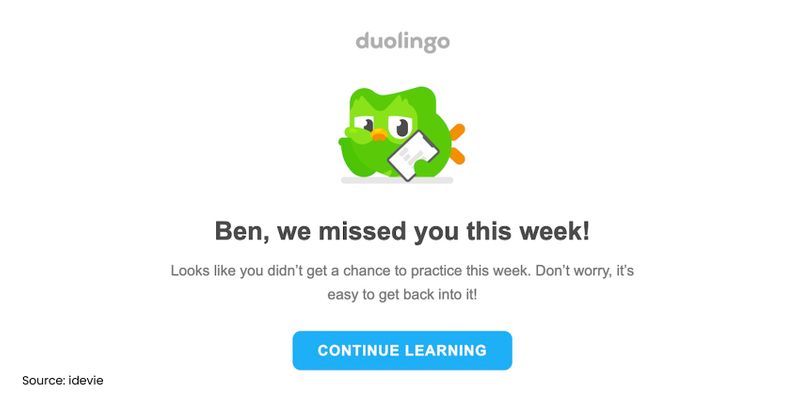
We can learn how to execute mobile email marketing right with Duolingo’s email copies, all of which are designed with mobile experience in mind.
💡 Fast Fact: Experian found that emails with personalized subject lines get opened 26% more often than generic ones.
Rosie Hoggmascall shared her experience on LinkedIn about how the company successfully convinced her to use the app again.
Duolingo sent her a personalized email 10 minutes after she opened the app, which she ignored for three months. Here are the two elements she found most notable from the email:
- Friendly tone
- CTA button on top of the fold
But if we look a bit closer, its email copies also have a clear subject line and a short message (with the recipient’s name) that feels like it was sent by a friend you haven’t seen in a while — personal and emotional.
Other than personalizing content, Neil Patel also shared his email marketing best practices, including segmenting campaigns, displaying relevant preview text, offering clear value, managing frequency, scheduling, and creating a responsive design.
10. Mobile-optimized PPC ads
The increase in smartphone usage provides opportunities for advertisers and marketers to reach the very people who use them through mobile-optimized PPC ads.
Pay-per-click (PPC) ads are advertisements that require payment only after someone (an actual site visitor) clicks them, typically to a provider such as Google or Meta.
It’s a digital advertising pricing model that has gained popularity over the years because it enables businesses to reach their target audience while generating profit without wasting resources.
💡 Fast Facts:
- 46% of web users can’t tell the difference between PPC (paid search) ads and organic SERP results. (HubSpot)
- The first three sponsored ads on Google attract 41% of total clicks. (WordStream)
And according to HubSpot, 52% of PPC ad clicks happen on mobile.
Mobile-optimized PPC advertising, in particular, attracts more clicks, increases conversions, and boosts brand awareness. This is because these ads are shorter, faster, and easier to click.
To make this work, you need to:
- identify the proper ad format for your brand;
- write short, clear headlines since phones show less text than desktops;
- use the right keywords for your PPC ads;
- make landing pages mobile-friendly so they load fast and are easy to read on a phone;
- use mobile ad extensions like a click-to-call button so users can call you with one tap;
- set ads on Google and/or Meta to target mobile devices, and
- monitor the ad regularly to see how many clicks and sales come from it.
11. Retargeting
If you’re running advertisements or campaigns, retargeting is one thing you can’t miss adding to your PPC strategy. It’s essential for reaching site visitors who need a little more push to convert.
Not all shoppers make a purchase on their first visit. Most browse on their mobile devices when they’re on the go.
Retargeting brings them back later when they’re ready to purchase.
On mobile, this could be:
Seeing your ad on Facebook after browsing your product on their phones.
Getting an in-app ad about the shoes they almost bought last night.
According to Web FX findings, retargeted customers are 70% more likely to make a purchase.
Since you’re targeting warm leads (people who already know you), your product will be at the top of their minds when they see the tailored ad.
▶ ️A dynamic QR code on posters is useful for reaching your offline audience through online ads.
Learn how it works: QR Code Retargeting: Generate Leads and Boost Conversions
12. Augmented Reality (AR)
If we are to discuss technologies that blend the physical and digital spaces, rather than just bridging the two, then we need to include Augmented Reality (AR).
It’s one of the best mobile marketing technologies that companies use to create immersive, interactive experiences directly from a smartphone (yes, they don’t require AR glasses or any specialized eyewear).
Static ads, banners, and even doodles on packaging move as if they are alive. That makes our target audience hooked and invested in a brand.
💡 Fast Fact: 61% of consumers prefer brands that offer AR experiences, according to Threekit.
Here’s an example of an AR marketing stunt by the Indian delivery service Zepto in collaboration with Tang India, which made ordinary paper bags into memorable experiences:
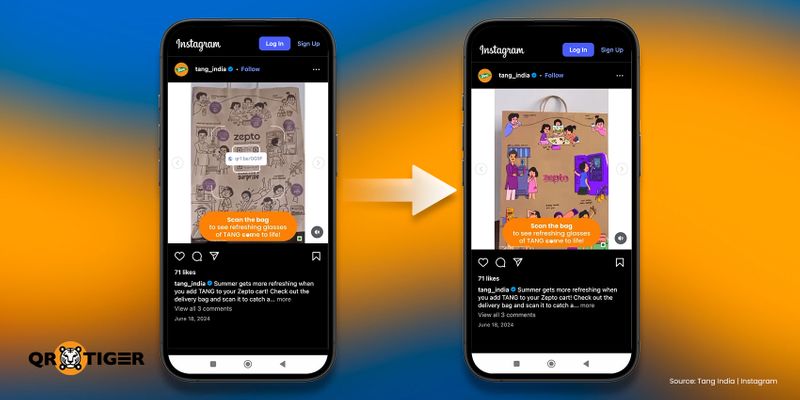
Through scanning the QR code on the bag, customers will see a doodle of people moving in colors.
Another marketing style that uses AR is Coca-Cola’s sugar-free Coke giveaway. It makes people want to participate, as by simply “grabbing” the digital Coke bottle that appears on their phone screens, they get a free drink.
Is setting up an augmented reality expensive?
It really depends on what you want to do with it. AR filters on Instagram and Snapchat are known to be low-cost, and there are web and mobile app-based platforms like Blippar and AR Makr that we can recommend.
These options enable individuals or teams in marketing and graphic design to create engaging mobile AR experiences for consumers.
13. Location-based marketing (Geofencing)
As mobile usage and personalization are at an all-time high, location-based marketing is one of the most effective mobile marketing strategies for brands to adopt.
It’s often powered by geofencing, a technology that uses GPS, Wi-Fi, Bluetooth, or cellular data to create a virtual boundary.
This marketing strategy is helpful for targeting consumers based on their real-time geographic location.
When a user’s mobile device enters or exits this boundary, they will receive location-specific notifications, ads, or offers.
For instance, a retail brand can trigger its app notifications when users walk into a mall where its store is located.
Or take, for example, Taylor Swift’s creative location-based marketing powered by QR codes.
The QR codes, spread across various cities in the United States and Europe, contain hints and cryptic messages that lead fans to the music video for her "The Fate of Ophelia" song.
Why is this relevant for professionals and businesses alike?
Consumers today expect timely, context-aware experiences, and geofencing delivers precisely that.
Brands can reach audiences directly on their mobile devices with hyper-personalized messages tailored to their location. This real-world context increases the relevance and conversion potential of every campaign.
▶ Implementing location-based marketing is now more efficient with the combination of dynamic QR codes and geofencing.
Learn how it works: QR Code GPS: Precise Location Tracking & Boundary Scanning
14. Social media marketing
Mobile advertising and marketing isn’t just about fitting ad campaigns to a smaller screen.
It’s also about reaching internet users in the space where they spend their time, according to Data Reportal, one full waking day each week: on social media sites.
And based on Sprout Social’s findings, people use not only one but up to seven platforms per month.
That’s why building or maintaining your presence in multiple social media sites is crucial if you want to increase your reach and engagement.
Additionally, audiences crave real and relatable content. Showing your brand’s human side builds trust faster than polished ads ever could.
In Matt Navarra’s interview on “The Social Media Marketing Trends You Need to Understand Today” with Neal Schaffer, he emphasized how content that feels more authentic tends to be better received.
Active engagement is another important factor for social media marketing in 2025. Brands that respond, ask questions, and create conversations perform better.
Data also indicates that the majority of users — from Facebook to Reddit to YouTube — access these sites primarily through their mobile devices and prefer mobile-friendly content, such as short-form vertical images and videos (e.g., Stories, Reels).
Creating content with authenticity and your audience’s behavior and preferences in mind is the most effective way to excel in social media marketing.
15. Short-form vertical video
If you’re still stuck in your 60-minute horizontal video era, it’s best to step up your game and produce short-form vertical videos.
Most internet users prefer watching 60-second short videos on their mobile devices, primarily for product discovery and learning purposes.
According to Social Sprout, short-form videos generate 2.5 times more engagement compared to long-form content.
Most of these engagements occur on mobile, with 75% of viewers watching on their phones, according to HubSpot.
Vertical videos, in particular, experience a 90% increase in completion rates compared to horizontal videos, as they are designed for fast mobile viewing.
What does this mean for marketers?
As people prefer digestible, mobile-friendly videos, you need to focus on creating content that both entertains and educates them.
Reels, TikTok, and YouTube Shorts are designed for this purpose, so take advantage of these platforms.
This doesn’t mean abandoning long-form videos.
In fact, producing both video formats is a smart strategy to cover a broader range of goals, audiences, and marketing touchpoints (many watch long-form YouTube videos for in-depth, high-value insights).
You can repurpose long-form videos into multiple short snippets for different platforms, saving you time and boosting content ROI (return on investment).
When creating a short-form vertical video, keep these things in mind:
- Hook viewers in the first two or three seconds. Most of them decide within this time frame whether to keep watching or not.
- Keep it under one minute. Make sure it has the following: a hook to grab attention, a body that delivers value or a story, and a call-to-action (CTA) to guide viewers on what to do next.
- Use on-screen text and captions. This ensures your message lands regardless of audio.
- Optimize for vertical framing (9:16). Your video should fill the entire screen, with key visuals centered and text safely within margins.
- Add quick cuts and movement. Use jump cuts, zoom-ins, or transitions to maintain energy and viewer interest.
- Use trending sounds or music. Popular audio can instantly boost visibility since algorithms push trending content (just make sure it aligns with your message).
- Be authentic and relatable. Speak naturally, share behind-the-scenes moments, or offer honest tips, because people connect with your brand through real faces, emotions, and stories.
- Design click-worthy thumbnails and titles. Use a high-contrast image of your face or subject and include short, curiosity-driven text (e.g., “You’re Doing This Wrong”).
💡 Fast Fact: Dr. Gloria Mark at the Speaking of Psychology, the flagship podcast of the American Psychological Association (APA), shared that people’s attention has shrunk considerably over the past two decades.
From an average of two and a half minutes in 2004, attention spans have continued to dwindle, reaching 47 seconds on average over the last five to six years.
This phenomenon is evident with popular television shows like Wednesday, which produce fewer episodes and shorter durations.
16. User-generated content
One way to demonstrate authenticity and increase engagement is by promoting user-generated content (UGC), a mobile marketing trend that we should not ignore.
These are online content published by real users of products and services, such as customer reviews, testimonials, and real-life videos.
Most UGC content is created using mobile devices like smartphones and tablets, making it feel raw, genuine, and relatable compared to studio-shot videos by influencers and brands.
UGCs also commonly use everyday language and mirror real experiences, attracting more engagement and purchase intent than robotic marketing copies.
💡 Fast Fact: Stackla found that 79% of people find UGC to be an impactful factor in their purchasing decisions.
While this type of marketing may seem “off-brand” to others, brand owners and marketers who encourage UGCs have a broader opportunity to reach their target consumers.
They have a more affordable, authentic, and scalable way to fill their marketing pipeline with content from ordinary customers who have become mobile marketers.
To execute UGC marketing properly for your brand, you need to be clear on why you’re doing it, i.e., building brand awareness or showcasing product authenticity.
Setting a clear goal will help you source UGC creators or loyal customers who can best match your target audience and brand image.
If you’re ready to tap into UGC, keep these tips in mind:
- guide creators with themes or prompts while still giving them freedom for creativity;
- incentivize customers to boost participation and volume of content by offering discounts or free products, and
- don’t let good content go to waste. Spread it across several social media platforms where your customers spend the most time.
17. SMS (Short Message Service)
If you think sending a text message for marketing is outdated, then you may not have seen its full potential yet.
Short Message Service (SMS) is one of the mobile phone marketing trends that continues to make an impact in an era where the internet reigns supreme.
It’s a strategy that allows you to communicate directly with customers using text messages since SMS doesn’t rely on internet access or social algorithms.
Text messages are often short, simple, and personal, which encourages customers to read and respond to them more.
According to G2, 58% of consumers welcome hearing from brands several times weekly through text.
It also has a higher open rate than email, with 98% of messages being read within three minutes, while 45% get a response. (Mailchimp)
But since encouraging customers to sign up for SMS is not always easy, you need a few tricks to get them to do so.
The most effective approach is always to provide clear value to your message and incentivize the recipient’s response, such as by offering a coupon or time-limited offer.
You also need to be mindful of the frequency and the type of SMS you should dispatch.
Just like in email marketing and push notifications, sending too many text messages to your customers is detrimental rather than beneficial.
In fact, Klaviyo found that 61% of people unsubscribe from SMS because they receive too many texts.
Plus, 37% of the individuals in the survey say they’d like to receive fewer abandoned cart or “interesting” reminders, 34% on low stock alerts, and 33% for those triggered by their actions.
Among the best practices when running SMS campaigns are to:
- Craft concise, valuable messages.
- Use names, purchase history, or location to make messages more engaging and personal.
- Segment your audience based on purchase behavior, demographics, or engagement level.
- Schedule campaigns and avoid spamming. One to three messages per week is often enough. Avoid early mornings or late nights.
- Include a clear CTA so recipients know the purpose of the SMS.
Remember to track its performance as well. Use the insights to adjust current campaigns and refine strategies for future campaigns.
You must also strictly adhere to privacy regulations and only send messages to those who opted in. Doing so will help build your business’s reputation and maintain your customers' interest, loyalty, and trust in your brand.
Why is mobile marketing important?
Mobile marketing gives us an opportunity to reach customers through the devices they touch and turn to almost every minute and use dozens, if not hundreds, of times a day.
These are the importance of mobile advertising and marketing:
- It reaches a massive number of people who are on their smartphones, boosting brand awareness.
- It provides people with quick access to information, enabling them to make decisions faster and interact with the brand on the go.
- It personalizes the brand-customer relationship by delivering relevant content and experiences based on people's location, behavior, interests, and device use.
- It leads to better engagement rates and customer interactions.
- It builds trust and loyalty by making every interaction feel personal and relevant.
- It works together with other channels, creating a cohesive omnichannel marketing strategy.
- It provides valuable data on campaign performance, user behavior, and preferences in real time, enabling the brand to refine its strategies.
- It keeps the brand relevant and competitive in a mobile-led future.
Keep in mind that marketing on mobile is effective with the right strategy.
We can’t just blast out SMS promos or repost our desktop content to Instagram (that’s like going to a war with only one piece of armor).
Our audience expects convenience, speed, relevance, and, above all, value. If our content isn’t designed for mobile behavior, it will be skipped, ignored, or worse — deleted.
If we want to be where our customers are, then our brands must think mobile, design for mobile, and act mobile.
This means that we need to:
- understand mobile behavior;
- design for small screens;
- time our messages right;
- use personalization and data wisely to deliver value, and
- respect privacy.
These are the factors for success.
When done right, mobile marketing does more than reach people. It connects our brands with them in the moments that matter most.
Be mobile-first
Mobile marketing trends focus on speed, personalization, interactivity, and meeting customers wherever they are.
Those who meet users where they are will dominate the mobile-first market.
If you’re ready to step up your mobile marketing game, start with dynamic QR codes. QR TIGER is a leading generator specializing in creating branded QR codes for marketing. Visit our website today to discover how we can assist you.
FAQ
What are the top 7 types of digital marketing?
The top seven types of digital marketing are:
- SEO: Optimizing websites to rank higher on Google and other search engines.
- PPC: Paid ads that appear on search engines or social media.
- Social Media Marketing: Promoting content and engaging with audiences on platforms like Facebook, Instagram, LinkedIn, TikTok, and X (Twitter).
- Content Marketing: Creating valuable, relevant content to attract and retain customers, such as blogs, infographics, videos, ebooks, and podcasts.
- Email Marketing: Sending personalized emails to nurture leads and build relationships.
- Affiliate Marketing: Partnering with affiliates (bloggers, influencers, publishers) who promote your product in exchange for a commission.
- Influencer Marketing: Taking advantage of influencers’ audiences to promote products.