
Thailand Mandates a Three-Color QR Code System on Taxis For Passenger Safety

THAILAND — On December 29, 2025, the Department of Land Transport (DLT) announced the deployment of three colored QR codes on metered taxis starting in Bangkok.
According to the Royal Gazette, public transport carrying no more than seven people must display the QR code stickers on different parts of the vehicle.
By June 2026, more than 70,000 taxis nationwide will be equipped with the three-color QR code system.
The new QR code taxi tracking and safety system is the government's answer to the inconsistent quality of public transport services.
Table of Contents
Thailand’s rampant taxi scams
For decades, locals and tourists have reported experiencing poor service from taxi drivers. This ranged from disagreements on destinations to demands for extra charges mid-trip.
Results from a 2025 survey conducted by the Tourism Council of Thailand (TCT) revealed that tourist-targeted scams are the number one concern among foreign tourists.
Thailand also ranked third among the world's taxi scam hotspots, according to a study by AllClear.
Adith Chairattananon, Secretary-General of the Association of Thai Travel Agents (ATTA), shared his concerns, saying, "It's no longer a few bad apples. It's a systemic issue tied to weak enforcement and a culture of impunity."
The DLT thus considers implementing a QR code system for taxis in Thailand as a positive step to curb the widespread problem. The agency believes this will set greater accountability in the taxi industry and create a safer transit experience for local and international travelers.
Inside the three-color QR code system
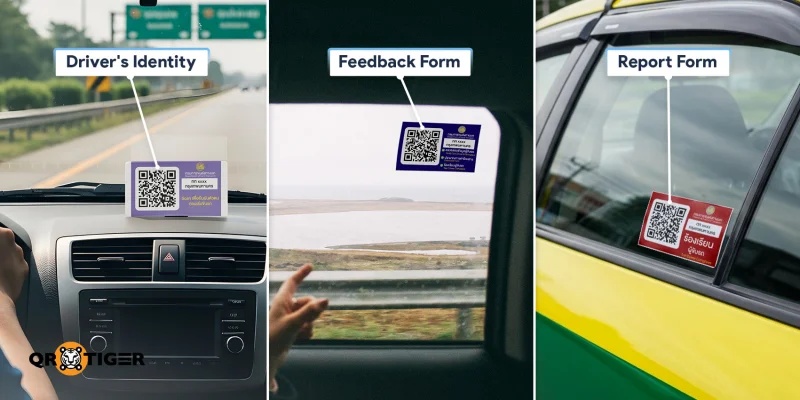
For its newest program, the DLT will use a secure QR code generator to create three types of QR codes in purple, blue, and red colors. Each one serves a unique purpose and is placed in specific parts of the taxi to enable convenient scanning.
The purple QR code links passengers directly to the DLT GPS Notice app, where they can view the driver's verification details. This is displayed on the windshield, facing both the driver and the passengers.
To monitor the taxis as well, the DLT reminds taxi drivers to keep the app active at all times while working.
Meanwhile, the blue QR code leads to a complaint page for a particular driver, if they received any. Passengers may also answer a feedback form through the same code.
Additionally, the blue QR code can help calculate fare estimates and allow passengers to share ride details with friends and family. It is positioned on the left rear passenger window,
Lastly, the red QR code allows passengers to report issues encountered during interactions with the driver, such as refusals, overcharging, and other inappropriate conduct, as soon as possible. It is placed outside the left rear door window.
Complaints submitted through this QR code are sent to government databases, enabling the DLT to act swiftly when needed.
Thailand's taxi QR codes will be distributed in phases. Vehicles registered in Bangkok must comply with the new regulatory standards starting from January 1, 2026, while those registered in other provinces must comply from January 1, 2027.
QR codes as a key element of Thai life
A 2025 report on QR code usage ranks Thailand as the third-largest adopter of QR code technology in the world. More than 50% of the population use a QR code in Thailand for both public and private purposes.
The new colored QR codes for taxi safety are only one of the many uses of the technology in the country.
Back in 2017, LINE Thailand partnered with Bangkok Taxi Co-operative Network to launch LINE TAXI. It is a taxi service similar to today's ride-hailing apps. Drivers received payments through Rabbit LINE Pay's QR code system, with cash still accepted.
Thailand also deploys QR codes for multiple travel purposes. For instance, foreign visitors can scan a QR code to complete their entry declaration digitally.
Another notable case was the Bank of Thailand's launching of PromptPay in 2016 to officially standardize QR code payments in the country. It enables payments and transfers and provides additional services, such as bill payments and government disbursement.
A safer taxi commute for Thailand
Long-standing issues require modern solutions.
The new QR code taxi system in Thailand will now allow locals and international travelers to enjoy friendlier, safer, and more accountable taxi services nationwide.
If successfully implemented, the world can expect QR codes to be at the top of the list of solutions to existing problems and set a new standard for transportation systems.